
Past Events
Webinar – Without Fear or Favour: Responses to the ALRC Report on Judicial Impartiality
On Thursday 29 September 2022, the Australian Law Reform Commission hosted a event featuring the Attorney-General’s address, which delivered the Australian Government’s response to the ALRC’s final report and recommendations in the Judicial Impartiality Inquiry, followed by reflections on different aspects of the report by three members of the Inquiry’s Advisory Committee.
Chair: The Hon Justice SC Derrington, President, ALRC and Judge, Federal Court of Australia
Keynote Speaker: The Hon Mark Dreyfus KC MP, Attorney-General of Australia
Panel Moderator: Sarah Fulton, Principal Legal Officer (A/g)
Panellists:
- The Hon Robert French AC, former Chief Justice of Australia, High Court of Australia
- Professor Gabrielle Appleby, Director, The Judiciary Project, Gilbert + Tobin Centre of Public Law, University of New South Wales
- Mr Anthony McAvoy SC, Barrister, Frederick Jordan Chambers
| View Recording – Without Fear or Favour: Responses to the ALRC Report on Judicial Impartiality Webinar |
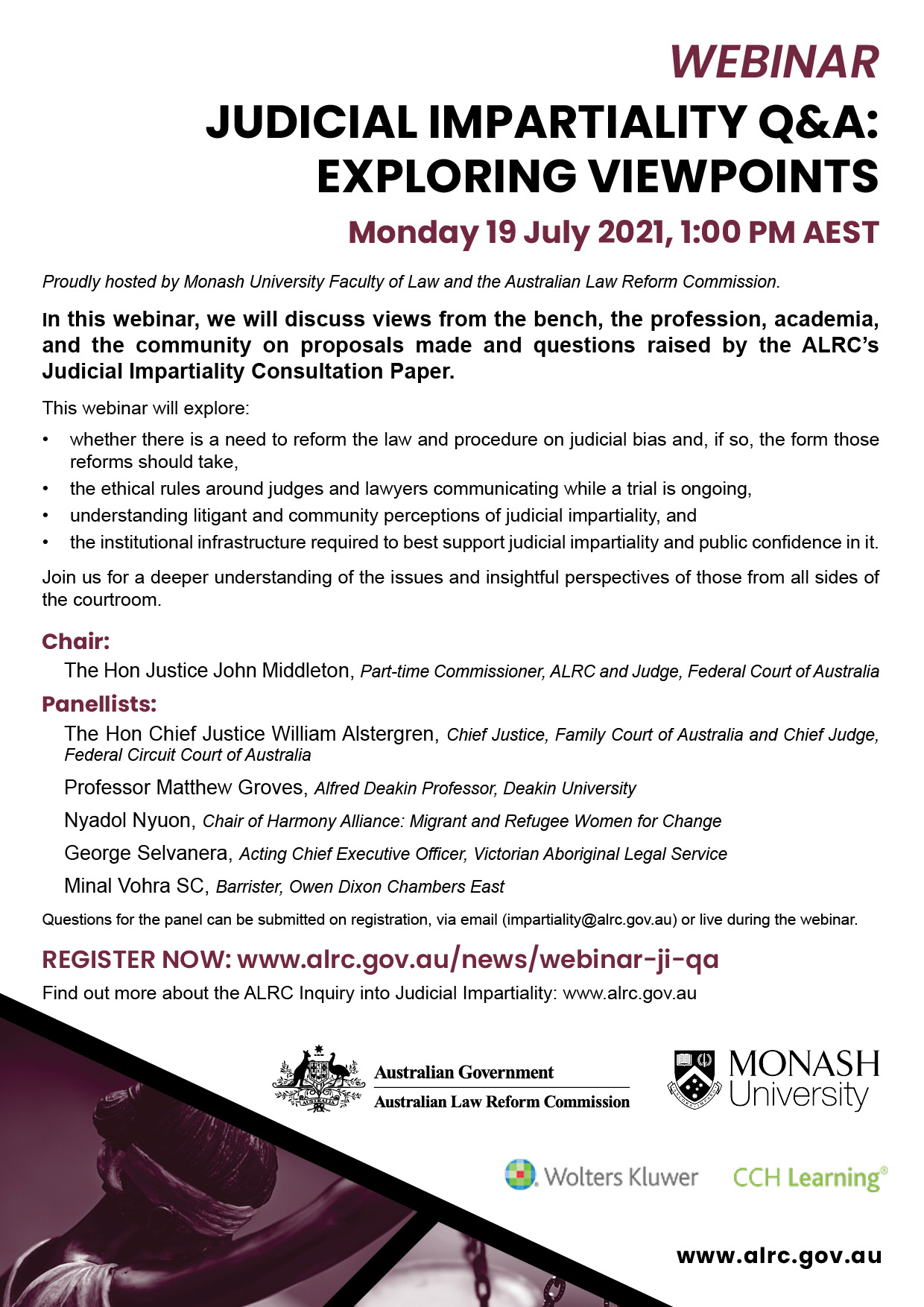
Webinar – Judicial Impartiality Q&A: Exploring Viewpoints
On Monday 19 July 2021, the Australian Law Reform Commission co-hosted a webinar with Wolters Kluwer to explore different viewpoints on judicial impartiality.
Panel:
- The Honourable Justice Middleton, Federal Court of Australia and ALRC Part-Time Commissioner (Chair)
- The Honourable Chief Justice William Alstergren, Chief Justice of the Family Court of Australia and Chief Judge, Federal Circuit Court of Australia
- Minal Vohra SC, Barrister
- George Selvanera, Acting Chief Executive Officer, Victorian Aboriginal Legal Service
- Professor Matthew Groves, Deakin University
Read more : Impartiality from both sides of the Bench
|
View Recording – Judicial Impartiality Q&A: Exploring Viewpoints |
Seminar: Public confidence, apprehended bias, and the modern federal judiciary
In conjunction with the Australian Academy of Law, the Australian Law Reform Commission (ALRC) hosted a panel seminar on Tuesday 2 March 2021.
An expert panel explored how the fair-minded observer is faring by examining issues of public confidence, apprehended bias, and the modern federal judiciary. The Q&A style format provided the opportunity for questions relevant to the ALRC’s ongoing review of judicial impartiality to be discussed.
Past Events
WEBINAR Legislation Renovation: What Interim Report B means for you
Re-designing, Renovating and Renewing the Legislative Framework for Corporations and Financial Services
On Wednesday 16 November 2022, the ALRC hosted a webinar to examine Interim Report B and its proposed legislative model.
| View Webinar Recording Legislation Renovation: What Interim Report B means for you |
WEBINAR What we’ve heard and where to next
Feedback on Interim Report A of the Financial Services Legislation Inquiry.
On Friday 17 June 2022, the ALRC hosted a webinar to discuss what we’ve heard and how the feedback received will shape the ALRC’s approach to the simplification of financial services and corporations laws.
Chair: Matt Corrigan, General Counsel, Australian Law Reform Commission
Panel:
- Professor Elise Bant, University of Western Australia Law School and Advisory Committee Member, ALRC Financial Services Legislation Inquiry
- Dr William Isdale, Senior Legal Officer, Australian Law Reform Commission
- Phoebe Tapley, Senior Legal Officer, Australian Law Reform Commission
| View Webinar Recording: What we’ve heard and where to next |
WEBINAR What goes where? A comparative discussion of the legislative puzzle
On Tuesday 24 May 2022, the Australian Law Reform Commission hosted a webinar featuring a panel of international experts to compare and discuss the approach of regulatory design in different jurisdictions. In particular, the panel discussed the question of what should go in primary legislation and what should go in delegated legislation.
The Hon Justice Colvin, part-time Commissioner of the ALRC and Federal Court judge, welcomed the international audience and introduced the distinguished panel:
- Professor Julia Black CBE, Strategic Director of Innovation and Professor of Law, London School of Economics and Political Science
- Ross Carter, Parliamentary Counsel, New Zealand Parliamentary Counsel Office
- Professor Hans Tjio, CJ Koh Professor and Director, EW Barker Centre for Law & Business, National University of Singapore
- Professor Wai Yee Wan, Associate Dean (Research and Internationalisation) and Professor, School of Law, City University of Hong Kong
| View Webinar Recording: What goes where? |
WEBINAR Reducing Complexity: Why? Where? How?
On Thursday 10 February 2022, the Australian Law Reform Commission hosted a webinar to delve deeper into key proposals and questions from Interim Report A of the ALRC’s ongoing Financial Services Legislation Inquiry.
ALRC Panel:
- Dr Andrew Godwin, Team Leader and Special Counsel
- Christopher Ash, Senior Legal Officer
- Dr William Isdale, Senior Legal Officer
- Nicholas Simoes da Silva, Senior Legal Officer
- Phoebe Tapley, Senior Legal Officer
| View Webinar Recording: Reducing Complexity: Why? Where? How? |
WEBINAR (Re)viewing Twin Peaks in Australia and Abroad
On Thursday 27 January 2022, the Australian Law Reform Commission, in partnership with Melbourne Law School, hosted a webinar to review the Twin Peaks model of financial regulation and to launch the book: The Cambridge Handbook of Twin Peaks Financial Regulation (Cambridge University Press, 2021).
| View Webinar Recording: (Re)viewing Twin Peaks in Australia and Abroad |
WEBINAR The Devilish Detail of Financial Services Laws
On Tuesday 20 July 2021, the Australian Law Reform Commission, in partnership with Melbourne Law School, hosted a webinar to launch the Company and Securities Law Journal Special Issue: Financial Services Laws – Understanding the Devil in the Detail.
Chair: The Hon Justice SC Derrington, President, Australian Law Reform Commission and Judge, Federal Court of Australia
Welcome: Professor Pip Nicholson, Dean of Melbourne Law School
CSLJ Welcome: Edmund Finnane, Editor of the Company and Securities Law Journal
Keynote Speaker: Associate Professor Rosemary Langford, Melbourne Law School
Panellists: Cindy Davies, ALRC; Associate Professor Scott Donald, UNSW Law; Dr Andrew Godwin, ALRC; Professor Gail Pearson, The University of Sydney Business; School; Phoebe Tapley, ALRC; Samuel Walpole, Barrister
| View Webinar Recording: The Devilish Detail of Financial Services Laws |
WEBINAR The Regulatory Ecosystem for Financial Services in Australia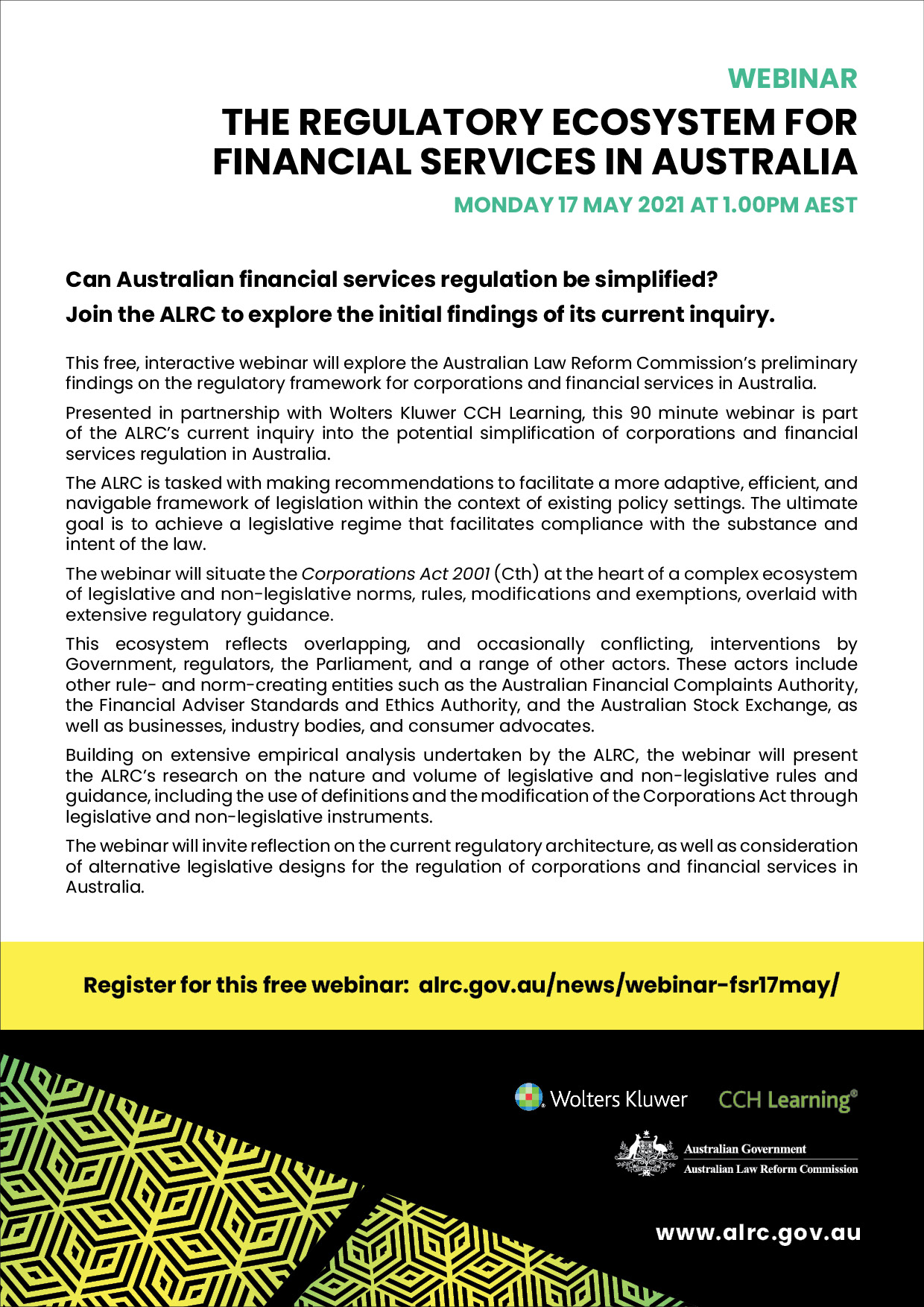
Can Australian financial services regulation be simplified?
On Monday 17 May 2021 the Australian Law Reform Commission hosted a webinar exploring the initial findings of the Financial Services Legislation Inquiry.
Read more: ALRC Scrutinises the Complexity of the Australian Financial Services Regulatory Ecosystem
| View Recording – The Regulatory Ecosystem for Financial Services in Australia |
WEBINAR Comparative Perspectives on Financial Services Regulation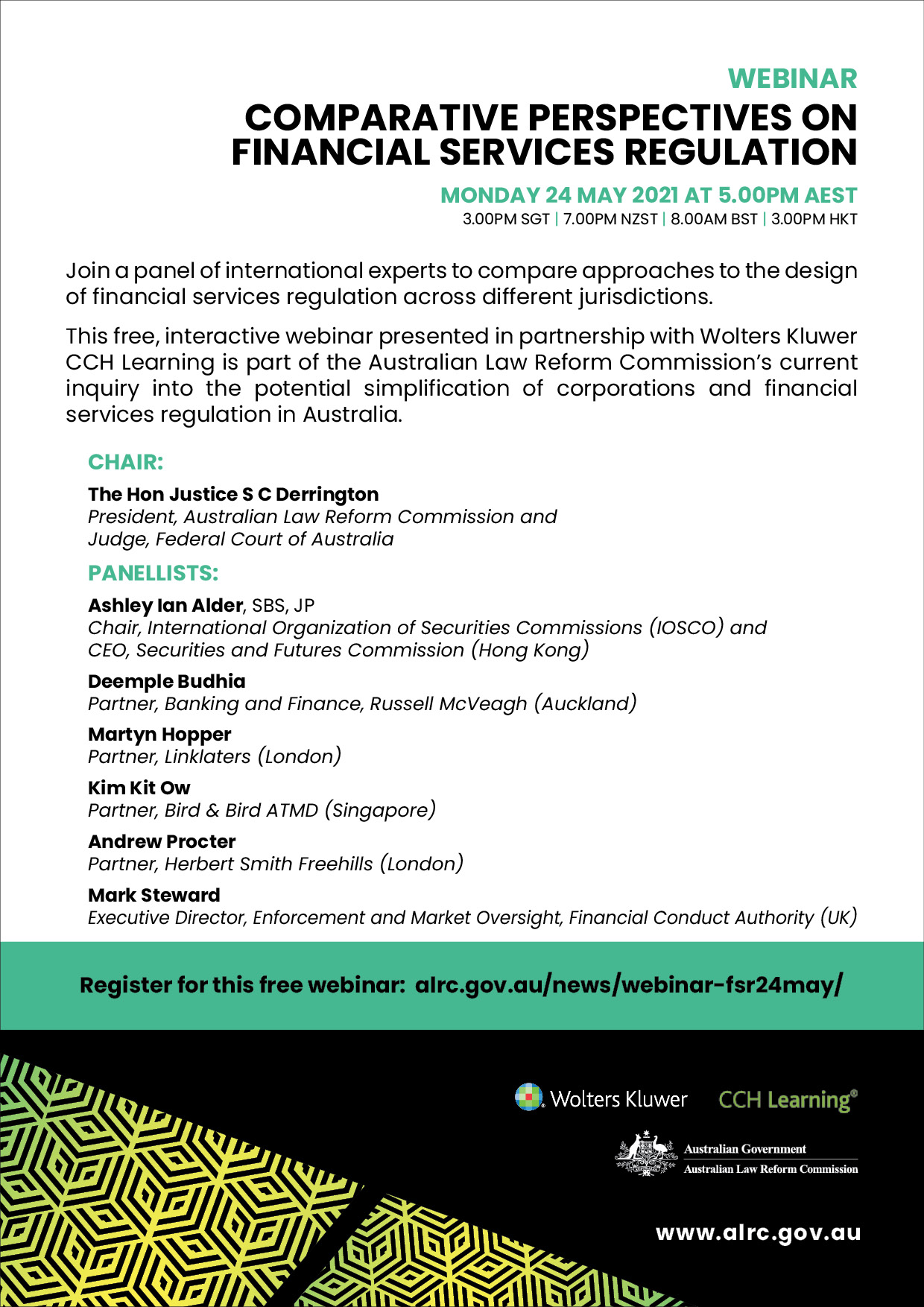
On Monday 24 May 2021 the Australian Law Reform Commission hosted a webinar featuring a panel of international experts who compared approaches to the design of financial services regulation across different jurisdictions.
Read more: International Perspectives on Financial Services Regulation Examined
| View Recording – Comparative Perspectives on Financial Services Regulation |
In April 2021, the ALRC published a Consultation Paper containing questions and draft proposals for public comment. The closing date for submissions in response to the Consultation Paper was 30 June 2021.
The Consultation Paper was accompanied by a series of background papers which provided a high-level overview of key principles and research on topics of relevance to the Judicial Impartiality Inquiry:
- The Law on Judicial Bias: A Primer (JI1)
- Recusal and Self-Disqualification (JI2)
- The Federal Judiciary – the Inquiry in Context (JI3)
- Conceptions of Judicial Impartiality in Theory and Practice (JI4)
- Ethics, Professional Development, and Accountability (JI5)
- Cognitive and Social Biases in Judicial Decision-Making (JI6)
- The Fair-Minded Observer and its Critics (JI7)
Download the Government Response to ALRC Report 135: Family Law for the Future – An Inquiry into the Family Law System.
Public engagement with the ALRC Judicial Impartiality Inquiry.
Public engagement with the ALRC Financial Services Legislation Inquiry.
Preliminary Analysis of Legislative Framework for Licensing Regimes
The ALRC completed a preliminary analysis of the legislative framework governing the licensing regimes in respect of financial services, credit and superannuation to identify and understand points of potential complexity, duplication, and over-prescription. Available outputs from this analysis are outlined below. The ALRC’s analysis was completed in mid-2020 and reflects the law at that time.
A. Compositional logic maps of licensing obligations
Download A1. MAP – Obligation to hold financial services licence
Download A2. MAP – Obligation to hold credit licence
Download A3. MAP – Obligation to hold RSE licence
These three maps outline the constituent components of the obligations to hold, respectively:
- an Australian Financial Services Licence (AFSL) pursuant to s 911A of the Corporations Act 2001 (Cth);
- an Australian Credit Licence (ACL) pursuant to s 29 of the National Consumer Credit Protection Act 2009 (Cth); and
- a Registrable Superannuation Entity (RSE) licence pursuant to s 29J of the Superannuation Industry (Supervision) Act 1993 (Cth).
The maps make reference to both a register of exemptions, and to a register of obligations for each licence, which are outlined below.
B. Register of obligations
1. Register of AFSL obligations
Download B1. AFS licensee obligations
This spreadsheet contains information about the obligations applicable to those persons holding an AFSL.
The information contained in the spreadsheet is summary information aimed at providing an indication of the contours of the legislative regime applicable to licensees, rather than a detailed outline of the precise form, scope and requirements of the relevant obligations.
The headings used in the spreadsheet and associated categorisation of information throughout the spreadsheet aim to capture information about the obligations that will aid understanding of the following aspects of the regime:
- structure (in particular, where obligations are located and the form in which they are expressed);
- design of obligations (in particular, approaches to prescribing and proscribing conduct by reference to the type of obligation legislated and the type of conduct regulated);
- scope of obligations (by identifying to whom and when the obligation applies);
- extent to which interaction with delegated legislation is required to understand the scope of obligations;
- consequences of non-compliance with the obligations; and
- similarity with obligations under the other licensing provisions.
2. Register of ACL obligations
Download B2. Credit licensee obligations
This spreadsheet is the equivalent of document B1 for the ACL licensing regime.
3. Register of RSE licence obligations
Download B3. RSE licensee obligations
This spreadsheet is the equivalent of document B1 for the RSE licensing regime.
C. Register of exemptions
Download C. Register of Exemptions
This spreadsheet contains all exemptions identified by the ALRC to the requirement to hold a licence under s 911A of the Corporations Act 2001 (Cth), s 29 of the National Consumer Credit Protection Act 2009 (Cth), and s 29J of the Superannuation Industry (Supervision) Act 1993 (Cth).
The information contained in the spreadsheet is summary information aimed at providing an indication of the contours of the legislative regime applicable to licensees, rather than a detailed outline of the precise form, scope, and requirements of the regime.
D. Register of ASIC Legislative Instruments
Download D. Register of ASIC Legislative Instruments (as at 10 July 2020)
This spreadsheet contains all ASIC legislative instruments listed as ‘currently in operation’ on the ASIC website as at 10 July 2020 and identifies the source of authority under which the legislative instrument was made. NB: The scope of this register is not limited to legislative instruments related to the disclosure regimes or the licensing regimes.
Preliminary Analysis of Legislative Framework for Product Disclosure Statements and Product Disclosure Statements
The ALRC completed a preliminary analysis of the legislative framework for prospectuses and Product Disclosure Statements (PDSs) to better understand the complexity of the law governing the provision and preparation of disclosure documents for securities and financial products. Available outputs from this analysis are outlined below. The ALRC’s analysis was completed in mid-2020 and reflects the law at that time.
A. Flowcharts:
Download A1. PDS regime – consolidated charts
Download A2. Prospectus regime – consolidated charts
These flowcharts depict the general application and requirements of the prospectus and PDS regimes, and their respective ‘sub-regimes’ (2-part simple corporate bonds prospectuses and short-form prospectuses in the case of securities, and short-form PDS and shorter PDS in the case of financial products).
Each PDF includes a table of contents and an ‘overview’ chart that provides a high-level summary of the disclosure regime with cross-references to the more detailed charts. The overview charts can be used to help navigate the more detailed charts, as well as offering some opportunity for high-level comparison of the different regimes. The detailed charts generally reflect the wording of the relevant provision, and engage with key regulations and legislative instruments where relevant. However, the charts do not represent a comprehensive statement of the law and should be treated as summary information only.
The overview charts also include a colour key that applies across all of the charts. Colour is used to distinguish between different functions of provisions, as well as to highlight the source of provisions (ie, primary vs delegated legislation) and to flag cross-references to other charts.
B. Summary spreadsheets:
1. Comparison of prospectus and PDS regimes
Download B1. Comparison of prospectus and PDS regimes
This is a high-level comparison of the key elements of the two regimes. This document is intended to operate both as a stand-alone summary view, as well as a guide to identifying and understanding points of comparison that are described in more detail in the respective flowcharts.
2. Comparison table of provisions
Download B2. Comparison table of provisions
This document provides for comparison within each of the two regimes (as opposed to between them). It identifies which provisions are common or exclusive between the standard version of a regime and its two sub-regimes. By necessity, these tables do not comprehensively include all provisions pertaining to a given regime. They are intended to provide summary information to facilitate quick comparison within regimes. The Explanatory Notes within the document provide further information.
3. Catalogue of Legislative Instruments
Download B3. Catalogue of legislative instruments
This table provides a comprehensive list of all Legislative Instruments listed as ‘currently in operation’ on the ASIC website as at 10 July 2020 that affect the prospectus or PDS regimes. It includes information regarding the nature of the Instrument, its mechanical effect on the primary legislation, and the substantive effect on the regime requirements. The Explanatory Notes within the document provide further information.
The ToR include a number of indications regarding the intended scope of the inquiry. For example, the ToR initially request the ALRC to consider changes to the Corporations Act 2001 (Cth) and the Corporations Regulations 2001 (Cth) (but not other statutes). Under Topic A the ALRC is to consider the use of definitions in ‘corporations and financial services legislation’; Topic B does not refer to any particular legislation in relation to ‘the coherence of the regulatory design’; and Topic C is specifically restricted to Chapter 7 of the Corporations Act, the provisions of which are to be ‘reframed or restructured’.
The ALRC’s proposed approach is to treat the ToR as one overarching inquiry, rather than as three sub-inquiries on discrete topics. This will have the benefit that the consolidated final report will be able to make a set of recommendations that inter-relate and make sense as a coherent whole. In any event, the sub-topics set out in the ToR will inevitably overlap and each will have implications for the others.
One way of achieving coherence across the topics to be covered in the Interim Reports is to maintain a level of consistency in scope throughout the Inquiry. Consequently, the ALRC proposes that Chapter 7 of the Corporations Act be a focus point for each of the topics. However, issues and themes arising in other parts of corporations and financial services law will also be identified and captured. That is, the ALRC will analyse other parts of the Corporations Act, other legislation relevant to corporations and financial services, and other Commonwealth statutes, in developing its recommendations. The ALRC’s recommendations will have implications for legislative design well beyond Chapter 7 of the Corporations Act.
Topic A – Definitions and concepts
For example, in the first Interim Report for this inquiry, the ALRC will examine the use of definitions and concepts including examples from across the Corporations Act (and key related statutes), and will develop principles for appropriate use of definitions and concepts. In addition, the ALRC will look in greater detail at key definitions and concepts used in Chapter 7 of the Corporations Act, and how they might be simplified in line with the identified principles.
In commenting on the purpose of definitions in legislation, the ALRC will make proposals regarding the appropriate use of definitions that would be generally applicable in Commonwealth legislation (noting the Office of Parliamentary Counsel has published some guidance on this issue). More specifically, the ALRC proposes to analyse whether the definitions relevant to Chapter 7 of the Corporations Act are utilised for appropriate purposes. As noted above, a key criticism is that definitions are used extensively as a method of ‘switching on and off’ the various obligations contained in Chapter 7, rather than for the purpose of elucidating meaning.
- For example, one criterion for whether a Product Disclosure Statement is required to be provided is that the client is a ‘retail client’.[3] Lengthy provisions in the Corporations Act and numerous provisions in the Corporations Regulations then define extensively when a person is considered to be a retail client, subject to numerous exceptions.[4]
In analysing the number and location of definitions, the ALRC will examine the definitions contained in Chapter 7, and throughout the Corporations Act, and investigate helpful ways of improving navigability. For example, some terms are defined in Chapter 7, although the same definition is used throughout the Corporations Act, while other terms are defined only in terms of their use in Chapter 7, but the definition appears earlier in the Corporations Act. There is a high volume of definitions spread throughout the Corporations Act, including words such as ‘on’, ‘of, ‘for, ‘expert’, ‘general law’, ‘information’, and ‘machine-copy’. The ALRC will examine whether their inclusion is justified or helpful (e.g. on the basis of judicial interpretation).
In relation to consistency in the use of definitions and concepts, the ALRC will examine options to achieve greater consistency, particularly for: (1) terms that are defined differently in different Parts of the Corporations Act (eg ‘security’); (2) terms that are defined differently in related statutes, in delegated legislation, and in other sources (eg ‘financial product’); and (3) terms and concepts that are defined or described differently in overseas legislation (particularly as financial products are increasingly becoming transnational in nature). This could contribute to the promotion of ‘robust regulatory boundaries’, as referred to in the ToR, in that definitions can act as a boundary line between different concepts that should be regulated differently.
In relation to the drafting and design of concepts, the ALRC will examine the extent to which key concepts found in Chapter 7 of the Corporations Act are expressed differently elsewhere in the Corporations Act and in related statutes. For example, Chapter 7 includes obligations on Australian Financial Service Licensees to act in their client’s best interests.[5] Similar, but differently drafted obligations apply in a number of other contexts, such as superannuation,[6] and mortgage broking.[7] Comparative analysis of the different approaches in these different statutory contexts may provide a basis for a recommended model of drafting such obligations in Chapter 7.
In examining the design and structure of definitions, the ALRC notes that some definitions in the Corporations Act and their related exceptions have been described as “labyrinthine”[8]. The Financial Services Royal Commission recommended ‘reducing the number and the area of operation of special rules, exceptions and carve outs’.[9] The ALRC will provide examples of key definitions in the Corporations Act, how they are potentially problematic, and how they could potentially be simplified, while retaining the underlying policy intent. (Acknowledging that there may not be consensus as to the underlying intent of the law.)
The ALRC also proposes to assess opportunities presented by technology to assist with the navigability of complex definitions and concepts. In addition, the ALRC would assess the extent to which regulatory language is ‘technology neutral’ in terms of not favouring any type of technology, and identify any aspects of conventional technology that may become obsolete due to technological advances.
Topic B – Regulatory design and hierarchy
The Corporations Act is heavily reliant on the operation of regulations and legislative instruments, as are some other Commonwealth statutes. Accordingly, the ALRC will examine existing provisions that delegate rule-making power, and the impact of delegated legislation on the complexity and navigability of regulation. The ALRC will make principled proposals for reform regarding the proper delegation of rule-making power. In relation to Chapter 7, the ALRC’s aim would be to propose a model under which appropriate guidance could be included transparently at each level of the regulatory hierarchy, such that users are able to identify, locate and apply the relevant rules. International comparisons with regulator powers in comparable jurisdictions will be examined and discussed, as will be the approach in other statutory frameworks in Australia.
Delegation powers: The legislative mapping work undertaken by ALRC to date demonstrates the extent to which Regulations and legislative instruments issued by regulators have been used not only to provide extra detail in relation to interpretation of the Corporations Act, but effectively to amend substantively the primary legislation. For example, Regulations may prescribe additional types of activity to be considered as ‘financial services’ for the purposes of Chapter 7, with significant implications in terms of the obligations consequentially imposed. The ALRC would recommend reforms to the use of Regulations, regulator powers, and instruments, such that users are able to more easily identify, locate and apply relevant rules.
Transparency: The ALRC proposes to examine the extent to which there is publicly available information that illustrates how instruments issued by ASIC exempt particular activities from the application of primary legislation, or otherwise amend the operation of primary legislation. The ALRC would assess options to increase transparency and accessibility of the law in this regard.
Individual exemptions: The ALRC would analyse the practice of regulators issuing to individual entities specific exemptions from particular legislative obligations, and the extent to which the process and outcome is open to scrutiny. The ALRC would assess appropriate processes for ruling on whether or not exemptions should be granted, and the terms on which exemptions are granted.
Notional provisions: Delegated legislation sometimes amends the Corporations Act by way of ‘notional provisions’. That is, the provisions of the delegated legislation say that the Corporations Act is ‘to be read as if’ a particular provision were included in the legislation, or amended in a certain way, although this is not apparent to the reader of the primary legislation. In addition, there is occasionally duplication of numbering of notional provisions, the legal effect of which is unclear.
- For example, there is no subsection (2A) contained in the text of s 1016A of the Corporations Act. However, three different instruments (the Corporations Regulations, an ASIC Class Order, and an ASIC Legislative Instrument) each purport to insert into the Corporations Act a different notional provision designated as ‘s 1016A(2A)’. The ALRC will assess the implications of notional provisions from the perspective of navigability, transparency, and rule of law concerns.
Soft law: The ALRC will consider the appropriate role of ‘soft law’ sources, and whether more regulatory detail could be contained in soft law such as regulatory guides and industry codes, rather than in legislation.
Topic C – Restructuring or reframing the provisions of Chapter 7
This topic is clearly focused on Chapter 7 of the Corporations Act. Nevertheless, the structure and framing of Chapter 7 is clearly influenced by, and affects, other parts of the Corporations Act and related statutes. The ALRC therefore needs to ensure its proposals allow for a coherent overall legislative structure incorporating the contents of Chapter 7.
Norms, principles, and outcomes: The ALRC will seek to identify the fundamental norms of behaviour embodied within Chapter 7, and to provide examples of how the legislation could provide clearer linkages between individual rules and relevant fundamental norms as recommended by the Financial Services Royal Commission. This would incorporate an assessment of the strengths and challenges of principle-based, outcomes-based regulation (as distinct from prescriptive, rule-based regulation) in the specific context of Chapter 7.
Comparative approaches: Building on the work in Topic A on different drafting of similar concepts across different statutes, the ALRC will examine whether other comparable regimes may offer examples of how particular provisions of Chapter 7 might be expressed more simply, with greater emphasis on the fundamental norms of behaviour, to ensure the intent of the law is met.
Legislative structure: Within Chapter 7 of the Corporations Act, various Parts regulate markets for financial products, other aspects concerning financial products, and financial services. The ALRC will examine the relationship between the various Parts of Chapter 7, the rest of the Corporations Act, and other related statutes, to assess whether greater legislative simplification and clarity could be achieved by changing the legislative structure.
Technology: The ALRC proposes to consider whether technology can be utilised to assist with the navigability of regulation generally, and whether regulation could be designed in a way that would aid the use of technology in helping people to navigate regulation.
[3] See, eg, Corporations Act 2001 (Cth) ss 1012A, 1012B, 1012C.
[4] See, eg, Corporations Act 2001 (Cth) ss 761G, 761GA; Corporations Regulations 2001 (Cth) Pt 7.1 Div 2.
[5] See Part 7.7A of the Corporations Act 2001 (Cth), commonly known as the ‘FOFA reforms’.
[6] See, eg, Superannuation Industry (Supervision) Act 1993 (Cth) s 52(2).
[7] National Consumer Credit Protection Act 2009 (Cth) ss 158LA, 158LE.
[8] Australian Securities and Investments Commission v Westpac Banking Corporation [2019] FCA 2147, [7].
[9] Royal Commission into Misconduct in the Banking, Superannuation and Financial Services Industry, Final Report, Volume 1, 16.
The ToR explicitly refer to the Royal Commission into Misconduct in the Banking, Superannuation and Financial Services Industry (‘Financial Services Royal Commission’) concluded in 2019. Recommendations 7.3 and 7.4 of the Financial Services Royal Commission related to simplification of the law. For example, recommendation 7.4 stated that:
As far as possible, legislation governing financial services entities should identify expressly what fundamental norms of behaviour are being pursued when particular and detailed rules are made about a particular subject matter.
These recommendations were described as examples of steps that need to be taken in the context of the ‘overall task’ of simplification of the law. Commissioner Hayne noted that such a task
will require examination of how the existing laws fit together and identification of the various policies given effect by the law’s various provisions. Only once this detailed work is done can decisions be made about how those policies can be given better and simpler legislative effect.[1]
In response, the Government tasked the Department of Treasury ‘to begin the longer term task of considering how to simplify the law, consistent with recommendations 7.3 and 7.4 of the Royal Commission.’[2] The ALRC’s work will complement this ongoing work by Treasury.
There have been a number of other earlier reviews relevant to the financial services sector. The ALRC’s ToR refer explicitly to four of them. In addition, there have been approximately 30 other reviews conducted since 2009 relevant to the financial system, its regulators, banking, superannuation, financial service licensees, credit licensees, and insurance. The 1997 Financial System Inquiry chaired by Mr Stan Wallis AC remains a landmark report underpinning much of the current regulatory architecture. The ALRC considers it will be important as part of the inquiry to reflect on the key aims of these earlier initiatives, and to understand how and why financial services came to be regulated in the manner they are.
[1] Commonwealth of Australia, Royal Commission into Misconduct in the Banking, Superannuation and Financial Services Industry, Final Report: Volume 1 (2019) 495.
[2] Australian Government, Restoring Trust in Australia’s Financial System: Financial Services Royal Commission Implementation Roadmap (2019) 5.