
Anti-Discrimination Laws Inquiry Update
27 January 2023
Consultation Paper Released
Today the Australian Law Reform Commission released a Consultation Paper with proposals for changing the way Commonwealth anti-discrimination law applies to religious schools and other educational institutions.
Stakeholder submissions are now invited.
Submissions close 24 February 2023.
| DOWNLOAD THE CONSULTATION PAPER |
| READ INQUIRY TERMS OF REFERENCE |
| MAKE A SUBMISSION |
Individual views and experiences
In addition to accepting formal written submissions from organisations and individuals on specific law reform proposals contained in the Consultation Paper, the ALRC has also provided a confidential survey for members of the public to share their views and experiences on some key questions relevant to the Inquiry.
Completion of the confidential survey does not preclude making a formal written submission on the propositions and technical proposals contained in the Consultation Paper – it is possible to do both.
The survey will remain open until 24 February 2023.
| SHARE INDIVIDUAL VIEWS AND EXPERIENCES |
Previous Inquiries and Key Reports Considered
Extensive consultations have been undertaken previously on the issues under examination in the inquiry into Religious Educational Institutions and Anti-Discrimination Laws.
The ALRC is considering submissions and reported findings from previous inquiries, in addition to key reports, published over almost 40 years, from 1984-2022, at Commonwealth, state, and territory levels.
| VIEW PREVIOUS INQUIRIES AND KEY REPORTS |
 What do you think?
Stakeholder feedback is crucial for developing recommendations for simplification of corporations and financial services legislation.
In this Background Paper, Reflecting on Reforms II – Submissions to Interim Report B, the ALRC provides an overview of the feedback it has received, by way of formal submissions, on questions and proposals outlined in Interim Report B. This feedback will inform the development of proposals in Interim Report C, as well as recommendations for reform made in the ALRC’s Final Report.
| READ FSL 10 REFLECTING ON REFORMS II – SUBMISSIONS TO INTERIM REPORT B |
Wednesday 15 February 2023 at 5.00pm AEDT
The Corporate Law and Financial Regulation Research Program, in association with the Australian Law Reform Commission, invites you to a webinar on the regulation of crypto assets and Decentralised Autonomous Organisations. The webinar will provide an update on regulatory developments in Australia and overseas, and will explore the direction of future reforms.
Please join the panel for a discussion covering:
- Key concepts and the current ALRC Review of the Legislative Framework for Corporations and Financial Services Regulation;
- Regulation of crypto assets in Australia in the context of global regulatory moves on crypto assets and stablecoins;
- Standards necessary for legal recognition of DAOs and regulatory reform; and
- DAOs and the non-profit sector: expanding the possibilities.
Panel:
- Chair Professor Rosemary Langford, Melbourne Law School
- Dr Andrew Godwin, Special Counsel, Australian Law Reform Commission
- Mr Laurence White, Barrister
- Ms Joni Pirovich, Principal, Blockchain & Digital Assets
- Emeritus Professor Myles McGregor-Lowndes OAM, Queensland University of Technology
| REGISTER TO ATTEND |
This webinar is being delivered live at 5.00pm AEDT on Wednesday 15 February 2023.
All are welcome. The webinar will be recorded.
Financial Services Legislation eNews
25 January 2023
What do you think?
Stakeholder feedback is crucial for developing recommendations for simplification of corporations and financial services legislation.
In this Background Paper, Reflecting on Reforms II – Submissions to Interim Report B, the ALRC provides an overview of the feedback it has received, by way of formal submissions, on questions and proposals outlined in Interim Report B. This feedback will inform the development of proposals in Interim Report C, as well as recommendations for reform made in the ALRC’s Final Report.
| READ FSL 10 REFLECTING ON REFORMS II – SUBMISSIONS TO INTERIM REPORT B |
You’ve heard of SAOs, but what about DAOs?
WEBINAR Wednesday 15 February 2023 at 5.00pm AEDT
The Corporate Law and Financial Regulation Research Program, in association with the ALRC, are hosting a webinar on the regulation of crypto assets and Decentralised Autonomous Organisations (DAOs) on 15 February 2023.
The webinar will provide an update on regulatory developments in Australia and overseas, and will explore the direction of future reforms. Learn more about the speakers and register via the link below.
| REGISTER TO ATTEND WEBINAR |
| DOWNLOAD ALRC BACKGROUND PAPER – NEW BUSINESS MODELS, TECHNOLOGIES, AND PRACTICES (FSL7) |
ALRC DataHub – Are you curious?
The ALRC DataHub offers insights into Australia’s statute book and reflects our commitment to identifying, analysing, and understanding complexity in legislation and the law more generally.
Currently the DataHub includes 16 data sets that can be analysed by researchers to generate novel insights into Australian law and legal history. These data sets cover all Commonwealth Acts and regulations ever made, as well as other forms of delegated legislation. The ALRC has published seven case studies to show how the data can be used, including on lawmaking during the COVID-19 pandemic, issues of Law, War, and Peace, and a history of the Australian statute book.
| VIEW THE ALRC DATAHUB |
| THE WONDROUS UNIVERSE OF LAW: THE ALRC’S DATAHUB AND A NEW AGE OF LEGAL EXPLORATION |
User-friendly legislation: Why we need it, and how to achieve it
In a new article, Dr William Isdale and Nicholas Simoes da Silva share some ideas on how legislation could be made more ‘user-friendly?
“Modern smartphones are some of the most technologically sophisticated pieces of equipment ever invented. And yet, to operate one, you don’t need a PhD in computer science or years of experience. For the most part, their operations are intuitive and their functions easily navigable. If only the same could be said for all modern legislation.”
| READ ABOUT USER-FRIENDLY LEGISLATION |

Dr William Isdale and Nicholas Simoes da Silva
Modern smartphones are some of the most technologically sophisticated pieces of equipment ever invented. And yet, to operate one, you don’t need a PhD in computer science or years of experience. For the most part, their operations are intuitive and their functions easily navigable. If only the same could be said for all modern legislation.
The usability of smartphones reflects the efforts of designers to ensure they are user-friendly. In the world of technology, this focus is called ‘user-experience’ or ‘UX’, and it dominates the design processes of many leading companies. As observed in the book ‘User Friendly’, ‘[t]oday, we take it for granted that the most advanced technologies ever created should never need any explaining whatsoever’.
Unfortunately, this humane philosophy is often missing in the Commonwealth statute book. In our view, the design, drafting, and publication of legislation in Australia needs a fundamental re-think based on ‘user-experience’. This would promote legislation that is more coherent, navigable, and which communicates its message as simply and clearly as possible.
After discussing the need for user-friendly legislation, this article outlines three potential means by which this could be achieved:
- first, by drafting legislation that is simpler and more intuitive in its expression and structure;
- second, by helping users of legislation navigate and comprehend it by providing ‘knowledge tools’; and
- third, by improving the law-making process generally, including by soliciting and integrating user feedback, and through undertaking more regular reviews.
Why we need user-friendly legislation
The things we make should reflect the things we value. And while there are many values that legislation should reflect, among the most important are those related to the ‘rule of law’ — including that the law be ‘accessible and so far as possible intelligible, clear and predictable’ (as Lord Bingham has written).
Unfortunately, as Krongold has observed, ‘[g]overnments have traditionally valued legal effectiveness over intelligibility’. With limited Parliamentary time and sometimes perceived political urgency, the emphasis is often on getting legislation drafted and passed quickly. The result is legislation that is too often not user-friendly. And once legislation is on the books, it is rarely reviewed to consider better ways of achieving the same ends. In short, our current statutory law-making processes do not sufficiently ensure user-friendly outcomes.
Legislation that is unintelligible, unclear, or difficult to navigate and understand, has significant practical implications. For one thing, such legislation is less likely to be complied with, and people may be unaware of whatever rights it affords them. Such legislation may even cause injustice, by requiring the observance of standards which are unreasonably difficult to know or comply with. More generally, such legislation is costly and burdensome to those who must use it. As the Victorian Law Reform Commission has observed:
‘A document that is not readily comprehensible takes longer to understand, is more likely to need a “translator” and is more likely to be misunderstood. … Poorly drafted Acts and regulations consume the time of those who must administer or comply with them. They reduce the efficiency of administration and of business activity. … They waste the time of lawyers and judges.’
While some legislation may never be as intuitive as a smart-phone, it should never be more complex — or less comprehensible — than it absolutely needs to be. It is precisely because the topics with which legislation deals are often so complex that, as Krongold writes, ‘words, syntactic structures and format … should not add to the complexity’.
In putting the user at the centre of the design process, a ‘user-experience’ focus could transform the way that legislation is conceived, created and implemented — for the benefit of us all. In the remainder of this article we outline how this could be achieved.
Drafting simpler legislation
The simplest place to start is with drafting simpler law. This includes a focus on clear and simple expression, but also the adoption of good legislative design — including a navigable structure. Sensible guidance on legislative drafting and structure is provided by the Commonwealth Office of Parliamentary Counsel’s Plain English Manual and its Guide to Reducing Complexity in Legislation. However, the wisdom embodied within these documents is not fully reflected in Australia’s statutes, and it’s worth revisiting some of the basics.
Simpler expression
The use of clear language is perhaps the most uncontroversial of all the ways in which legislation can be made more ‘user-friendly’ — a topic on which the Victorian Law Reform Commission has outlined an extensive set of recommendations and principles.
Drafting practices that cause particular headache include the custom of ‘nesting’ clauses within clauses, which force a reader to ‘keep track of the initial part of the construction until the nested item has been absorbed and the balance of the construction is revealed’ (as Krongold observes). Also, the extensive use of defined terms and cross-references to other provisions and Acts. As the ALRC has previously noted, the Corporations Act 2001 alone contains more than 14,500 internal cross-references, and uses more than 1,000 defined terms. A user is often required to follow long interconnected ‘chains’ of defined terms, simply to understand a single legislative concept. This can, and should, be minimised.
Another means by which legislation can be expressed more simply is through the use of principles-based drafting techniques, which emphasise statutory objectives and eschew overly prescriptive detail. At present, much modern legislation is full of unnecessary minutiae, which can serve to cloud the fundamental objectives. As Kuang and Fabricant have written in the context of user-friendly design more generally, ‘too much information and too little meaning can overwhelm the humans who are supposed to be in control’. The downsides of overly prescriptive legislation have been highlighted in pleas from distinguished jurists, including Chief Justice Bathurst, Justice Rares, and Lord Burrows, but seemingly to little avail.
Legislative structure and design
The design and structure of legislation is also an important contributor to its user-friendliness (or lack thereof). In short, good structure makes it possible for a user to find their way around. As a UK Parliamentary Committee chaired by Lord Renton observed in 1975:
‘A draftsman can contribute a great deal to comprehensibility by arranging the provisions of a statute logically and orderly, dividing it into parts in some cases and inserting headings, sub-headings and marginal notes … as guide-posts.’
The placement of law ‘horizontally’ within legislation should observe some basic principles. These include that the most significant material should come first, leaving the ‘more technical areas of the law, such as regulation-making powers, schedules and temporary provisions at the end’ (as Krongold has argued). Furthermore, as far as possible, provisions concerning the same or similar topics should be clustered together, and consolidated where possible. The current scattering and proliferation of conduct obligations throughout financial services legislation (including across different Acts), is only one of the many areas where this could be achieved. Finally, having settled on a rational legislative structure, it’s important to be consistent, so users have a helpful mental model they can rely on in the future.
The placement of law within a legislative hierarchy — in other words, ‘vertically’ — is also important. As the ALRC has observed in relation to financial services legislation, ‘core obligations are currently scattered across different layers of the legislative hierarchy’ (the Act, regulations, and other legislative instruments). There appears to be no rhyme or reason as to what goes where, or why. The ALRC has proposed fixing this through a more coherent legislative model, comprised of an Act (which sets the core policy direction), a Scoping Order (providing a single home for exclusions and exemptions), and thematically consolidated ‘rulebooks’ (containing necessary prescriptive detail). The adoption of such a hierarchy could potentially improve the comprehensibility and navigability of legislation in other areas too.
Knowledge tools
As long ago as 1843, Bentham lamented the tortuous nature of some legislation, remarking that:
‘Pitching blocks are erected in the streets of London, for porters with their loads: when will English legislators take equal care for the relief of the minds of those who study their labours’.
There are limits to how much more ‘user-friendly’ we can make legislation by only improving its expression and structure. However, to the extent legislation must remain complex, users can be additionally assisted by tools that help them navigate and comprehend it.
A ‘pitching block’ equivalent for modern users of legislation could include ‘knowledge tools’ that help users find what they need on legislation registers. Assistance may be as much about removing what people don’t need to know, as much as highlighting what they do. At present, users of legislation are often overwhelmed with peripheral and irrelevant provisions, making it hard to see the forest from the trees. A useful ‘knowledge tool’ would be the ability to switch ‘on’ or ‘off’ notes and examples, and to only display provisions that apply to certain entities, or in certain circumstances.
Greater ‘interactivity’ of legislation, in the ways described above (and beyond), could be facilitated by drafting in Extensible Markup-Language (or XML), as the ALRC has discussed in a Background Paper on Improving the Navigability of Legislation. New drafting technologies, such as the Lawmaker software now in use in the United Kingdom, make drafting in XML easier to achieve. But while numerous State and Territory jurisdictions in Australia now draft using XML, the Commonwealth has not yet made this transition.
There are numerous other ‘knowledge tools’ and improvements that could be incorporated into the way that legislation is presented. For example, an improved Federal Register of Legislation would ideally include hyperlinking of cross-referenced provisions, ‘pop up’ boxes for defined terms, greater ease of access to Explanatory Memorandums and other secondary materials (including Second Reading speeches), and the ability to more easily review the amendment history of provisions (without needing to navigate the endnotes). Legislation websites in other jurisdictions reveal a wealth of other potential improvements.
In short, the presentation and accessibility of legislation is in need of an overhaul, with a greater focus on the user-experience. While a redeveloped Federal Register of Legislation is expected to go live in 2023, the extent of any new functionalities remains unclear. The redevelopment at least indicates a welcome desire to improve the current state of affairs.
User feedback and legislative review
Otto von Bismark is reputed to have once quipped that, ‘[l]aws are like sausages. It is better not to see them being made’. However, improving the user-experience will require us to look closely at the processes and methods by which we develop, review and revise our legislation. Evidence-based policy needs to be accompanied by evidence-based law design and review, to highlight what works and what doesn’t.
User feedback
To design for humans, it helps to get to know them. As Kuang and Fabricant have written, good design should ‘start by understanding the needs of … users and then work backward’. Unfortunately, the legislative development process often involves little or no input from the ultimate end-users. While stakeholders might be consulted initially about the need for legislation of some kind, consultation on exposure drafts of legislation is often perfunctory (when it occurs at all).
This is a problem, because user-friendly outcomes are best achieved through a process of iteration that involves input from users. In other fields, this is done through prototyping and user-testing, which seeks to draw out and integrate user feedback. As Stanford Design School’s legendary Professor Bob McKim taught (quoting from Kuang and Fabricant):
‘To create a design that worked, you had to build it, watch it fail while people tried to use it, fix it, then watch it fail again until you finally had something’.
Similar processes should be undertaken by legislative drafters. As Krongold (herself a legislative drafter) has written, the best way to tell if people are going to be able to ‘find what they need and understand what they find’ would be to ‘have people try to use and read the statute while it is being drafted’. In overseeing and implementing user feedback, legislative drafters could serve as guardians of user-friendly legislation. But they will need to be resourced appropriately to do so.
Legislative review
Good legislation isn’t a set and forget exercise. The world changes, and legislation must change with it. To keep legislation in good order, it is necessary to have systems of periodic review. Unfortunately, such systems are currently lacking, and the result is that badly designed legislation often remains on the books for decades. As Krongold has observed, the unfortunate reality is that
‘after a law is drafted, no one gets formal feedback about the provisions that cause administrators and the public difficulty. No one keeps track of how much time the public service spends in explaining particular provisions over and over.’
There needs to be a greater focus on the care and maintenance of the statute book, and not just on introducing new law. A good place to start would be reviewing for and fixing errors. As the ALRC has found, even simple errors in corporations and financial services legislation — like incorrect cross-references, redundant definitions, and duplicated provision numbers — have remained there for years.
A simple means for users to point out basic errors could go part of the way to ensuring more user-friendly legislation. Such a functionality could potentially be built into legislation websites, such as the Federal Register of Legislation. At the Commonwealth level, the Office of Parliamentary Counsel has power under s 15V of the Legislation Act 2003 (Cth) to fix many such errors, but the power appears under-utilised. Again, government needs to ensure that our legislative drafting agencies, who are well placed to undertake such maintenance, are appropriately resourced to do so
Other problems are likely to be more substantive. At present, reviews of specific aspects of legislation are undertaken by the Australian Law Reform Commission and by other bodies and experts. Unfortunately, such reviews are usually ad hoc and conducted only in response to a crisis. The ALRC, for example, can only review legislation pursuant to terms of reference given to it by government, and it lacks the resources to undertake more than a small number of reviews at any one time.
Deep-dive reviews should also be complemented by more regular, periodic reviews, which include a focus on the user-experience. Such reviews could be more technically, rather than policy, focussed — aimed at improving the law within existing policy settings. For example, New Zealand’s Legislation Act 2019 (NZ) establishes an ongoing programme of legislative revision, aimed at making ‘New Zealand statute law more accessible, readable, and easier to understand’. Systems of ‘post-legislative review’ are also found in some European countries.
Conclusion
From our smartphones to our sneakers, we take it for granted that the objects we use will serve our needs, and that the user-experience has been taken into account. Unfortunately, a focus on user-experience is not adequately reflected in modern legislation — the usability of which has failed to keep pace with its sheer volume.
To ensure legislation reflects rule of law values, and does not impose an undue burden on its users and society, this article has outlined three key ways in which legislation could be made more ‘user-friendly’ by:
- drafting in a way that is simpler and more intuitive, in both expression and structure;
- providing ‘knowledge tools’ that help users of legislation navigate and comprehend it; and
- improving law-making processes, including by better soliciting and integrating user feedback, and by undertaking more regular legislative reviews.
If implemented, these ideas could substantially improve the user-experience of legislation for the benefit of all. Achieving this, however, will require a demand from stakeholders for more user-friendly legislation, and a commitment from government to achieving it.
On 9 January 2023, the Attorney-General of Australia, the Hon Mark Dreyfus KC MP, announced the appointment of the Hon Justice Mark Moshinsky as a part-time Commissioner of the ALRC. Justice Moshinsky will also fulfil the role of Acting President until a permanent replacement is confirmed.
Outgoing ALRC President, the Hon Justice Sarah Derrington AM welcomed the appointment of Justice Moshinsky.
“It has been a privilege to hold the role and to have had the opportunity to build such an exceptional team around me. In particular, I would like to thank all contributors to ALRC Inquiries who willingly volunteer their time and expertise to the ALRC,” said Justice Derrington.
The ALRC would like to take this opportunity to thank the Hon Justice Sarah Derrington AM.
ALRC General Counsel, Mr Matt Corrigan acknowledged the significant contribution that Justice Derrington has made to law reform in Australia.
“Previous Presidents of the ALRC have set the bar high in terms of academic rigour and leadership. Justice Derrington exceeded that bar as an innovative and collaborative leader who leaves a tremendous legacy after 5 years,” Mr Corrigan said.
During Justice Derrington’s five year term the ALRC has published the following Reports:
- Integrity, Fairness and Efficiency – An Inquiry into Class Action Proceedings and Third-Party Litigation Funders (ALRC Report 134),
- Family Law for the Future—An Inquiry into the Family Law System (ALRC Report 135)
- Corporate Criminal Responsibility (ALRC Report 136),
- Financial Services Legislation: Interim Report A (ALRC Report 137),
- Without Fear or Favour – Judicial Impartiality and the Law on Bias (ALRC Report 138); and
- Financial Services Legislation: Interim Report B (ALRC Report 139).
In addition to numerous consultation and background research papers, the ALRC also published The Future of Law Reform: A Suggested Program of Work 2020-25.
See Attorney-General’s media release >>
ENDS
|
Media contact: |
Nadine Davidson-Wall, Communications and Events Co-ordinator |
On Monday 5 December 2022, the ALRC hosted the Inaugural Michael Kirby Lecture at the Federal Court of Australia in Melbourne. The 2022 keynote address was delivered by the Attorney-General of Australia, the Hon Mark Dreyfus KC MP.
The event also provided the opportunity to formally thank outgoing ALRC Commissioner, the Hon Justice John Middleton AM, for his significant contributions to law reform. Justice Middleton was first appointed as a part-time Commissioner in 2012 and has provided invaluable expertise and guidance to numerous ALRC Inquiries over the last ten years.
This annual lecture celebrates the law reform legacy of the Hon Michael Kirby AC CMG both as the inaugural Chairman of the ALRC and as one of Australia’s leading jurists.
| Download the recording transcript |
| Download the Attorney-General’s speech |
In this article the ALRC announce the launch of the DataHub, which will enable greater explorations of our Universe of Law. Using the DataHub and new tools of discovery, this article summarises four key learnings about our law. They concern the law’s scale, expansion, complexity, and tendency to disorder. These learnings, and others gleaned from the DataHub, can help improve our Universe of Law, for the benefit of all.
Nicholas Simoes da Silva and Dr William Isdale
The launch of the ALRC DataHub
Just like the Universe of stars and planets, our Universe of Law is vast, complex, and expanding. Today, the ALRC launches its DataHub, which provides new insights into the dynamic and intricate nature of our legal cosmos. It’s one small step for man, but one giant leap for legal understanding.
The DataHub is an open-access repository that includes 16 data sets and seven case studies that use data to understand our laws. The data sets cover everything from the subject-matter, length, and maker of legislation, to the sunsetting date of all legislative instruments, and the number of obligations in each Act of Parliament. Hundreds of data points have been collected by the ALRC. The DataHub offers the possibility of rich vistas and new understandings of our law and legal system.
In the reminder of this article we briefly outline four key learnings that we have gained through creating the DataHub, which relate to the law’s scale, expansion, complexity, and tendency to disorder. At the end of this article, there are links to further resources.
New learnings from our Universe of Law
Scale
Our Universe of Law is vast. Comprising over 282,000 pages across more than 1,220 Acts and 17,600 pieces of delegated legislation, the volume of law currently in force in Australia boggles the mind. The more than 21 million words currently contained in Commonwealth Acts of Parliament would take a person over 1,400 hours to read, and that doesn’t even include delegated legislation (which is larger again). The scale of the Commonwealth statute book dwarves the stars of the literary universe, being equivalent in length to 533 copies of James Joyce’s Ulysses, or 252 copies of Leo Tolstoy’s War and Peace.
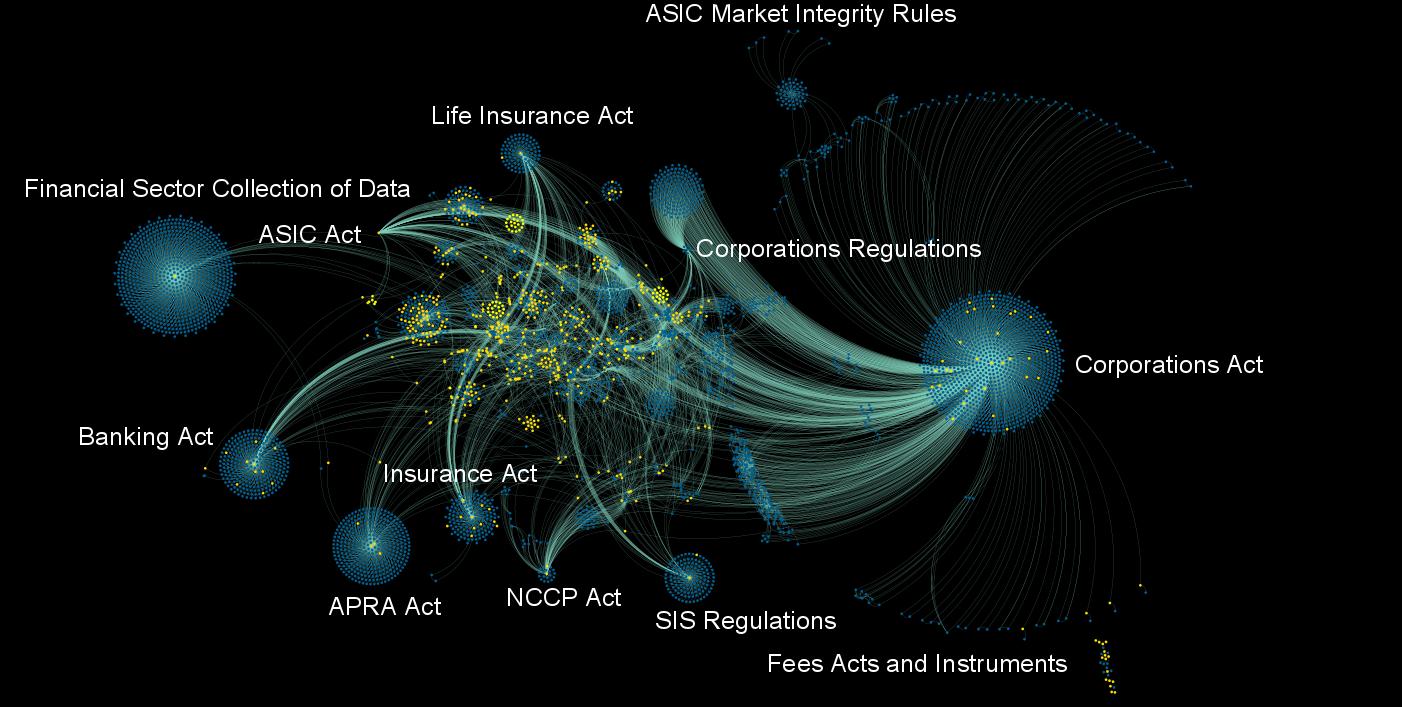
Using the DataHub, our Universe of Law can now be visualised for the first time (with the open-source software Cytoscape, and the programming language R). Figure 1 highlights a part of this Universe — the more than 5,400 Acts (yellow) and legislative instruments (blue) that comprise the galaxy of corporations and financial services legislation. The vast and frequent connections among these pieces of legislation — as created by amendments, modifications, and authorisations — can finally be explored.
Figure 1: Connections between corporations and financial services legislation
The staggering scale of our Universe of Law is also made clear in other ways. For example, the DataHub reveals that there are more than 6,600 references to ‘commits an offence’ or ‘guilty of an offence’ in Commonwealth Acts currently in force. There has also been an explosion in civil penalty provisions, from none in 1990, to more than 1,650 in force today. Both of these data points highlight the risks that may befall those who fail to comply with the myriad requirements of our vast legal cosmos.
Expansion
Much as we live in an expanding Universe, so too do we live with an expanding Universe of Law. Expansion since the 1980s is particularly noticeable, as the Australian Government moved from generally producing fewer than 5,000 pages of Acts and regulations in a single term of Parliament, to consistently producing above 20,000 (and sometimes close to 40,000). Before 1965, there were only two Acts or Regulations that were longer than 400 pages, but there have been 210 that have equalled or exceeded that length since then.
Today, the statute book is growing at an unprecedentedly fast rate, and this growth has been accelerating. For example, the 46th Parliament beginning on 20 May 2019 saw more than 111,000 new pages of legislation made, compared to 90,000 in the 44th Parliament that ended on 9 May 2016. A concise statute book is now but a faint echo from the deep past.
Complexity
While the Universe is composed of fundamental units called atoms, our Universe of Law is composed of words. From these simple materials have come all manner of creations. Over time, the complexity of these creations has greatly increased.
Consider the use of defined terms. Today, there are over 49,000 defined terms in use across Commonwealth Acts. Since 1998, at least 1,000 new definitions have appeared each year in new Acts. While many of these definitions help to clarify meaning, some have simply increased complexity. For example, the ALRC has previously identified that the term ‘property’ is differently defined more than seventeen times in the Corporations Act 2001 — making that legislation extremely difficult to understand.
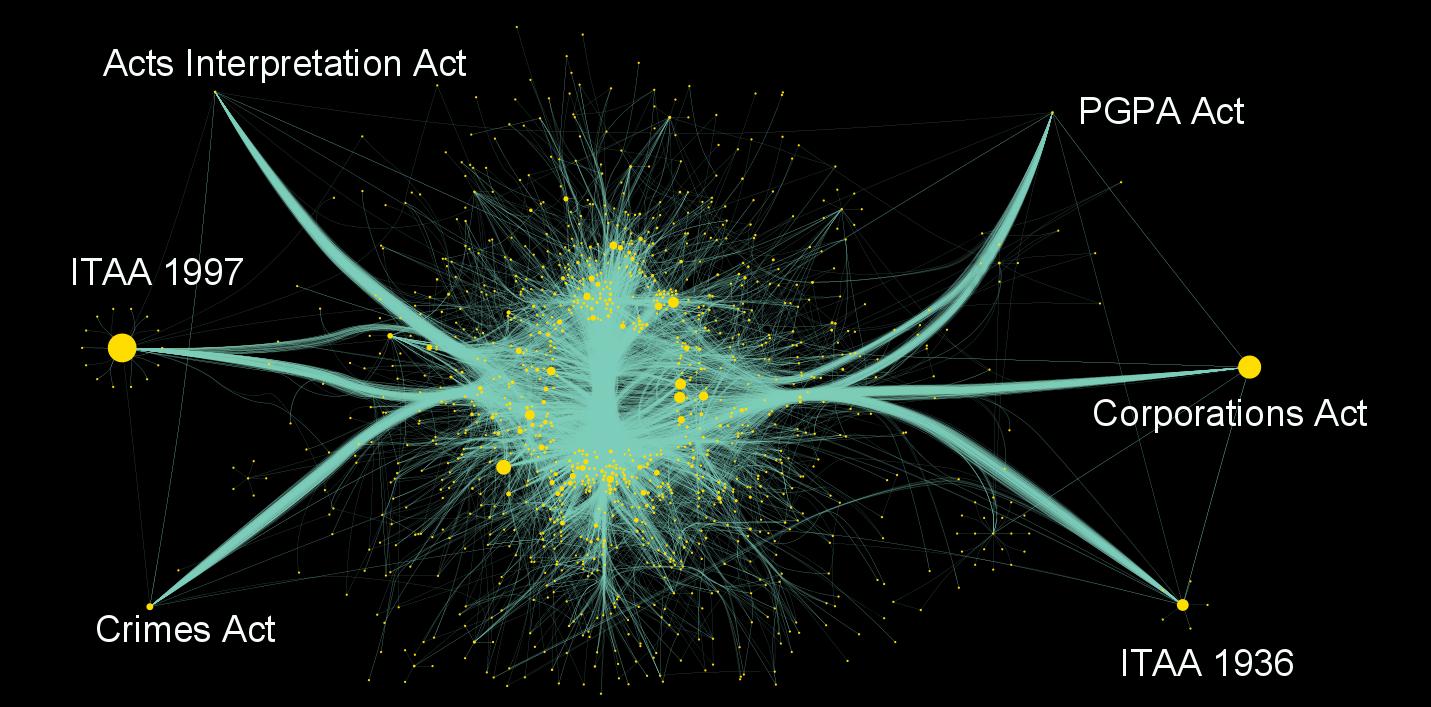
The complexity of our Universe of Law is also a result of its interconnected nature. Figure 2 illustrates the extent to which some laws exert powerful forces upon others. The Figure shows every in force Act of the Australian Parliament as yellow points, the size of which depends on the length of the legislation. The lines represent cross-references between Acts, where one Act refers in its text to another Act. The width of the lines represents the number of cross-references. The six Acts with the most cross-references are highlighted by name.
Figure 2: Cross-references between Commonwealth Acts
An alternative representation is provided by Figure 3. This Figure offers a more distant view than Figure 2. It highlights corporations and financial services legislation in red. All other legislation is blue, and the size of the nodes depends on each Act’s page length. Images like this give some perspective on how large and interconnected our Universe of Law really is.
Figure 3: The messiness of cross-references between Commonwealth Acts

The complexity of our Universe of Law is of particular concern to the ALRC, and several pages and data sets on the DataHub are dedicated to shining a light on this issue. Currently, it can take many light-years to navigate and understand even a fraction of our vast body of law. We are hopeful that the DataHub will further a discussion about the causes of complexity, and potential solutions.
The tendency to disorder
In the Universe, chaos is more common than order. There are simply more ways for matter to be distributed in a disorderly manner than an orderly one. For instance, there are more ways for sand to form a shambolic pile than a sculpted sandcastle.
So too in our Universe of Law. Without constant care and attention, law can easily fall into disrepair. The challenge has grown as the diversity of legislation has exploded, making it harder for our law-makers to maintain. Figure 4 shows all Commonwealth Acts of Parliament, with significant areas of lawmaking coloured according to their subject-matter and the size of each node dependent on the number of pages in each Act. The red giants are the Income Tax Assessment Acts of 1936 and 1997. The figure highlights the eclectic diversity of our statute book, which is as varied as the sparkling stars in the night sky.
Figure 4: The diverse subject matter of Commonwealth Acts

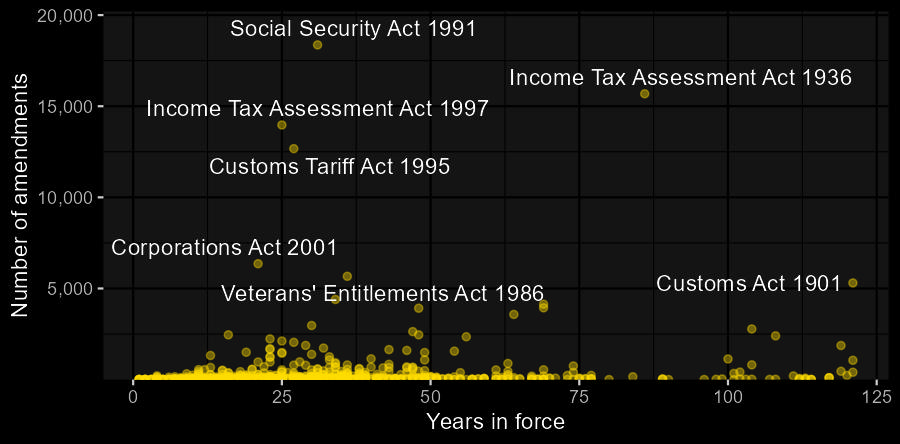
Reflecting the challenge of keeping legislation up-to-date, the proportion of Commonwealth legislation that amends other legislation has been steadily increasing. Amending legislation now constitutes more than 70% of new legislation, up from less than 20% in the early 1900s. Figure 5 shows the number of amendments made to in force Commonwealth Acts since 1901, as shown in the endnotes. Some have seen change on a truly galactic scale, including the Social Security Act 1991, which has had thousands of distinct amendments.
Figure 5: Number of amendments to principal Commonwealth Acts
Our obligation to cherish and preserve
While the Universe of stars and planets is governed by laws of its own, the Universe of Law is of our own making. We are connected to it in a very real sense. We write it and we are governed by it. Its fate is our fate.
One only needs to peer into social worlds where legal systems are absent or ineffective to appreciate law’s beneficial effects. But whether our Universe of Law will continue to cradle and support us — or will swallow us whole into a black void — will depend on what we do now to improve and protect it.
The ALRC hopes that legal scholars and others will be able to glean new insights from the case studies and data sets available through the DataHub, and help further a discussion about how our Universe of Law can be improved for the benefit of all.
To learn more about the ALRC’s DataHub, see the DataHub homepage. You can also find out how ALRC data has been used to offer insights on lawmaking during the Covid-19 pandemic, issues of Law, War, and Peace, and a history of the Australian statute book.
Re-designing, Renovating and Renewing the Legislative Framework for Corporations and Financial Services
What goes where (and why) in the legislative hierarchy?
Who makes the law, and how can they make it easier to find?
Who should create offences and set penalties?
On Wednesday 16 November 2022, the ALRC hosted a webinar to examine Interim Report B and its proposed legislative model.
Watch the recording to hear about the research and novel data analysis underpinning the ALRC’s most recent report into simplifying the legislative framework for corporations and financial services legislation.
Learn about the benefits of the ALRC’s proposed legislative model for Chapter 7 of the Corporations Act, which could produce a more user-friendly legislative framework for financial services.
The live online audience was invited to ask questions of the ALRC panel.
The panel also foreshadowed key questions to be addressed in Interim Report C, focusing on how Chapter 7 of the Corporations Act could be restructured or reframed to simplify the law.
Submissions in response to proposals and questions raised in Interim Report B closed on 30 November 2022.
| Download the recording transcript |

This article provides a high-level summary of the ALRC’s latest Background Paper on unconscionable and misleading or deceptive conduct provisions in financial services legislation. The ALRC proposes a consolidation of such provisions, to improve the expressive power of the law, and to reduce the burden of compliance and enforcement.
Starting in around 300 BC, the Roman Republic began constructing an extensive road network, connecting its many provinces, with the city of Rome at the centre. This is the origin of the common expression, ‘all roads lead to Rome’. In much the same way, over the past several decades lawmakers in Australia have enacted a plethora of provisions that proscribe misleading, deceptive or unconscionable conduct in financial services legislation. This has resulted in a sprawling regime that, at its heart, is targeted at essentially the same kinds of conduct.
In a new Background Paper released today — ‘All Roads lead to Rome: unconscionable and misleading or deceptive conduct in financial services law’ — the ALRC argues that the proliferation of legislative ‘roads to Rome’ contributes to unnecessary complexity in the law, and increases compliance and other costs. The proposed solution is to strengthen some of the key legislative ‘highways’ (the core provisions), and to remove the relatively unused and more complex back streets and alleyways (the lesser used provisions). This is likely to result in a smoother and more efficient passage through the legislative landscape.
Unconscionable conduct
The doctrine of unconscionable conduct concerns unconscientious advantage being taken of persons who suffer from some special disadvantage. Courts have long provided relief for those who are subject to such conduct, including the setting aside of otherwise legally binding transactions.
Limitations to the doctrine at general law motivated the development of complementary statutory provisions. In the context of financial services legislation, these provisions include ss 991A of the Corporations Act 2001 (Cth), and 12CA and 12CB (complemented by 12CC) of the Australian Securities and Investments Commission Act 2001 (Cth) (ASIC Act). Compared to the general law doctrine, these provisions allow access to a broader range of remedies, and regulator enforcement by the Australian Securities and Investments Commission (ASIC). While s 991A and s 12CA are essentially statutory incantations of the general law doctrine with these additional benefits, s 12CB seeks to proscribe an even broader range of conduct.
In the ALRC’s view, the inclusion of several statutory provisions aimed at essentially the same conduct adds unnecessary complexity to the law. This is undesirable for a number of reasons, including that:
- The expressive power of the prohibition against unconscionable conduct may be reduced on account of unnecessary proliferation and complexity. There are expressive benefits in having a single, powerful and broad prohibition, rather than several variations which may serve to cloud or obscure what is intended to be achieved.
- The existence of several statutory prohibitions, rather than one, may unnecessarily invite or require parties to consider, and potentially plead, more than one provision. This adds costs for all stakeholders, including litigants, regulators, and courts.
- More generally, a more complex statute — on account of unnecessary proliferation and overlapping provisions — is simply more difficult to comprehend and apply. This makes it less likely that the law is complied with, or effectively enforced.
The current proliferation of unconscionable conduct provisions gives rise to these detriments without any countervailing consumer protection (or other) benefits. There does not appear to be a sound rationale for the current state of proliferation and overlap.
The ALRC considers that a suitable path out of the current legislative tangle would involve the repeal of unconscionability provisions other than s 12CB of the ASIC Act (accompanied by s 12CC). This is possible because s 12CB:
- prohibits ‘unconscionable conduct’ in the broadest sense of all of the provisions (not being limited to the meaning of that concept in equity);
- applies to the broadest class of persons and in the broadest set of circumstances; and
- provides access to the broadest range of statutory remedies. Most importantly, it enables regulator action to secure a civil penalty.
Currently, the myriad provisions proscribing unconscionable conduct require a user of legislation to muster the Stoic strength of Marcus Aurelius. But there is no need for users to peruse a statutory regime as sprawling as the Roman Empire at its height in 100AD, when the same regulatory outcomes could be achieved more simply through reliance on a single core provision, rather than three.
Misleading or deceptive conduct
A prohibition on misleading or deceptive conduct in matters of trade or commerce was inaugurated in Australian law by s 52 of the Trade Practices Act 1974 (Cth). Since then, however, things have degenerated. Like a legislative Mount Vesuvius, Parliament has spewed forth an enormous array of provisions addressing essentially the same conduct. In the context of financial services legislation, this includes ss 1041E, 1041F and 1041H Corporations Act, and ss 12DA, 12DB, 12DC and 12DF ASIC Act.
The current suite of statutory provisions range from the principled (e.g. s 12DA ASIC Act) to the painfully prescriptive (e.g. 1041F Corporations Act). The result is a great deal of overlap, and provisions so impenetrable they might as well be written in Latin. For example, s 12DA ASIC Act provides simply that ‘[a] person must not, in trade or commerce engage in conduct in relation to financial services that is misleading or deceptive or is likely to mislead or deceive’. Despite this, s 12DC goes on to proscribe misleading or deceptive conduct in far more specific circumstances, namely where the product ‘consists of, or includes, an interest in land’.
The parlous state of the law in this area undermines its effectiveness in guiding conduct, and increases costs for consumers, regulated entities, the regulator, and courts. The proliferation and overlap has even led to judicial exasperation. Notably, in Wingecarribiee Shire Council v Lehman Brothers Australia (in liq) (2012) 301 ALR 1, Rares J referred to the misleading or deceptive conduct provisions in financial services legislation as:
‘a plethora of pointlessly technical and befuddling statutory provisions scattered over many Acts in defined situations. The repealed, simple and comprehensive s 52 of the Trade Practices Act 1974 (Cth) … has been done away with by a morass of dense, difficult to understand legislation.’
The ALRC considers that a pathway out of the current quagmire would involve a return to the core, principled provision in s 12DA ASIC Act, and repeal of the other provisions. Greater reliance on s 12DA is possible because it:
- is the broadest, principle-based expression of the core requirement not to engage in misleading or deceptive conduct. It appears to capture all, or almost all, of the conduct caught by the other provisions;
- operates in the broadest set of circumstances and applies to the broadest range of persons; and
- enables access to the broadest range of statutory remedies — including, but extending beyond, those available for a contravention of the Corporations Act
However, contravention of s 12DA is not presently an offence, and does not give rise to civil penalty liability. In the ALRC’s view, to ensure the achievement of the current regulatory objectives, a sensible approach would be to amend s 12DA to make it a civil penalty provision, and to introduce a new offence provision, otherwise identical to s 12DA, but applying only where the conduct is dishonest, intentional, or reckless (so as to justify criminal liability).
Conclusion
One theory about why the Roman Empire declined is that it simply became too large and scattered to be successfully governed. Similarly, the current proliferation of provisions concerning unconscionable and misleading or deceptive conduct in corporations and financial services legislation is too diffuse to efficiently administer. The current state of the law imposes an undue burden on regulated entities, consumers, regulators, and the courts.
Although simplifying the law may appear to be a Herculean task, the problem is only likely to increase if it is not tackled now. If implemented, the consolidation and amendments proposed by the ALRC’s new Background Paper would promote a more efficient passage through the key legislative ‘highways’, and thereby more effectively implement the underlying policy objectives of the existing law. While the statutory provisions discussed in this article (and Background Paper) may all ‘lead to Rome’, through consolidation and amendment they can get there by way of a less arduous journey.
Read the full background paper: All roads lead to Rome: unconscionable and misleading or deceptive conduct in financial services law

In this article the ALRC considers how principles of ‘human-centred design’ could be used to improve the ‘user experience’ of Australia’s legislation — and increase the likelihood that it is understood and complied with.
Dr William Isdale and Christopher Ash
In his popular book, The Design of Everyday Things, the cognitive scientist Don Norman observes that ‘[a]ll artificial things are designed’. Some person, or group of persons, have made decisions about ‘the layout, operations, and mechanisms’ — whether it be of a piece of furniture, the latest and greatest tech gadget, or for that matter, law.
The design of law is a topic that should concern us all. We now live in an ‘age of statutes’, and ignorance of the law is considered by our legal system to be no excuse. We face potentially severe consequences for failing to abide by increasingly voluminous legislation. But rather than enlightening or successfully guiding conduct, many statutes are liable to confuse or mislead. There are very real, and negative, consequences to poor law design — including the increased costs we all pay for products and services, and in publicly funding courts and regulators who are required to decipher poorly designed laws.
In this article we make the case for a greater focus on law design, to reduce complexity and increase the likelihood of compliance. In particular, we explore a number of features of good design, borrowed from the field of ‘human-centred design’. Human-centred design aims to ensure that the things we design are ‘understandable and useable’, that they accomplish the ‘desired tasks’, and that the ‘experience of use is positive’.
In summary, the design of law should be improved through a greater focus on:
- discoverability (improving the ability to know the law, including by enhancing accessibility and navigability);
- signifiers (measures to improve the communicative power of the law, to more clearly indicate what the law is intending to achieve);
- conceptual models (improving the coherence and rationality of the law, particularly in its structure, to make the law more intuitive and consistent, and easier to know where to find things);
- drafting style and quality (removing undue prescription, and reducing unnecessary linguistic complexity that impedes understanding); and
- the law design process (improving the structures and supports that help law designers do their job, and implementing processes of review to improve the quality of law and keep it up to date).
Discoverability (how to find the law)
We’ve all had the experience of pushing on the wrong side of a door, when it’s not clear how it opens; or having to turn on and off a bank of switches, simply to discover how to control the correct light. These are failures of discoverability, and symptoms of bad design.
Unfortunately, failures of discoverability are common in Australia’s statute books. For example, the ALRC is particularly concerned by the use of ‘dark law’ in corporations and financial services legislation. Dark law consists of ‘notional amendments’ to legislation made by legislative instruments. These instruments are effective at changing the law, but the changes made are not apparent on the face of a statute. For example, the text of s 1012G of the Corporations Act has remained unchanged for over 18 years, but its content was replaced by a notional amendment in 2004. Such amendments make the primary law the tip of a proverbial iceberg — rendering the law deeply inaccessible, and likely to lead users into error.
To improve the law’s discoverability, the ALRC has suggested an end to notional amendments as a method of law-making — something it accommodates in its recently suggested model for corporations and financial services legislation (a model that may also be applied elsewhere). However, there are also other measures that would meaningfully improve discoverability. For example, in its Background Paper on Improving the Navigability of Legislation, the ALRC suggests the use of technological aids, including:
- hyperlinks within statutes (to cross-referenced provisions and definitions); and
- the use of Extensible Markup Language in legislative drafting, which would facilitate greater customisability for users to engage with legislation (for example, to only display provisions containing criminal offences, or applying to certain entities).
The ALRC also supports the provision of other materials designed to improve the discoverability of the law — such as annotated versions of legislation, which flag relevant legislative instruments and other detail not apparent on the face of the law. Users of legislation should not need to purchase commercially produced compilations (often at significant cost), simply to work out what the law requires of them. Just as most products come with a user guide or manual, so too should some statutes.
Signifiers (how to know what the law intends)
When confronted with a complex product, Norman notes that ‘[p]eople search for clues, any sign that might help them cope and understand’. Good designers make things easy for users by providing ‘signifiers’, which help communicate the ‘purpose, structure, and operation of the device to the people who use it’. Good law design requires the same.
At its heart, legislation is an act of communication. However, the complexity of some legislation means that its message isn’t being understood. For example, in the Financial Services Royal Commission’s Final Report, it was observed that legislative complexity may ‘cause the regulated community to lose sight of what the law is trying to achieve’. In the context of penalties and offences, the ALRC has observed that over-particularisation and a large number of overlapping provisions may serve to obscure the underlying norms — the ‘essence of the obligation or prohibition’. This is inimical to the law’s communicative function, and reduces the likelihood of compliance.
The use of legislative signifiers can improve the likelihood that users will understand what the law is intending to achieve. For example, the ALRC has suggested the increased use of legislative examples as aids to understanding, the use of simplified outlines (showing the structure of a statute or component parts) or visuals (such as helpful flow-charts), the use of clear headings, and notes designed to communicate intent and other important information. Objects clauses may be another way in which legislation can more clearly signify what is intended, and thereby help users to work out what is expected.
We all know the frustration that comes from purchasing a product with seemingly inexplicable features that leave us wondering — ‘what is that for?’. Legislation shouldn’t leave us in a similar state of confusion. Good law should be a user manual, not a mystery novel.
Conceptual models (how to know where to find things / use the law)
Through our use of the designed products and systems around us, we build up a conceptual model of how they work, and how we should interact with them. When products or systems provide a good conceptual model, they are intuitive and easy to use. When they don’t, they cause untold frustration, or worse. As Norman writes, a good conceptual model gives users a ‘structure to the apparent randomness’ — enabling them to figure things out.
Regrettably, much of our legislation does not equip users with a good conceptual model. To the contrary, it contains a great deal that is unintuitive and inconsistent. For example, the ALRC has observed that in corporations and financial services legislation there is no consistent approach to the identification of defined terms, and in some circumstances the same term is defined to mean different things in different parts of the same Act. For instance, the term ‘property’ is defined 17 times in the Corporations Act, and the term ‘financial product’ is defined differently between the Corporations Act and ASIC Act, despite the complementary nature of those statutes. It is hard to imagine a less intuitive use of language, or a use more likely to result in error.
The location of the law may also fail to afford a clear conceptual model. This makes it difficult for users of legislation to know where to go to locate what they need. For example, corporations and financial services law currently lacks a clear legislative hierarchy — or a rationale for ‘what goes where’, and why. As the Department of the Treasury observed in the context of the Financial Services Royal Commission:
Decisions taken on legislative design — what material is included in primary legislation, regulations, class orders and what should be left to firms and industry to grapple with — has varied over time, resulting in inconsistencies in design and a lack of a clearly discernible legislative design philosophy across the law.
In the ALRC’s view, a better conceptual model could be provided in a number of ways. This would include the ordering of material within legislation, so as to provide a logical flow of ideas and concepts. Further, the clustering of provisions containing related obligations, or concerning similar themes or topics — as opposed to the diffuse scattering that is common at present. Perhaps most importantly, a good conceptual model should be provided through the use of a clear and consistent legislative hierarchy, governing what is contained in the principal Act and supporting legislative instruments.
At the end of the day, law should be as simple to comprehend and comply with as possible. Law should be a guide to conduct, not an intelligence test.
Drafting style and quality
Good design doesn’t end with a clever schematic. The actual embodiment of a product or system in practice really matters. However whiz-bang a product may first appear, its reception is unlikely to be positive if it isn’t durable or built with quality materials. So too with law.
Words are the timbers from which we build our legislation, and it’s important to use the right ones. Unfortunately, too much of our legislation is poorly expressed, rendering it as short-lived as a cheap plastic trinket. For example, prescriptive rather than principles-based legislation makes it necessary to amend the law more frequently to tailor or update. It may be more quickly superseded by technological developments, or gamed and avoided by regulated entities looking for loopholes. In comparison, a more principles-based approach to drafting would likely reduce the length and complexity of the law, and help achieve the rule of law ideal of accessibility.
A number of other measures could help improve the drafting style and quality of legislation, some of which are outlined by the ALRC in its Background Paper on Complexity and Legislative Design. For example, the ALRC suggests that the current complexity of legislation is contributed to by extensive cross-referencing, the complex use of conditional statements (‘if’, ‘where’, etc), the proliferation of exclusions and exemptions, and a failure to prioritise core concepts or follow a logical structure.
Most importantly, good law design should take account of human limitations. If you’ve ever forgotten a person’s name right after meeting them, then you know something of the limits to human memory. Similarly, as the Office of Parliamentary Counsel has observed, ‘overly long sections’ can mean that the ‘reader struggles to maintain a clear understanding of what a particular section is trying to achieve’. There is only so much we can keep in our working memory, and as Norman writes, ‘[e]ven minor distractions can wipe out the stuff we are trying to hold on to’. Technological tools, such as the Flesch Reading Ease score, could be used by drafters to identify provisions that are likely to be particularly difficult to comprehend — and deserving of simpler expression.
Law design systems and processes
In a poem entitled ‘The Parliamentary Draftsman’ published in 1947, the author (identified only as ‘J.P.C’) provides a humorous take on the travails of legislative drafting. The poem concludes:
I’m the Parliamentary Draftsman,
And they tell me it’s a fact
That I often make a muddle
Of a simple little Act.
I’m a target for the critics,
And they take me in their stride —
Oh, how nice to be a critic
Of a job you’ve never tried!
While this article has been critical of some current legislation and law design practices, this is not a critique of legislative drafters. As J.P.C. noted, it’s easy to be a critic of a job you’ve never tried — and it’s clear that the job of a legislative drafter is a challenging one. In particular, legislation often needs to be drafted under severe time pressures. An aversion to principles-based drafting may also come from other organs of government, or from external stakeholders. Further, there may be insufficient resources to review or improve the existing stock of law — so great is the pressure to simply attend to the latest legislative initiatives.
The ALRC considers that it is critical to provide processes that help to improve law design, and assist drafters to do their job. There is a need to improve the institutional framework that supports the legislative process. For example, the ALRC has proposed compulsory consultation with an expert Advisory Committee before the making of delegated corporations or financial services legislation, and periodic sunsetting, to help ensure its quality and fitness for purpose. The ALRC has also suggested improved guidance to help law-makers use a principled legislative hierarchy, and to guide them in the design of powers that enable delegated law-making.
There is also much to be said for periodic reviews, and other structured mechanisms, to ensure that the law remains in good shape. For example, some inspiration may be drawn from New Zealand’s approach to legislative stewardship. This includes a Legislation Design and Advisory Committee, which advises departments in the initial stages of developing legislation, and scrutinises Bills that come before Parliament. The Legislation Act 2019 (NZ) also requires the Attorney-General to prepare a 3-yearly revision programme for each new Parliament. The purpose of this programme is to ‘make New Zealand statute law more accessible, readable, and easier to understand’. Some European countries also have formal systems of ‘post-legislative review’.
As with any product, there are always improvements that can be made, to fix errors and keep pace in a rapidly changing world. Processes should be in place to ensure the law does the same.
Conclusion
This article has made the case for a greater focus on law design, to reduce complexity in legislation and increase the likelihood of compliance. Borrowing from the field of human-centred design, legislation could be improved by focusing on discoverability, signifiers of meaning, conceptual models, drafting style and quality, and on law design systems and processes.
Ultimately, the principles of design are just as relevant to law as to anything else. As Norman writes, the principles are the same ‘across all domains’, because ‘[p]eople are the same, and so the design principles are the same’. Better law design, founded on the principles of human-centred design, would make the ‘user experience’ of legislation more pleasant for everyone — and increase the likelihood that it is understood and complied with.