
Australian Public Law Blog Article by Sarah Fulton and Geneviève Murray
Judicial impartiality — and within that, an absence of bias — is at the heart of the Australian judicial system and central to how judges see themselves. But while serving and retired judges of the High Court have had a lot to say about when judicial bias arises, they have (with some notable exceptions, as noted in the ALRC Judicial Impartiality Report, p 234) said little publicly about how such matters should be raised with and considered by the courts. Until now.
In QYFM v Minister for Immigration, Citizenship, Migrant Services and Multicultural Affairs [2023] HCA 15 (‘QYFM’), judges of the High Court not only clarified the law on apprehended bias as it applies to a judge who was previously involved in the prosecution of a party, but also took the opportunity to set out their views on the processes for determining issues of bias raised in multi-member courts (such as Courts of Appeal, Full Courts, or the High Court itself).
Restructuring and reframing the legislative framework for financial services
Monday 10 July 2023 at 1.00pm AEST
| Register now |
Everyday objects are easier to use if they are well designed. The same is true of the law.
Join the ALRC to examine Interim Report C and what it means for you. Hear about the ALRC’s proposals for restructuring Chapter 7 of the Corporations Act and creating a Financial Services Law, in pursuit of a more user-friendly legislative framework for financial services.
 Ask questions, as the panel outlines further detail about how the key reforms proposed by the ALRC — including the ALRC’s proposed legislative model discussed in Interim Report B — may be implemented.
Topics of discussion include:
- Why does the structure and framing of legislation matter?
- What are the problems with the current structure of Chapter 7 of the Corporations Act?
- How can financial services legislation be made easier to navigate and understand?
Chair:
- The Hon Justice Craig Colvin, Part-time Commissioner, Australian Law Reform Commission and Judge, Federal Court of Australia
Panel:
- Christopher Ash, Principal Legal Officer, ALRC
- Ellie Filkin, Legal Officer, ALRC
- Nicholas Simoes da Silva, Senior Legal Officer, ALRC
Submit your questions to the panel on registration or via [email protected].
Ellie Filkin and Christopher Ash
Chapter 7 of the Corporations Act 2001 (Cth) is like an old cupboard: it is crammed full and poorly organised, with insufficient time set aside for the occasional spring clean. While the first few boxes fit in this cupboard, over time the containers have become mislabeled and inconsistently sorted. More and more law has been packed into old suitcases, tattered boxes, and shabby bags. The cupboard contains more than it was ever designed to hold.
The sense of dread when opening a messy cupboard is the same feeling that confronts many users of Chapter 7. Interim Report C is, fundamentally, about how the cupboard that is Chapter 7 could be better organised so that users can find what they need without having to go through every box of old CDs and cassette tapes.
Today, the ALRC launches the third (and final) interim report as part of its Review of the Legislative Framework for Corporations and Financial Services Regulation. Like Interim Report B, a central theme of Interim Report C is finding the right ‘home’ for different parts of the law. Interim Report C focuses on Chapter 7 of the Corporations Act (concerning financial services regulation), but many of the law design principles examined by the Interim Report are relevant to legislation more generally. This article reflects on some of these principles, and other findings of the Interim Report.
Stakeholders are invited to make submissions on the proposals and question in Interim Report C by 26 July 2023.
|
|
Financial Services Legislation: Interim Report C (ALRC Report 140) Submissions open until 26 July 2023. |
Legislation should be as easy to navigate and understand as possible
There are practical and principled reasons for why legislation should be as easy to navigate and understand as possible. Legislation that takes longer to find and understand costs more to comply with. Laws that are hard to find, or once found can only be understood with difficulty, are unlikely to achieve their purpose. Legislation that is hard to find and understand also runs contrary to rule of law principles.
Even experts in financial services law have told the ALRC that they have difficulty navigating Chapter 7 of the Corporations Act. As the ALRC’s Inquiry has shown, users of Chapter 7 must sift through too much poorly organised prescriptive detail to find and understand their core rights and obligations.
Interim Report C applies some of the approaches from human-centred design — commonly used in non-legal fields —to show how financial services legislation could be made more user-friendly and, ultimately, more effective.
Unpacking financial services legislation
From the outside, Chapter 7 of the Corporations Act looks thematically consistent: it regulates financial products, financial services, and financial markets. However, thematic consistency at that high level is unhelpful, and has produced a chapter that — at 254,000 words — is longer than all but nine Commonwealth Acts. As the Chapter’s contents have expanded, more has simply been placed into existing boxes, particularly those relating to financial products and services. Compared with every other substantive chapter in the Corporations Act, Chapter 7 simply does too much.
Even where provisions within Chapter 7 are grouped together in a way that makes sense, core obligations are often obscured by administrative and procedural detail. Exceptions are sometimes placed prior to the rule, and specifics before more general (and fundamental) obligations. A reformed structure is needed to better organise existing provisions and accommodate future policy developments.
Financial services providers and consumers face the additional problem that Chapter 7 is not the only Act they must consult to find the relevant law. The ASIC Act — focused largely on establishing the financial services regulator — contains many of the most fundamental standards of commercial behaviour for financial services providers and many protections for consumers. The fact that several of these provisions overlap with provisions of Chapter 7 compounds the difficulty of understanding the law.
The current structure of financial services legislation means finding the relevant law takes longer than it should, and once found the law is still unnecessarily complex and difficult to interpret and understand. Law that is unnecessarily difficult to understand is less likely to be followed. Such non-compliance can result in policy failure and harmful consequences for consumers, businesses, and the effective functioning of markets. Increased resources associated with navigating, understanding, and applying unnecessarily complex legislation increases costs for financial services providers, which are in turn passed on to consumers.
Repacking financial services legislation
The ALRC suggests that financial services legislation should find a new home and legislative identity in a schedule to the Corporations Act — to be known as the Financial Services Law (Proposals C9 and C10). This new home would allow a reformed structure and framing to be implemented, less burdened by the drafting styles and ad hoc legislative design choices of the past. Moving can be a lot of work, and so the ALRC’s implementation roadmap shows how it could best be done.
Interim Report C identifies several areas of existing legislation that should be grouped together to make the legislation easier to navigate and understand. These topics should form separate chapters of the Financial Services Law, covering consumer protections, disclosure, financial advice, and general regulatory obligations. If the Financial Services Law were not adopted, this grouping could also be undertaken within the existing body of the Corporations Act (either as chapters or parts within a chapter), although such an approach is likely to be less effective.
Consumer protection
Consumer protections lie at the heart of financial services legislation, and the fundamental norms that they embody resonate throughout the legislative framework. Generally applicable consumer protection provisions have the broadest application, and typically provide a cause of action and remedy directly to consumers. Such protections should be intuitively grouped together and easy to locate, particularly given their relevance to consumers who may be unfamiliar with the legislation. Currently, however, these provisions are spread between various provisions of Chapter 7 of the Corporations Act and Part 2 Div 2 of the ASIC Act.
The ALRC proposes consolidating Part 2 Div 2 of the ASIC Act with consumer protection provisions currently in Chapter 7 of the Corporations Act (Proposal C1). The ALRC also suggests that several consumer protections, such as the prohibitions on misleading or deceptive conduct (Proposal C2) and unconscionable conduct (Proposal C3), could be consolidated to express their normative significance more forcefully. These measures would help to improve the navigability and communicative power of consumer protection provisions.
Financial advice
The fact that Parliament has made a concerted effort to create a legal framework for financial advice is far from clear on the face of Chapter 7 of the Corporations Act. The original Chapter 7 included almost no provisions specifically regulating financial advice, and as such it has never had a logical ‘home’ for these provisions. As the regulation of financial advice has developed, provisions have been slotted in among other topics, without any hints as to where financial advice provisions are located or how they fit together. The ALRC suggests that provisions relating solely to financial advice should be reframed and grouped into a financial advice chapter (Proposal C6).
Disclosure
The provisions relating to disclosure for financial products and services in Chapter 7 are some of the most unnecessarily complex and least coherent provisions of the Corporations Act. Their complexity makes it difficult and costly for regulated persons to navigate and understand disclosure obligations. Restructuring and reframing disclosure provisions into a single legislative chapter (Proposal C4) is an area where reform represents substantial ‘bang for your buck’.
The ALRC also suggests that the framing of disclosure provisions could be improved by making explicit what is currently implicit: namely, by making clear the outcome — consumer understanding — that disclosure documents are meant to produce (Proposal C5).
General regulatory obligations
General regulatory obligations underpin how financial services providers conduct their business. The ALRC proposes that the range of general regulatory obligations currently spread across financial services legislation should be more coherently organised into two legislative chapters (Proposals C7 and C8). Alongside the creation of a chapter focused on consumer protection (Proposal C1), this would be central to a more navigable and comprehensible legislative framework.
User-friendly design
Adopting the logic of human-centred design, each reformed chapter (or part) should be structured and framed with the needs of users in mind. The ALRC proposes several law design principles that would help achieve this (Proposal C14). For example, provisions should be ordered so as to prioritise core obligations and norms, with administrative and procedural matters given lesser prominence. Obligations should not just appear in ‘shopping lists’ — rather, their order should reflect their relative importance and scope of application. Prescriptive detail should be separated from core obligations, with legislative notes and other aids to interpretation used to signpost where further information is located.
Dedicated removalists
Anyone who has moved house would attest that the process is much easier when you have the right people to help. It is reassuring to know that your valuables are in safe hands and won’t get damaged or lost along the way. Restructuring and reframing financial services legislation should be treated with the same level of care.
The ALRC proposes that a dedicated taskforce (or taskforces) should be formed to oversee the staged reform of financial services legislation (Proposal C12). This would allow expertise and stakeholder involvement at each step of the process. Partnerships between the public sector, industry, and academic expertise would help to maintain momentum throughout the reform process.
Conclusion
In short, Interim Report C shows how unpacking and repacking financial services legislation could make it more user-friendly and a less daunting prospect for those who open its doors. If we leave the task any longer, the cupboard will only become even more crammed and jumbled.
To learn more, download the ALRC’s Interim Report C (in both summary and complete forms). The ALRC welcomes submissions in response by 26 July 2023.
Today the Australian Law Reform Commission’s (ALRC’s) third Interim Report in its three year review to reduce complexity in corporations and financial services legislation was tabled in Parliament by the Attorney-General of Australia, the Hon Mark Dreyfus KC MP.
Interim Report C includes proposals for restructuring and reframing financial services legislation to make it easier to navigate and understand.
Interim Report C demonstrates that the existing structure and framing of financial services legislation — which have developed in an ad hoc manner since the legislation was introduced in 2001 — are sources of unnecessary complexity in the legislative framework. This complexity has produced unnecessary costs for regulated persons, consumers, and other stakeholders.
The ALRC anticipates that the reform ideas in Interim Report C would offer considerable benefits to all users of the legislation, including consumers, industry, and regulated entities, by producing legislation that is easier to navigate and understand. This would, in turn, reduce the costs of compliance and the costs of enforcement faced by regulators and consumers.
Interim Report C contains 4 recommendations, 14 proposals, and 1 question.
The ALRC is seeking submissions from the public in response to the proposals and questions by 26 July 2022. Submissions and further consultations will help the ALRC to formulate its ultimate recommendations at the conclusion of the inquiry. Interim Report C is the final interim report due in this Inquiry and it provides the last opportunity for submissions before the Final Report.
The ALRC proposes that financial services legislation in the Corporations Act 2001 (Cth) and Australian Securities and Investments Commission Act 2001 (Cth) (known as the ASIC Act) should be restructured and reframed in accordance with accepted principles of legislative design. In particular, the ALRC proposes that there should be a Financial Services Law in a schedule to the Corporations Act 2001 (Cth), in similar manner to the Australian Consumer Law in Sch 2 to the Competition and Consumer Act 2010 (Cth).
Interim Report C also discusses how the ALRC’s broader proposals, including the proposed legislative model discussed in Interim Report B, may be implemented. The ALRC welcomes stakeholder feedback on its proposal for the creation of reform taskforces and the implementation roadmap detailed in Interim Report C.
The Inquiry is part of the Government’s response to the Royal Commission into Misconduct in the Banking, Superannuation and Financial Services Industry released in February 2019. The final report of the Inquiry is due by 30 November 2023.
|
|
Financial Services Legislation: Interim Report C (ALRC Report 140) Submissions open until 26 July 2023. |
The Attorney-General of Australia, the Hon Mark Dreyfus KC MP, has today announced an extension to the reporting deadline for the Australian Law Reform Commission’s (ALRC’s) Inquiry on Religious Educational Institutions and Anti-Discrimination Laws.
The report, which was initially due on 21 April 2023, will now be delivered to the Attorney General by 31 December 2023.
The extension responds to a request made by the ALRC in late February for further time to consider more than 420 submissions received in response to its Consultation Paper on reform proposals, and more than 40,000 survey responses.
Part-Time Commissioner tasked with leading the Inquiry, the Hon Justice Stephen Rothman AM, said that the ALRC was pleased to have been granted further time to work through the issues raised by stakeholders in relation to proposed reforms.
“The issues raised by this Inquiry are of great significance to a large number of Australians. It is important that the Commission considers the many varied perspectives thoroughly and sensitively.”
The extension will also enable the ALRC to engage further with its Advisory Committee in finalising its recommendations, but will not involve another round of broad consultations in light of the large volume of submission and survey responses already received.
On 15 February 2023, the Australian Law Reform Commission, in association with the Corporate Law and Financial Regulation Research Program at Melbourne Law School, held a webinar on the regulation of crypto assets and Decentralised Autonomous Organisations (DAOs).
The webinar provided an update on regulatory developments in Australia and overseas, and explored the direction of future reforms.
Following an introduction by Professor Rosemary Langford of Melbourne Law School, Dr Andrew Godwin discussed relevant terminology and concepts and identified the challenges for regulatory design.
Mr Laurence White, barrister at the Victorian Bar, then spoke in detail about the regulatory and legal issues concerning crypto assets from a global perspective.
Ms Joni Pirovich, creator of LawFi DAO, discussed the standards necessary for legal recognition and limited liability for DAOs.
Finally, Emeritus Professor Myles McGregor-Lowndes OAM of QUT shared his experience on DAOs and the nonprofit sector, a sector in which DAOs have generated a significant amount of interest.
Selected Speakers Presentations
- Andrew Godwin, The Regulation of Crypto Assets and Decentralised Autonomous Organisations –Setting the Scene.
- Laurence White, Crypto Assets Regulation in Global Context.
- Myles McGregor-Lowndes OAM, DAOs and the Nonprofit Sector.
On 6 February 2023, Dr Andrew Godwin (Special Counsel and Team Leader at the Australian Law Reform Commission) presented a paper with Professor Rosemary Langford of Melbourne Law School on ‘Corporations, Financial Services and Charities — Regulatory Complexity and Coherence’. The paper was presented at a plenary session of the Society of Corporate Law Academics (SCOLA) 2023 Annual Conference at Swinburne University in Melbourne. The session was chaired by Emeritus Professor Stephen Bottomley of the ANU College of Law.
The paper examined complexity in the areas of corporations, financial services and charities regulation. Dr Godwin compared the challenges of complexity in each of these areas, outlined the work undertaken by the ALRC to date, including in the identification and use of complexity metrics, and engaged with research and commentary by academics such as Emeritus Professor Stephen Bottomley. Dr Godwin noted the potential benefits of metrics in terms of distinguishing between complicated and complex provisions, and agreed with Emeritus Professor Bottomley that ‘some degree of complexity is necessary or unavoidable, and that the task is to find the optimal or necessary degree of complexity to achieve the system’s aims (Stephen Bottomley, ‘The Complexity of Corporate Law’ (2022) 44(3) Sydney Law Review 415, 435).
Professor Langford then introducing her work in a research project funded by the Australian Research Council — ‘Restoring Public Trust in Charities: Reforming Governance and Enforcement’ — and explained the challenges of complexity and coherence in the regulation of charities. After outlining the causes of complexity — including overlapping duties and requirements, inconsistencies and constitutional limitations — Professor Langford suggested various solutions and concluded that some complexity is necessary to allow for diversity and nuance, and that it is a matter of managing/navigating necessary complexity and reducing unnecessary complexity.
The slides for Dr Godwin and Professor Langford’s presentation are available for download here.
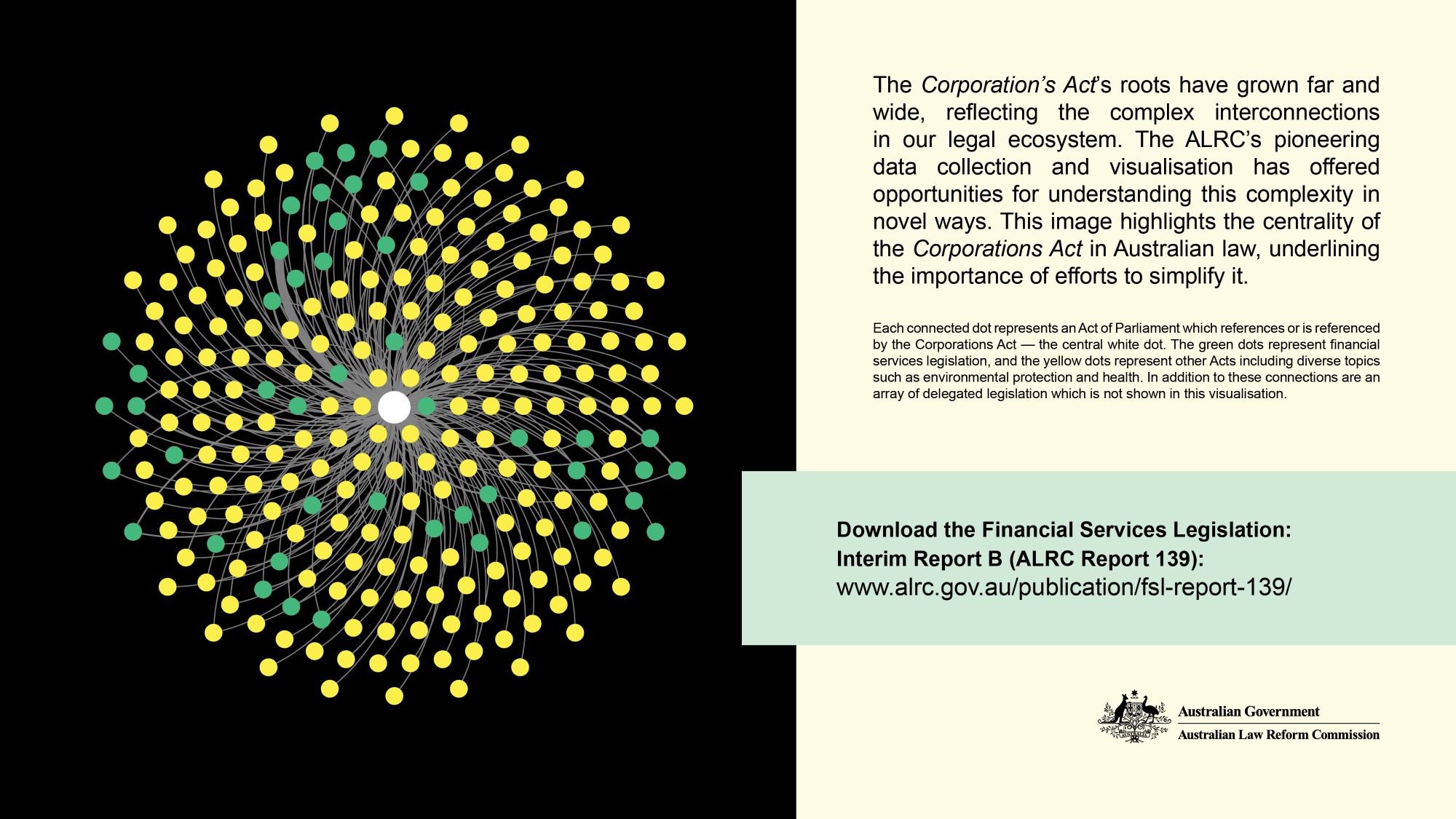
The following image, highlighting the complexity of the Corporations Act, appears in the slides presented by Dr Godwin.
This article published in Australian Law Journal Volume 97 (1) by the Hon Justice Stephen Gageler AC addresses some of the key themes of the ALRC Report, Without Fear or Favour: Judicial Impartiality and the Law on Bias (ALRC Report 138).
Consultation Paper Released
On 27 January 2023, the Australian Law Reform Commission released a Consultation Paper with proposals for changing the way Commonwealth anti-discrimination law applies to religious schools and other educational institutions.
Stakeholder submissions are now invited.
Submissions close 24 February 2023.
| DOWNLOAD THE CONSULTATION PAPER |
| READ INQUIRY TERMS OF REFERENCE |
| MAKE A SUBMISSION |
Individual views and experiences
In addition to accepting formal written submissions from organisations and individuals on specific law reform proposals contained in the Consultation Paper, the ALRC has also provided a confidential survey for members of the public to share their views and experiences on some key questions relevant to the Inquiry.
Completion of the confidential survey does not preclude making a formal written submission on the propositions and technical proposals contained in the Consultation Paper – it is possible to do both.
The survey will remain open until 24 February 2023.
| SHARE INDIVIDUAL VIEWS AND EXPERIENCES |
Previous Inquiries and Key Reports Considered
Extensive consultations have been undertaken previously on the issues under examination in the inquiry into Religious Educational Institutions and Anti-Discrimination Laws.
The ALRC is considering submissions and reported findings from previous inquiries, in addition to key reports, published over almost 40 years, from 1984-2022, at Commonwealth, state, and territory levels.
| VIEW PREVIOUS INQUIRIES AND KEY REPORTS |
 What do you think?
Stakeholder feedback is crucial for developing recommendations for simplification of corporations and financial services legislation.
In this Background Paper, Reflecting on Reforms II – Submissions to Interim Report B, the ALRC provides an overview of the feedback it has received, by way of formal submissions, on questions and proposals outlined in Interim Report B. This feedback will inform the development of proposals in Interim Report C, as well as recommendations for reform made in the ALRC’s Final Report.
| READ FSL 10 REFLECTING ON REFORMS II – SUBMISSIONS TO INTERIM REPORT B |
You’ve heard of SAOs, but what about DAOs?
WEBINAR Wednesday 15 February 2023 at 5.00pm AEDT
The Corporate Law and Financial Regulation Research Program, in association with the ALRC, are hosting a webinar on the regulation of crypto assets and Decentralised Autonomous Organisations (DAOs) on 15 February 2023.
The webinar will provide an update on regulatory developments in Australia and overseas, and will explore the direction of future reforms. Learn more about the speakers and register via the link below.
| REGISTER TO ATTEND WEBINAR |
| DOWNLOAD ALRC BACKGROUND PAPER – NEW BUSINESS MODELS, TECHNOLOGIES, AND PRACTICES (FSL7) |
ALRC DataHub – Are you curious?
The ALRC DataHub offers insights into Australia’s statute book and reflects our commitment to identifying, analysing, and understanding complexity in legislation and the law more generally.
Currently the DataHub includes 16 data sets that can be analysed by researchers to generate novel insights into Australian law and legal history. These data sets cover all Commonwealth Acts and regulations ever made, as well as other forms of delegated legislation. The ALRC has published seven case studies to show how the data can be used, including on lawmaking during the COVID-19 pandemic, issues of Law, War, and Peace, and a history of the Australian statute book.
| VIEW THE ALRC DATAHUB |
| THE WONDROUS UNIVERSE OF LAW: THE ALRC’S DATAHUB AND A NEW AGE OF LEGAL EXPLORATION |
User-friendly legislation: Why we need it, and how to achieve it
In a new article, Dr William Isdale and Nicholas Simoes da Silva share some ideas on how legislation could be made more ‘user-friendly?
“Modern smartphones are some of the most technologically sophisticated pieces of equipment ever invented. And yet, to operate one, you don’t need a PhD in computer science or years of experience. For the most part, their operations are intuitive and their functions easily navigable. If only the same could be said for all modern legislation.”
| READ ABOUT USER-FRIENDLY LEGISLATION |
Want your own copy?
Limited copies of our latest reports are available for purchase.
Place your order now:
- Financial Services Legislation: Interim Report B (ALRC Report 139)
- Without Fear or Favour: Judicial Impartiality and the Law on Bias (ALRC Report 138)
- Corporate Criminal Responsibility (ALRC Report 136)
Or email [email protected] to request copies of ALRC past reports.
The Australian Law Reform Commission (ALRC) today released a Consultation Paper with proposals for changing the way Commonwealth anti-discrimination law applies to religious schools and other educational institutions.
On 4 November 2022, Commonwealth Attorney-General, the Hon Mark Dreyfus MP KC, asked the ALRC to recommend reforms to the law to implement the Government’s policy commitments in this area in a way that is consistent with Australia’s international legal obligations.
The paper sets out four general propositions supported by 14 technical proposals for reform. If adopted, these would:
- make discrimination against students on the grounds of sexual orientation, gender identity, marital or relationship status, or pregnancy in schools and other religious educational institutions unlawful, by removing exceptions currently available under federal law,
- protect teachers and other school staff from discrimination on the grounds of sex, sexual orientation, gender identity, marital or relationship status, or pregnancy, by removing similar exceptions, and
- allow religious schools to maintain their religious character by permitting them to:
- give preference to prospective staff on religious grounds where the teaching, observance, or practice of religion is a part of their role (and it is not discriminatory on other grounds); and
- require all staff to respect the educational institution’s religious ethos.
The proposals would bring Commonwealth anti-discrimination laws into greater alignment with the majority of Australian states and territories.
The ALRC seeks feedback on its propositions and proposals by 24 February 2023. It will provide its final recommendations to the Attorney-General by 21 April 2023.
Federal anti-discrimination and employment laws, including the Sex Discrimination Act 1984 (Cth) and the Fair Work Act 2009 (Cth), prohibit discrimination in a wide range of settings on grounds including sex, sexual orientation, gender identity, marital or relationship status, and pregnancy. However, these laws currently provide broad exceptions for religious educational institutions, including early childhood education centres, schools, colleges, and universities. The ALRC’s proposals would remove exceptions relating specifically to students and staff in religious educational institutions, while retaining exceptions relating to participation in religious worship and observance and the training and appointment of religious leaders.
|
Media contact: |
Nadine Davidson-Wall |