
The Australian Law Reform (ALRC) has begun its inquiry into the justice system’s response to sexual violence.
Attorney-General, the Honourable Mark Dreyfus KC MP, has referred the inquiry to the ALRC with the aim of strengthening and harmonising sexual assault and consent laws.
The referral asks the ALRC to promote and consider just outcomes for people who have experienced sexual violence, including minimising re-traumatisation.
The inquiry’s terms of reference require the ALRC to examine a range of issues including:
- Laws and frameworks about evidence, court procedures/processes and jury directions.
- Laws about consent.
- Policies, practices, decision-making, and oversight and accountability mechanisms for police and prosecutors.
- Training and professional development for judges, police, and legal practitioners to enable trauma-informed and culturally safe justice responses.
- Support and services available to people who have experienced sexual violence, from the period prior to reporting to the period after the conclusion of formal justice system processes.
- Alternatives to criminal prosecution, including restorative justice, civil claims, compensation schemes, and specialist court approaches.
The ALRC will take a take a trauma-informed, holistic, whole-of-systems, and transformative approach to its inquiry, whilst considering matters raised for reform and detailed in prior reports and inquiries.
The inquiry will consult with relevant stakeholders across Australia, including but not limited to:
- people who have experienced sexual violence.
- people and organisations representing population cohorts that are overrepresented in sexual violence statistics.
- state and territory government and law enforcement agencies.
- policy and research organisations.
- community service providers; and
- the legal profession including prosecution and defence lawyers.
The ALRC has been asked to provide its final report to the Attorney-General by 22 January 2025.
You can find the Terms of Reference for the inquiry here: https://www.alrc.gov.au/inquiry/justice-responses-to-sexual-violence/terms-of-reference/
Further information on the work of the ALRC: https://www.alrc.gov.au/
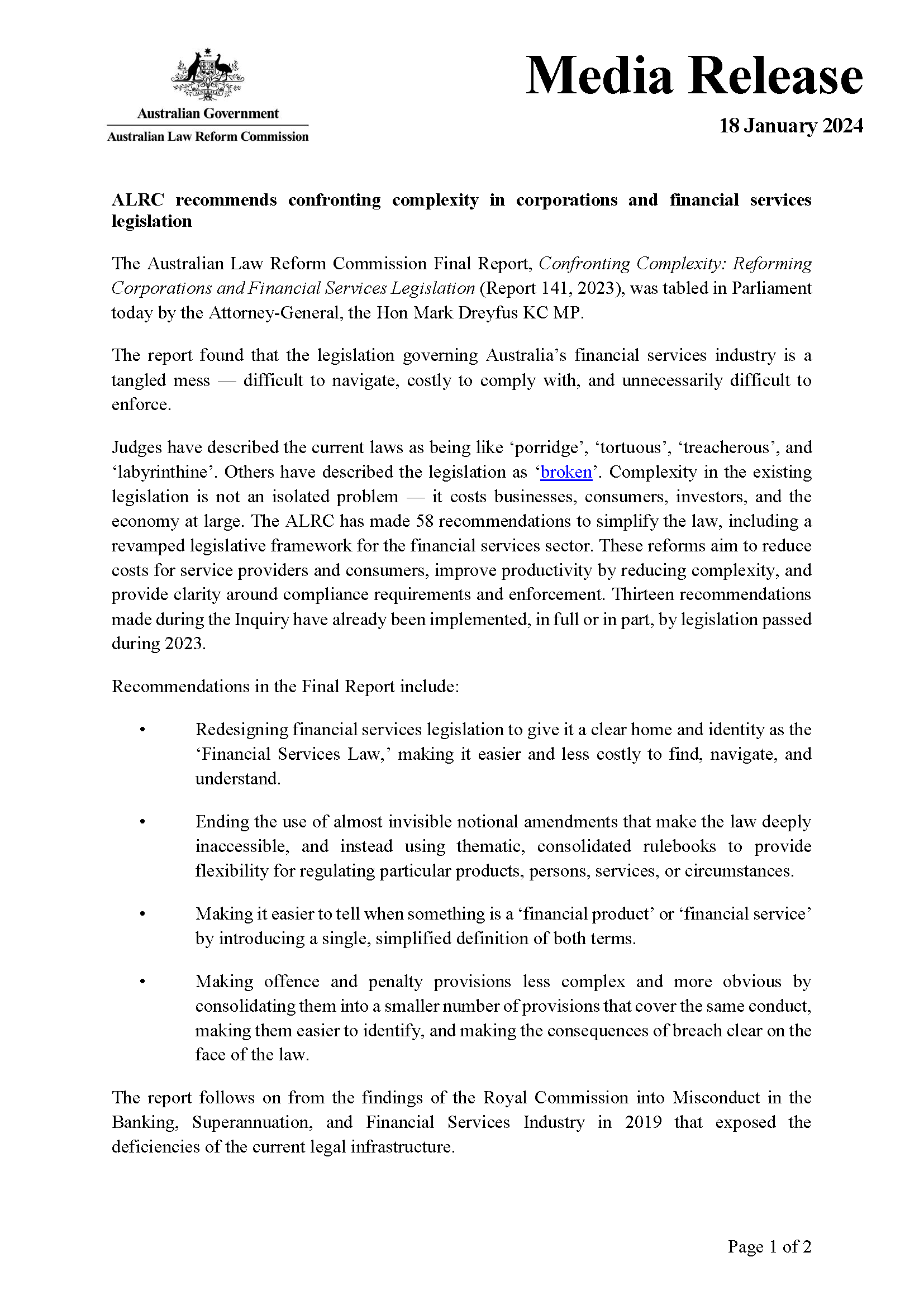
The Australian Law Reform Commission Final Report, Confronting Complexity: Reforming Corporations and Financial Services Legislation (Report 141, 2023), was tabled in Parliament today by the Attorney-General, the Hon Mark Dreyfus KC MP.
The report found that the legislation governing Australia’s financial services industry is a tangled mess — difficult to navigate, costly to comply with, and unnecessarily difficult to enforce.
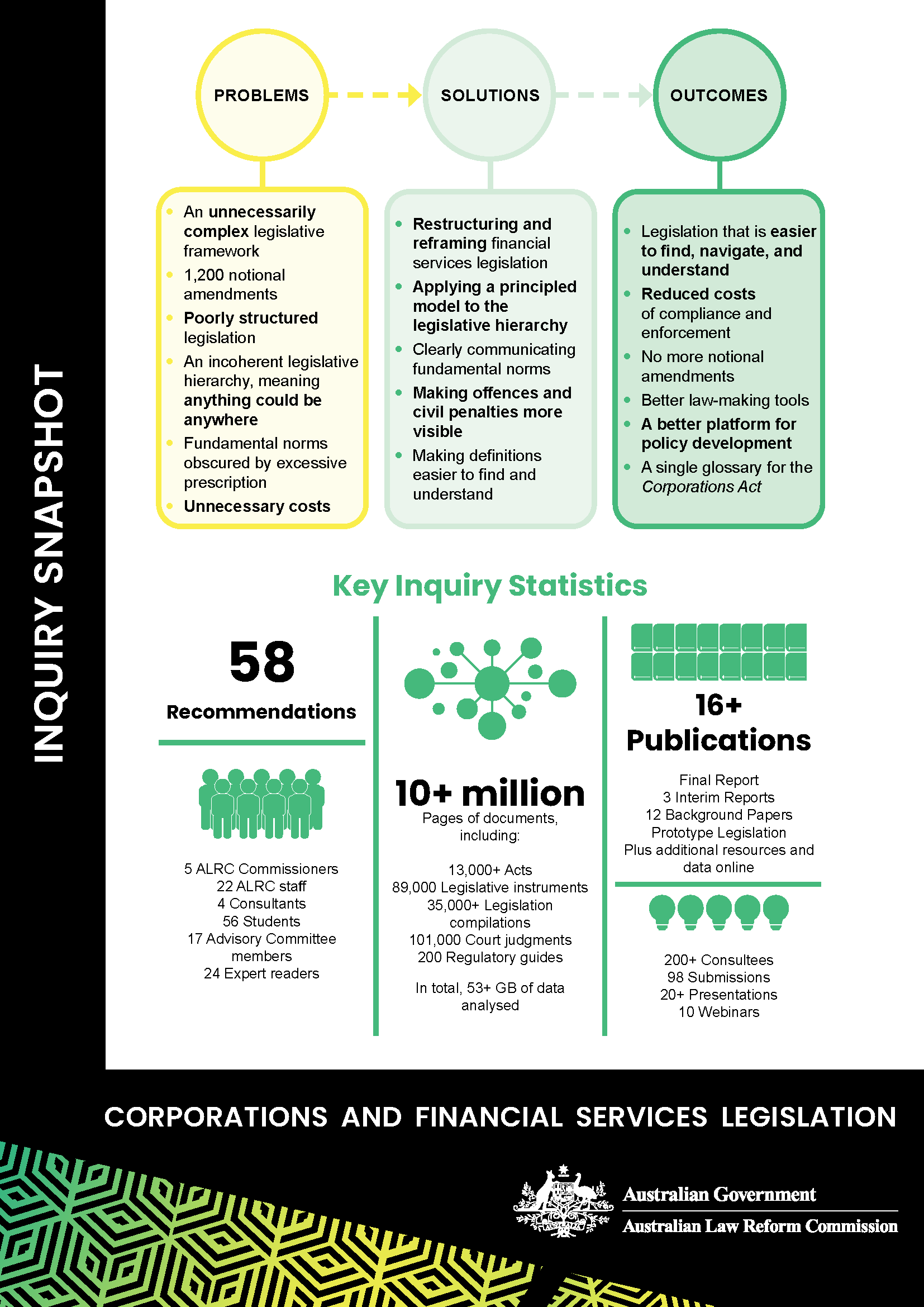
Judges have described the current laws as being like ‘porridge’, ‘tortuous’, ‘treacherous’, and ‘labyrinthine’. Others have described the legislation as ‘broken’. Complexity in the existing legislation is not an isolated problem — it costs businesses, consumers, investors, and the economy at large. The ALRC has made 58 recommendations to simplify the law, including a revamped legislative framework for the financial services sector. These reforms aim to reduce costs for service providers and consumers, improve productivity by reducing complexity, and provide clarity around compliance requirements and enforcement. Thirteen recommendations made during the Inquiry have already been implemented, in full or in part, by legislation passed during 2023.
Recommendations in the Final Report include:
- Redesigning financial services legislation to give it a clear home and identity as the ‘Financial Services Law,’ making it easier and less costly to find, navigate, and understand.
- Ending the use of almost invisible notional amendments that make the law deeply inaccessible, and instead using thematic, consolidated rulebooks to provide flexibility for regulating particular products, persons, services, or circumstances.
- Making it easier to tell when something is a ‘financial product’ or ‘financial service’ by introducing a single, simplified definition of both terms.
- Making offence and penalty provisions less complex and more obvious by consolidating them into a smaller number of provisions that cover the same conduct, making them easier to identify, and making the consequences of breach clear on the face of the law.
The report follows on from the findings of the Royal Commission into Misconduct in the Banking, Superannuation, and Financial Services Industry in 2019 that exposed the deficiencies of the current legal infrastructure.
Complexity costs consumers not only in the expenses that are passed on by financial services providers, but by failing to protect them from misconduct. The Royal Commission clearly demonstrated the economic and human costs of non-compliance with the law. The ALRC’s reforms would strengthen consumer protection substantially and reduce costs for business by making the law simpler to comply with and easier to enforce.
QUOTES — Justice Mordy Bromberg, President of the ALRC
‘Australia’s laws governing financial services are a confusing maze and need to be overhauled. The reforms outlined in this report will make these laws easier to understand and navigate, drive down the costs associated with complying with the law, and make it easier for consumers to understand and enforce their rights.’
‘These laws provide the legal and economic infrastructure of the financial services industry. The reforms we’re proposing are broadly supported by stakeholders and if implemented will see substantial improvements for both consumers and business.’
ENDS
Download the Final Report
Download the Summary Report
About the Australian Law Reform Commission
The Australian Law Reform Commission (ALRC) is an independent Australian Government agency that provides recommendations for law reform to Government on issues referred to it by the Attorney-General of Australia.
|
|
|
|
|
|
|
Media contact: |
Francis Leach, Media and Communications Director [email protected], 0409 947 180 |


Final Report submitted
On 30 November 2023, the Final Report of the ALRC’s Corporations and Financial Services Legislation Inquiry was submitted to the Attorney-General. Thank you to everyone who contributed during the Inquiry. We look forward to participating in public discussions on the ALRC’s recommendations in due course.

Article: The regulatory challenges of evolving technology and financial services law
As the Corporations and Financial Services Legislation Inquiry concludes, Dr Vannessa Ho, ALRC Legal Officer, looks to the future and asks: in an ever-evolving technological landscape, what will be the next challenge for financial services law?
This short article explores some recent innovations — such as ‘robo-advice’ — and the regulatory challenges that future developments pose in the context of financial services law.
How time flies: You’re almost 23, Corporations Act
In 2021, the ALRC marked the 20th birthday of the Corporations Act. As the Act approaches its 23rd birthday in 2024, revisit the light-hearted dialogue in which a mother and father implore their son (the Corporations Act) to grow up.

Final Report update
The ALRC is due to submit its Final Report to the Attorney-General by 31 December 2023. Thank you to the many people and organisations that made submissions, completed the survey, and participated in consultations during the Inquiry into Religious Educational Institutions and Anti-Discrimination Laws.
Background Papers
The ALRC has published two Background Papers that provide a high-level overview of topics of relevance to the Inquiry, including key principles and areas of research that underpin the development of recommendations.
 International Comparisons (ADL1)
Around the world, jurisdictions have grappled with the problem of how best to maximise realisation of all human rights in the context of religious educational institutions. Different jurisdictions have dealt with this issue in different ways, which has led to a variety of legal approaches. This Background Paper discusses the application of anti-discrimination law to religious educational institutions from a comparative law perspective. The laws of five foreign jurisdictions are examined, including the European Union, England and Wales, the Republic of Ireland, New Zealand, and Canada.
 What We Heard (ADL2)
This Background Paper aims to reflect what the ALRC heard from a wide range of stakeholders during its Inquiry into Religious Educational Institutions and Anti-Discrimination Laws. The Background Paper includes an overview of the Inquiry approach, including the methodology adopted to create an evidentiary base for the ALRC’s recommendations, and an analysis and discussion of key themes and interrelated issues which emerged from consultations, submissions, and survey responses.
Webinar
Maximising rights in religious educational institutions: International perspectives
In August 2023, the ALRC and Wolters Kluwer hosted a webinar to hear from international human rights experts on how to best maximise the realisation of all rights in the context of religious educational institutions.
Speakers included former UN Special Rapporteur on freedom of religion or belief, Professor Heiner Bielefeldt (University of Erlangen-Nuremberg), Professor Lucy Vickers (Oxford Brookes University), and Professor Carolyn Evans (Griffith University). The discussion centred on what happens when rights to non-discrimination and religious freedom interact, and how limitations on rights are managed in the context of religious educational institutions, internationally.

Season’s greetings
The ALRC expresses its gratitude to everyone who has contributed to and engaged with the ALRC’s work in 2023. Best wishes for a safe festive season and a happy new year.
Author: Dr Vannessa Ho
As the ALRC’s Financial Services Legislation Inquiry reaches its conclusion, it pays to look to the future. In an ever-evolving technological landscape, what will be the next challenge for financial services law? This article explores some recent innovations and the regulatory challenges they (and similar future developments) pose in the context of financial services law.
Continually evolving technologies
Technological advancements can lead to new or more efficient business practices in the financial services industry. However, the law can struggle to keep up with the fast pace of technological progress. This challenge is not new, and technology will continue to evolve in unanticipated ways. The question then becomes, how can financial services legislation be reformed to best accommodate continually evolving technologies?
The Australian Government has recognised the need to modernise financial services regulation. The ALRC’s forthcoming Final Report for the Financial Services Legislation Inquiry (‘Final Report’) seeks to outline reform that would produce a more adaptive legislative framework. Adaptivity in the face of technological development can help to support innovation and protect consumers from harm, thereby helping to ensure that markets for financial services operate efficiently and productively.
The regulatory challenges of evolving technologies
While financial services legislation should be technology neutral, challenges when regulating evolving technology persist. This is partly because it is difficult to determine how, and whether, legislation should regulate new technologies. There are also competing interests which may need to be considered before extending existing legislation to uses of new technology. For example, the law aims to protect consumers without imposing burdensome regulation that has the effect of stifling innovation. Three examples highlight the regulatory challenges of new technology: automated financial advice (commonly known as ‘robo-advice’); buy now pay later (‘BNPL’); and crypto assets.
Robo-advice
The term ‘robo-advice’ is used to encompass a wide range of technological capabilities. ASIC defines the term expansively to include ‘the provision of automated financial product advice using algorithms and technology without direct involvement of a human adviser’. Robo-advice can be used to provide financial advice on superannuation, other investments, mortgages, insurance, and credit products (see Ringe and Ruof’s article for further discussion on the current capabilities of robo-advice).
Robo-advice has the potential to benefit consumers as it could make financial product advice more affordable and convenient. This, in turn, could encourage more consumers to seek out financial advice before making important financial decisions. Further, with continual advancements in artificial intelligence, robo-advice seems likely to become more sophisticated, which may reduce the amount of human intervention needed when providing automated advice.
The existing legislative framework for financial services in Australia applies to robo-advice in the same way that it applies to human advice. This means that any weaknesses in the existing legislative framework would also affect robo-advice. Throughout the Financial Services Legislation Inquiry, the ALRC has highlighted how financial services legislation is unnecessarily complex. The legislative framework contains excessive prescriptive detail, is difficult to navigate, and costly to comply with. This complexity is likely to be a deterrent for firms that have the technological capability to enter the robo-advice sector.

There are many ways the existing legislative framework could be reformed to accommodate robo-advice. This article discusses the regulatory challenges associated with two options.
The first option would be to create bespoke legislation for robo-advice. The main challenge with this approach, however, is that robo-advice is still an emerging technology. The risks of a bespoke legislative framework for any emerging technology include:
- ensuring legislation is drafted to be sufficiently technology neutral, so that it does not become redundant as the technology evolves;
- if the legislative framework is restrictive or produces uncertainty, it may disincentivise firms looking to invest in research and development of the technology; and
- if legislation is too prescriptive, it is likely to require tailoring, exemptions, and carve-outs as the technology evolves.
The ALRC’s Inquiry has shown how excessive prescription and incoherent use of the legislative hierarchy to tailor regulatory regimes is a significant source of complexity. A more coherent approach to using the legislative hierarchy, such as that discussed in Interim Report B, would help to minimise this complexity.
The second option would be to maintain the current approach and continue to treat robo-advice in the same way as human financial advice. Under this option, reform could be made to the existing financial product advice regime. For example, the Quality of Advice Review discussed ‘digital advice’, which includes (and is sometimes used synonymously with) robo-advice. The Quality of Advice Review concluded that its recommendations would help facilitate digital advice. The Australian Government is now consulting further on the recommendations made by the Quality of Advice Review and potential changes to financial advice provisions in the Corporations Act 2001 (Cth) (‘Corporations Act’).
Changes to financial advice provisions may be further supported by the ALRC’s reforms which aim to improve navigability and increase the adaptivity of the financial services legislative framework. A more navigable and adaptive legislative framework would facilitate the advancement of robo-advice technologies, and similar innovations, by making the legislation less costly to comply with.
Buy now pay later
ASIC describes BNPL as an arrangement that ‘allow consumers to buy and receive goods and services immediately from a merchant, and repay a [BNPL] provider over time’. Specific BNPL arrangements may vary depending upon what features the provider offers. However, consumers may seek to use BNPL because:
- it enables them to delay payment but obtain goods and services immediately;
- interest is generally not charged; and
- it can be easier to set up than a credit card or personal loan.
Many BNPL arrangements can fall outside the existing regulatory framework for financial services and credit. As a result, there are increasing concerns that BNPL may cause consumer harms, such as financial stress, hardship, and excessive fees. In response to these concerns and due to the similarity of BNPL with traditional credit facilities, the Australian Government has committed to extending the National Consumer Credit Protection Act 2009 (Cth) (‘NCCP Act’) so that it captures BNPL arrangements. However, due to the variety of BNPL arrangements, there may be challenges when extending the existing credit regime. These challenges are likely to include:
- defining the concept of BNPL to ensure it encompasses a sufficiently broad range of business models;
- tailoring the responsible lending requirements of the NCCP Act to protect consumers without stifling innovation; and
- preventing unnecessary legislative complexity from creeping further into the credit regime, with the aim of avoiding the level of complexity that has developed within the Corporations Act.

Crypto assets
As highlighted in the ALRC’s Background Paper ‘New Business Models, Technologies, and Practices’, crypto assets can be defined in different ways and for different purposes. Crypto assets have also been variously referred to as digital assets, virtual assets, tokens, or coins. One description of crypto assets, advanced by Treasury, is that it
is a digital representation of value that can be transferred, stored, or traded electronically. Crypto assets use cryptography and distributed ledger technology.
Treasury has more recently undertaken a token mapping exercise to examine the crypto ecosystem within Australia and its intersection with existing financial services legislation. The token mapping exercise developed an understanding of the key concepts of crypto assets and related terms like crypto networks, tokens, and token systems. This exercise is a step towards policy development for the regulation of crypto assets within Australia.
The existing definitions of ‘financial product’ in Australian legislation are framed in technology neutral terms. This means that crypto assets are capable of meeting these definitions and falling within the existing regulatory regime. Regulatory challenges largely stem from the wide variety of crypto assets and the subsequent difficulty in reaching a settled definition. The obstacles caused by developing a coherent definition of crypto assets may be somewhat resolved by Treasury’s token mapping exercise. However, Treasury has noted that some types of token systems may not fit within the existing framework.
Following the token mapping exercise, Treasury released a consultation paper on a proposal which seeks to ‘introduce a regulatory framework to address consumer harms in the crypto ecosystem while supporting innovation’. Rather than regulate crypto assets directly, Treasury proposes to regulate crypto exchanges via the Australian Financial Services licensing regime, thereby requiring crypto exchanges to meet a licensee’s obligations and requirements within the Corporations Act. Regardless of the form this proposal takes, it is still important that the legislative framework be adaptive to support innovation of the crypto economy.
What could be done?
The regulatory challenges of evolving technologies highlight the importance of an adaptive, efficient, and navigable legislative framework. This is the case for technologies that fall within the existing legislative framework (such as robo-advice) and technologies for which policy is being developed (such as BNPL and crypto assets). The findings of the ALRC’s Inquiry demonstrate that the existing legislative framework for financial services is unnecessarily complex — it is difficult to navigate, hard to understand, and key principles are often buried in prescriptive detail. Adaptation in the existing legislative framework often takes the form of complex notional amendments and conditional exemptions, spread incoherently across the legislative hierarchy. This increases the costs of compliance and creates barriers to innovation.
The ALRC’s Final Report will contain recommendations aimed at reforming the existing legislative framework so that it is more adaptive, efficient, and navigable. The ALRC’s recommendations will focus on:
- restructuring and reframing financial services legislation to better communicate its core requirements and emphasise fundamental norms of behaviour;
- creating more coherent and principled use of the legislative hierarchy, making the legislative framework easier to navigate and more adaptive (without generating unnecessary complexity); and
- ensuring definitions are easier to find and understand.
Conclusion
The are many benefits of using evolving technology to innovate and enhance productivity. Tempered against these benefits, however, is a need for sufficient consumer protection where there is risk of significant harm. The ALRC’s forthcoming Final Report will discuss how the existing legislative framework for financial services legislation is unnecessarily complex. In the context of evolving technology, this complexity can stifle innovation and productivity, and undermine consumer protection. Complexity in the existing legislative framework also makes it harder to implement policy initiatives aimed at regulating emerging technologies. The reforms recommended by the ALRC in the Final Report aim to produce an adaptive legislative framework for financial services that can support innovation, policy development, and consumer protection more effectively than at present.

Author: Jane Hall
Emojis are ubiquitous in modern communication. In 2021, Unicode reported that 92% of the world’s online population use emojis. Emojipedia estimates that over 900 million emojis are sent each day without text on Facebook Messenger, and that by mid-2015, half of all comments on Instagram included an emoji.
Given how frequently we use emojis, it should come as no surprise that emojis are making their way into the law (a recent episode of the Law Report on Radio National explored this development). A recent decision of the King’s Bench for Saskatchewan made headlines when the court determined that the 👍 emoji could be a legally binding indication of agreement to a contract (see South West Terminal Ltd v Achter Land & Cattle Ltd [2023] SKKB 116). This decision was one in a growing line of cases where courts have been asked to interpret the meaning and legal effect of different emojis (see Eric Goldman, ‘Emojis and the Law’).
This article explores another potential use for emojis: legislative drafting. The ALRC is currently preparing its Final Report in the Financial Services Legislation Inquiry. Throughout the Inquiry, the ALRC has explored ways to improve the navigability and comprehensibility of legislation. If emojis are already cemented in our daily lives, could they also help make legislation easier to navigate and understand?
After examining how the law has started to use emojis and other images, this article considers:
- 🥸 the characteristics of good legislation and the goals of legislative design;
- 🎨 how emojis could be used in legislation; and
- 🏆 whether emojis could help achieve the goals of good legislative design.
While emojis may improve the navigability and comprehensibility of legislation, these benefits are (for the foreseeable future at least) likely to be outweighed by the additional uncertainty 🫤 and ambiguity 🙃 emojis introduce.
🤔 Why consider using emojis in legislation?
Emojis are not just playful devices to express our sense of humour, or to send subliminal messages. They can have serious legal consequences.
For example, in In re Bed Bath & Beyond Corp. Securities Litigation, 2023 U.S. Dist. LEXIS 129613 (D.D.C. July 27, 2023), the US District Court found that the use of the ‘full moon face’ emoji (🌝), in a Tweet by the respondent, Cohen, about shares in a particular company could be understood by shareholders as an indication that the stock would increase in value and that shareholders should therefore buy or hold stocks. The Court stated:
In the meme stock “subculture,” moon emojis are associated with the phrase “to the moon,” which investors use to indicate “that a stock will rise.” So meme stock investors conceivably understood Cohen’s tweet to mean that Cohen was confident in Bed Bath and that he was encouraging them to act.
In South West Terminal, the Court determined that the 👍 emoji could act as a signature on a contract for the delivery of flax. The court recognised that the use of the 👍 emoji was a ‘non-traditional’ means of signing a contract but that nonetheless, in circumstances where the parties had previously reached similar agreements via text message, it was a valid way to convey the purposes of a signature.
These cases can be seen as part of a broader trend of embracing images to affect legal interactions and to make the law more accessible. Initiatives such as Comic Book Contracts and Creative Contracts have been exploring the use of visual and cartoon-based contracts. Cartoon-based contracts use images to convey the key terms of the contract. Sometimes the images are accompanied by simplified text but other times the contract only contains images. These types of contracts have been particularly useful for linguistically diverse workplaces. For example, Creative Contracts developed an employment contract for a citrus farming business in South Africa, a country in which multiple languages are spoken. The cartoon-based contracts produced by Creative Contracts ‘reduced the induction time from four hours to 40 minutes’, reflecting the potential for images to effectively convey information.
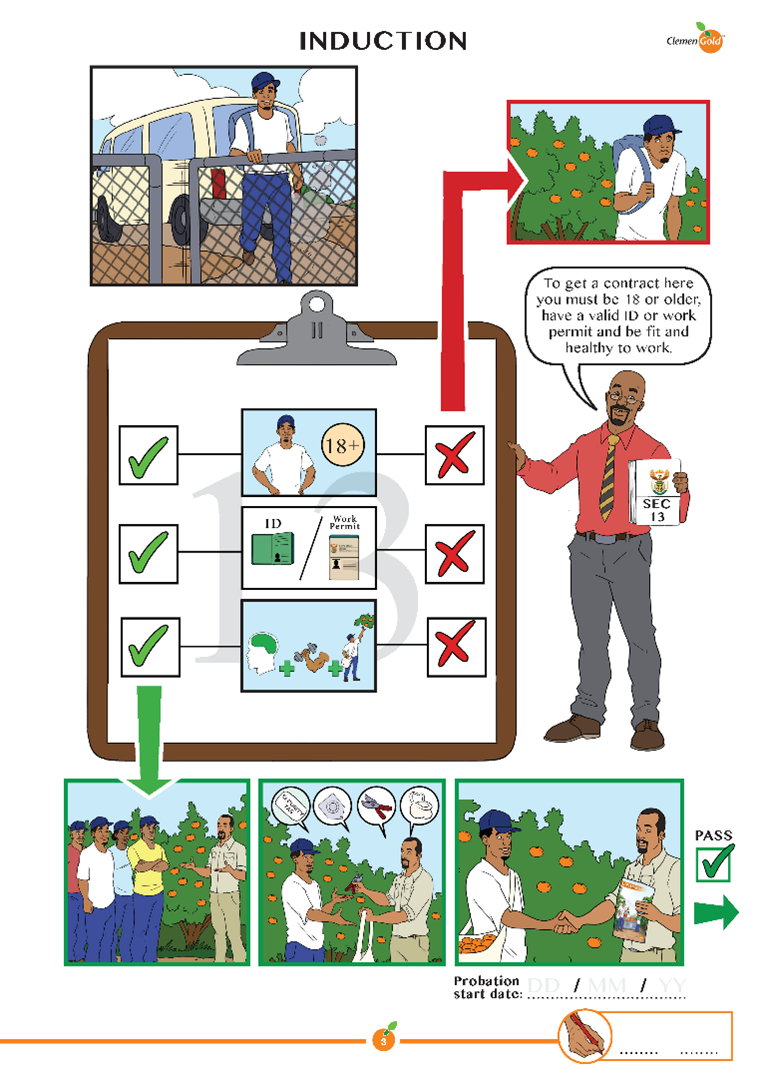
Source: Creative Contracts (https://creative-contracts.com/clemengold/)
In 2018, Aurecon and the University of Western Australia co-designed the first employment contract for an Australian workplace that combined text and images to make concepts like probation and leave entitlements more easily comprehensible to a workforce that did not have legal training.
Legislative drafters too have been experimenting with different ways of presenting information to improve the ‘readability’ of legislation. For example, guidance from the Office of the Parliamentary Counsel emphasises the use of ‘readability aids’, which includes the use of visual aids such as flow-charts (see, eg, Evidence Act 1995 (Cth) ch 3, which uses a flowchart to show how the Chapter applies to particular evidence).
If we are already using emojis in ways that affect legal relations and to develop contracts, and we’re already experimenting with different readability aids, it begs the question: is the next logical step to use emojis in legislation? Could emojis help to make legislation more accessible?
🥸 What does good legislation look like?
The question ‘what makes for good legislation’ will be answered differently depending on who you ask. In this article, I assess the quality of legislation by reference to how easy it is to access and use.
The ALRC has previously published on good legislative design and user-friendly legislation, and has proposed seven working principles for the structuring and framing of corporations and financial services legislation in Interim Report C. This article focuses on the concept of ‘mental models’ that enhance the navigability and comprehensibility of legislation. I consider that good mental models focus on the following:
- 👌 simplicity (improving the coherence and clarity of the legislation);
- 💡 comprehensibility (highlighting important matters that may not be immediately apparent); and
- 🧭 navigability (both within and between Acts).
These three elements will form the criteria for assessing the potential effectiveness of emojis in legislative design.
🎨 How could emojis be used in legislative drafting?
Using emojis in legislative drafting does not mean turning legislation into a visual cryptic crossword by replacing all references to ‘Australia’ with the 🦘 or 🐨 emoji, or substituting the 🧑⚖️ emoji for the word ‘court’. Rather, emojis could be used as visual aids, or signalling devices, to improve the navigability of legislation by:
- ❗ highlighting important matters, such as offence provisions;
- 🔎 identifying matters that may not be immediately apparent on the face of the provision, such as defined terms or notional amendments; and
- 👩🎨 improving the visual appeal of legislation.
🧪 Case study: section 791A of the Corporations Act 2001 (Cth)
To illustrate what this could look like, I took a current provision from the Corporations Act 2001 (Cth) and inserted emoji ‘signals’. The provision is currently located in Chapter 7 of the Corporations Act, a chapter described as being like an old cupboard in need of a good spring clean 🧹.
The provision currently reads:
Emojis could be used as signalling devices to highlight the following:
|
Information |
Emoji |
|
Section 791A is a civil penalty provision |
🚫 |
|
Sub-section (1) contains an obligation |
⚠️ |
|
The provision contains terms that are defined in the Corporations Act 2001 (Cth) |
📖 |
|
The provision contains terms that are defined in other legislation |
📘 |
|
The provision was introduced after the Corporations Act 2001 (Cth) was enacted and has been subsequently amended |
📝 |
The reframed provision could look like the following:
Does it work?
The reframed provision appears to partially satisfy the criteria for a good mental model:
|
|
Aim |
Achieved? |
|
|
Simplicity |
Coherence and clarity |
🤔 |
While the emojis are useful signalling devices, they remove some whitespace and may make the provision seem crowded. There is a risk of ‘information overload’. |
|
Comprehensibility |
Highlight important matters that may not be apparent on the face of the legislation |
✅ |
The emojis highlight that the provision contains obligations and offence provisions, and that it has been amended since its enactment. |
|
Navigability |
Improve navigability within the Act and with other Acts |
🤔 |
The emojis identify terms that are defined within this Act, and tell users that certain terms are defined in other Acts. But, the emojis are quite distracting, an issue the ALRC has previously noted when it comes to identifying defined terms. |
👎 The downsides
While there is certainly a case for using emojis to assist with the simplicity, comprehensibility, and navigability of legislation, embracing emojis in legislation comes with some potential downsides. Goldman identifies five key issues with the use of emojis in law more generally:
- 🕵️ visual decoding (emojis are relatively small in size and several emojis look quite similar, which can make it difficult to identify which emoji has been used);
- 👯♀️ multiple meanings (there is no definitive reference source catalogue for emojis and Unicode’s criteria for accepting new emojis suggests that it prefers emojis that have multiple potential uses);
- 😵💫 depiction diversity (emojis appear differently on different platforms, which can increase confusion as to their intended meaning);
- 💂♀️ culture-specific meanings, which inform metonyms (using emojis as a form of figurative language to replace words or expressions, such as using the 🤔 emoji instead of the phrase ‘hmm’ or ‘let me think’ – see Javier Morras and Antonio Barcelona, ‘Emojis: Metonymy in Meaning and Use’); and
- 🖊️ unsettled grammatical rules when using multiple emojis in a thread.
The first three of these issues are particularly relevant for emojis in legislation.
Visual decoding may undermine the potential for emojis to be useful signalling devices in legislation. If it is difficult to identify which emoji has been used, then readers will not benefit from the visual prompt.
For example, the 📝 emoji (which in the example above indicates that the provision has been amended since the statute’s enactment) could be confused with another writing-based emoji, such as: 📃📄📜🗒️. At best, this may result in users of legislation simply ignoring the emoji. At worst, it could result in confusion and uncertainty.
Multiple meanings could create ambiguity and uncertainty.
For example, while in South West Terminal the 👍emoji was interpreted as a signature on a contract, in Lightstone RE LLC v Zinntex LLC, 2022 N.Y. Misc. LEXIS 5925 (N.Y. Supreme Ct. Aug. 25, 2022), the Supreme Court of New York considered that the same emoji did not constitute acceptance of a contract in circumstances where the surrounding text messages showed that the sender did not intend to be bound by the agreement. Even in South West Terminal there was argument about whether the 👍emoji should merely be interpreted as a confirmation of receipt of the text message.
Such ambiguity could be mitigated through an interpretive provision being inserted into the Acts Interpretation Act 1901 (Cth) to explain what the emojis indicate. Such a provision could be along the lines of:
Use of emojis
If a provision of an Act includes an emoji, the following table provides the meaning of the emoji in the particular context.
|
References to Emojis in Acts |
|||
|
Item |
If the provision uses the following emoji |
in the following context |
then the emoji indicates … |
|
1 |
📝 |
in the margin next to a provision title |
that the provision has been amended since enactment |
|
2 |
📖 |
in the margin of a provision followed by certain terms |
that those terms are defined terms within the Act |
|
3 |
📘 |
in the margin of a provision followed by certain terms |
that those terms have a defined meaning in another Act, which applies to this Act |
|
4 |
⚠️ |
in the margin of a sub-provision |
that the sub-provision contains an obligation |
|
5 |
🚫 |
in the margin of a sub-provision |
that the sub-provision is an offence provision |
However, it may be unrealistic to expect that users of legislation would instinctively turn to the Acts Interpretation Act to resolve any confusion they have as to the meaning of an emoji that appears in an Act. It is more likely that users would rely on their own understanding of the emoji, which could differ significantly from another user’s understanding, or would run a search on the internet to learn the meaning. This would lead to further issues because legislation would be giving the emoji a new, context-specific meaning that may differ from what users would understand to be the ‘ordinary meaning’ of the emoji.
Another option would be to use ‘hover boxes’ to show the intended meaning of the emoji. However, this may be limited by the current capabilities of the Federal Register of Legislation.
Depiction diversity would likely cause issues because users of legislation may not recognise the emoji if its depiction in legislation differs from the way that the emoji appears on a user’s platform.
For example, the ‘full moon face’ emoji referred to in South West Terminal is depicted quite differently on various platforms:
|
Apple |
Microsoft |
|
Noto Emoji Font |
|
Twitter/X |
 |
 |
 |
 |
 |
 |
If we are going to use emojis in legislation, we may need to accept that the depiction that is chosen is likely to be recognisable to people familiar with that platform but may be unrecognisable or confusing for people familiar with a different platform, or who do not use emojis at all. The ability of users to recognise the emoji, and to understand its meaning, would therefore depend on (a) whether that person uses emojis at all, and (b) which platform the user is most familiar with. This would seem to undermine the purpose of using emojis: to increase the accessibility and navigability of legislation. It is also at odds with the principle that legislation should be generally accessible and comprehensible by all users.
The combined effect of these three issues is to produce a level of ambiguity and legal uncertainty that seems to outweigh the benefits emojis could bring to legislation.
💭 Conclusion
Parts of the Commonwealth statute book are in need of an upgrade and an update. The ALRC is currently reviewing financial services legislation in an attempt to make it easier to navigate and understand. The question is, could emojis help achieve those aims? 🤔
In the case of financial services legislation, any improvement to navigability and comprehensibility would seem to be outweighed by the increased ambiguity and uncertainty that emojis would introduce😞 .
While emojis may not be the solution for reforming financial services legislation, there could be a case for using emojis as legislative signalling devices to help bring legislation into the twenty-first century 🪄 . I commend anyone brave enough to attempt that feat 👏 .
Data collection and analysis have been crucial in the ALRC’s inquiry into the legislative framework for corporations and financial services regulation. During the Inquiry, the ALRC partnered with leading academics and consumer advocacy group CHOICE to commission survey research of consumer understandings and experiences with financial services and the legislative framework for their regulation.
The results of that survey are in, and they are analysed in detail in the submission of Associate Professor Andy Schmulow, Professor Therese Wilson, Nicola Howell, Professor Nina Reynolds, and Dr Paul Mazzola now available for download.
The survey and submission are particularly focused on fairness in the provision of financial services. Of note, the survey reveals that those who reported experiencing unfair treatment were also more likely to have lower expectations of how financial institutions should behave. In general, survey participants felt that the performance of financial service providers fell short of their expectations.
The ALRC extends its sincerest thanks to the submission’s authors for conducting the survey and analysing the results. The ALRC is also grateful to CHOICE and the more than 2,000 anonymous survey participants.
Both the ALRC and CHOICE contributed funding for the survey and assisted in formulating the questions asked of participants in the survey.
The submission will help to inform the ALRC’s Final Report for this Inquiry, which is due by 30 November 2023.
Human rights practitioners and policymakers have long considered how to ‘balance’ human rights when they intersect or overlap. But what if we have been using the wrong metaphor to guide this important work?
As part of the ALRC’s Inquiry into Religious Educational Institutions and Anti-Discrimination Laws, the ALRC and Wolters Kluwer hosted a webinar to hear from international human rights experts on how to best maximise the realisation of all rights in the context of religious educational institutions.
In launching this discussion, former UN Special Rapporteur of freedom of religion and belief, Professor Heiner Bielefeldt (University of Erlangen-Nuremberg), queried whether the ‘balancing’ metaphor presumes that human rights interact in a zero-sum manner in which one right must be compromised to allow for the other. If so, this act of balancing may detract from the aspiration that all humans enjoy all rights to the maximum extent possible.
Reframing the ‘balancing’ of rights as the ‘maximising’ of all rights, moderator Professor Carolyn Evans (Griffith University) led Professor Heiner Bielefeldt and Professor Lucy Vickers (Oxford Brookes University) through an exploration of international perspectives on how rights can be maximised in the provision of education and employment in religious educational institutions. This discussion responded to questions posed by webinar attendees such as:
- What happens when rights to non-discrimination and religious freedom interact? How are limitations on rights managed in the context of religious educational institutions?
- The child is a right holder as is the parent, how do these right interact?
- What is the role of the state as a guarantor of rights? How relevant is the child’s right to education?
- How does religious freedom permit religious educational institutions to cultivate a community of faith and when can religious freedom be limited
- If there is tension between rights to non-discrimination and religious freedom, should this be resolved by an individual leaving a religious educational institution? Does this protect all rights?
Like Australia, countries around the world have grappled with the question of how anti-discrimination laws should apply to religious educational institutions. This engages a range of overlapping rights including the right to freedom of religion or belief, right to non-discrimination, right to education, children’s rights, and right to privacy. Different jurisdictions have – informed by their own histories and institutional structures – approached this task in different ways, leading to a range of legal frameworks.
Join the ALRC, Wolters Kluwer, and leading international experts in the fields of human rights and equality law for a live webinar to discuss international perspectives on maximising the realisation of overlapping rights in religious educational institutions.
Critical issues we will also explore include:
- The interactions of institutional autonomy and individual religious freedom;
- Equality obligations in education;
- Respecting parents’ and childrens’ rights and;
- Preferencing staff to maintain a community of faith.
Speakers:
- Professor Lucy Vickers, Professor of Law, Oxford Brookes University, United Kingdom
- Professor Heiner Bielefeldt, Professor of Human Rights and Human Rights Policy, University of Erlangen, Germany. Former UN Special Rapporteur on freedom of religion or belief.
Expert Moderator: Professor Carolyn Evans, Vice-Chancellor and President, Griffith University
Participants are invited to ask questions of speakers. Cannot attend the webinar? Register to receive the recording.

New ALRC President
On 10 July 2023, the Hon Justice Mordecai Bromberg commenced his five year term as President of the ALRC.
Justice Bromberg has been a judge of the Federal Court of Australia since December 2009. He has significant experience in the leadership of legal research and expertise across a broad range of practice areas, including industrial law, personal injuries, commercial law, product liability, constitutional law, administrative law, and trade practices. We look forward to working with Justice Bromberg as President.
We are grateful to the Hon Justice Mark Moshinsky for his service as Acting President and look forward to his continued involvement as a part-time Commissioner of the ALRC.

Seeking Submissions

The ALRC is seeking submissions from the public in response to the proposals and question raised in Financial Services Legislation: Interim Report C (ALRC Report 140).
Interim Report C contains proposals for restructuring and reframing financial services legislation to make it easier to navigate and understand. The Interim Report also contains a detailed outline of how the ALRC’s reforms may be implemented and the potential benefits of implementation. The ALRC anticipates the reform ideas in Interim Report C would benefit consumers, industry, and regulated entities by making the law easier to navigate and understand, in turn making the law easier and less costly to comply with and enforce.
Submissions close 26 July 2023.
WEBINAR
Maximising rights in religious educational institutions: International perspectives
24 August 2023, 5.00–6.00PM AEST
Countries around the world have grappled with the question of how anti-discrimination laws should apply to religious educational institutions. Different countries approach this task in different ways, leading to a range of legal frameworks informed by their own histories and institutional structures.
Join the ALRC, Wolters Kluwer, and leading international experts in human rights and equality law for a live webinar to discuss international perspectives on maximising the realisation of overlapping rights in religious educational institutions. Key questions for discussion include:
How can overlapping rights — including children’s rights, the rights to freedom of religion, non-discrimination, education, and privacy — be maximised?
How can a community of faith be fostered while respecting equality obligations in education?
How does institutional autonomy interact with individual religious freedom in the education context?
Speakers:
Professor Carolyn Evans (Moderator), Vice-Chancellor and President, Griffith University
Professor Lucy Vickers, Professor of Law, Oxford Brookes University, United Kingdom
Professor Heiner Bielefeldt, Professor of Human Rights and Human Rights Policy, University of Erlangen, Germany. Former UN Special Rapporteur on freedom of religion or belief
Forthcoming: Background paper
In this forthcoming background paper, the ALRC examines the legal approaches taken in different countries to protections against discrimination in the context of religious educational institutions. The paper explores anti-discrimination laws, and exceptions to those laws for religious educational institutions, in several countries as important context for the Religious Discrimination and Anti-Discrimination Law Inquiry’s Final Report. Comparing different legislative approaches helps inform ways in which the policy objectives in the Inquiry Terms of Reference might be met.

Webinar Recording now available
Why does the structure and framing of legislation matter?
What are the problems with the current structure of Chapter 7 of the Corporations Act?
How can financial services legislation be made easier to navigate and understand?
On Monday 10 July 2023, the ALRC hosted a webinar to discuss Interim Report C and what it means for users of corporations and financial services legislation. Watch the recording to hear about the ALRC’s proposals for reforming Chapter 7 of the Corporations Act 2001 (Cth) and how they may be implemented.
Pressed for time?
Take a few minutes to read Ellie Filkin and Christopher Ash’s short article on Interim Report C:
‘The sense of dread when opening a messy cupboard is the same feeling that confronts many users of Chapter 7. Interim Report C is, fundamentally, about how the cupboard that is Chapter 7 could be better organised so that users can find what they need without having to go through every box of old CDs and cassette tapes.’

ALRC DataHub — Take a deeper dive
The ALRC DataHub offers insights into Australia’s statute book and reflects our commitment to identifying, analysing, and understanding complexity in legislation and the law more generally.
Currently the DataHub includes 16 data sets that can be analysed by researchers to generate novel insights into Australian law and legal history. These data sets cover all Commonwealth Acts and regulations ever made, as well as other forms of delegated legislation. The ALRC has published seven case studies to show how the data can be used, including on lawmaking during the COVID-19 pandemic, issues of Law, War, and Peace, and a history of the Australian statute book.
For another look at what’s possible when using legislation as data, check out the NSW Data Analytics Centre’s Legislation Twin. The Legislation Twin site ‘provides visualisations of cross references and definitions in NSW legislation, provides a keyword search of NSW legislation and shows the connections between members of parliament, ministers and department’.
Restructuring and reframing the legislative framework for financial services
Why does the structure and framing of legislation matter?
What are the problems with the current structure of Chapter 7 of the Corporations Act?
How can financial services legislation be made easier to navigate and understand?
On Monday 10 July 2023, the ALRC hosted a webinar to examine Interim Report C and what it means for you.
Watch the recording to hear about the ALRC’s proposals for restructuring Chapter 7 of the Corporations Act and creating a Financial Services Law, in pursuit of a more user-friendly legislative framework for financial services.
The live online audience was invited to ask questions of the ALRC panel.
Discover further detail about how the key reforms proposed by the ALRC — including the ALRC’s proposed legislative model discussed in Interim Report B — may be implemented.