
Amended Timeframe for reporting 6 October 2021
The High Court of Australia delivered judgment in Charisteas v Charisteas and Ors (Case P6/2021) on Wednesday 6 October 2021, accordingly the date for delivery of the report to the Attorney-General was 6 December 2021.
Amended Timeframe for reporting 21 June 2021
The ALRC should provide its report to the Attorney-General by 30 September 2021, or two months from delivery of the High Court of Australia’s judgment in Charisteas v Charisteas and Ors (Case P6/2021), whichever is later.
Terms of Reference 11 September 2020
I, the Hon Christian Porter MP, Attorney-General of Australia, having regard to:
- the importance of maintaining public confidence in the administration of justice for all Australians;
- the importance of ensuring that justice is both done and seen to be done in Commonwealth courts and tribunals; and
- the fundamental principles of procedural fairness, including that decision-makers must be independent and impartial
REFER to the Australian Law Reform Commission (ALRC) for inquiry and report, pursuant to subsection 20(1) of the Australian Law Reform Commission Act 1996 (Cth), a consideration of whether, and if so what, reforms to the laws relating to impartiality and bias as they apply to the federal judiciary are necessary or desirable, in particular in relation to the following matters:
- whether the existing law about actual or apprehended bias relating to judicial decision-making remains appropriate and sufficient to maintain public confidence in the administration of justice;
- whether the existing law provides appropriate and sufficient clarity to decision-makers, the legal profession and the community about how to manage potential conflicts and perceptions of partiality;
- whether current mechanisms for raising allegations of actual or apprehended bias, and deciding those allegations, are sufficient and appropriate, including in the context of review and appeal mechanisms; and
- any other matters related to these Terms of Reference.
I further request that the ALRC consider what changes, if any, should be made to Commonwealth legislation to implement its recommendations.
Collaboration and consultation
In undertaking this reference, the ALRC should consult widely with the legal profession, courts, tribunals and the broader community. The ALRC should produce consultation documents to ensure experts, stakeholders and the community have the opportunity to contribute to the review.
Timeframe for reporting
The ALRC should provide its report to the Attorney-General by 30 September 2021.

|
The Government has committed to implementing all three recommendations made to it in Without Fear or Favour: Judicial Impartiality and the Law on Bias (ALRC Report 138) |
Any person before a court has the fundamental right to a hearing by a judge who is independent and impartial. In Australia, judicial independence and impartiality are seen as fundamental to the common law system of adversarial trial, to the exercise of judicial power under the Australian Constitution, and to upholding public confidence in the administration of justice. Ensuring impartiality also promotes the important values of treating parties to litigation with equal respect and dignity. The ALRC has been asked to undertake a review of the laws relating to impartiality and bias as they apply to the federal judiciary. The federal judiciary is comprised of four Courts: the High Court of Australia, the Federal Court of Australia and, within the Federal Circuit and Family Court of Australia (FCFCOA), the two courts that were previously known as the Family Court of Australia (Division 1 of the FCFCOA) and the Federal Circuit Court of Australia (Division 2 of the FCFCOA).
Tied to this, the rule against bias is one of the two pillars of natural justice. Australian courts have long recognised that “[t]he public is entitled to expect that issues determined by judges and other public office holders should be decided, among other things, free of prejudice and without bias”.
In Australia, including in relation to the federal judiciary, the law on bias is predominantly found in common law. Two different types of bias may be alleged: actual or apprehended, reflecting the imperative that justice must both be done, and be seen to be done. A claim of actual bias requires proof that a decision-maker in fact approached the issues with a closed mind or had prejudged them such that he or she was “so committed to a particular outcome that he or she will not alter that outcome, regardless of what evidence or arguments are presented”. On the other hand, the test for apprehended bias considers “whether, in all the circumstances, a fair-minded lay observer with knowledge of the objective facts might entertain a reasonable apprehension that the judge might not bring an impartial and unprejudiced mind to the resolution of the question”.
The Inquiry related to the law as it applies to judges in the High Court, Federal Court, Family Court and Federal Circuit Court.
The Terms of Reference for this Inquiry directed the ALRC to consider whether:
- the law about actual or apprehended bias relating to judicial decision-making is sufficient and appropriate to maintain public confidence in the administration of justice;
- the law provides clarity to decision-makers, the legal profession and the community about how to manage potential conflicts and perceptions of partiality; and
- the mechanisms for raising allegations of actual or apprehended bias, and deciding those allegations, are sufficient and appropriate.
The Inquiry considered whether, and if so what, reforms to the laws on judicial impartiality and bias may be necessary or desirable.
In undertaking the Inquiry, the ALRC consulted widely with the legal profession, courts, tribunals and the broader community. A consultation paper was released in April 2021. The closing date for submissions in response to the Consultation Paper was 30 June 2021.
| Subscribe to eNews |

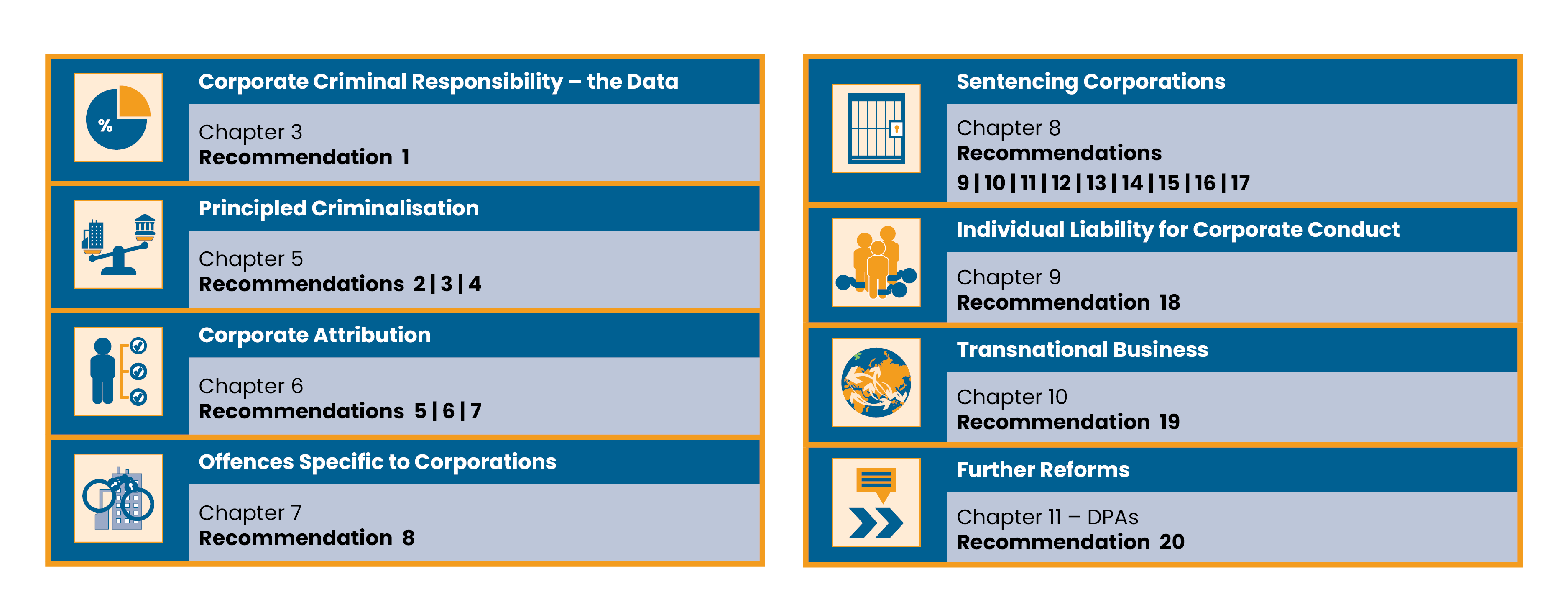
Recommendation 1 The Australian Government, together with state and territory governments, should develop national principles and policies for the collection, maintenance, and dissemination of criminal justice data.
Recommendation 2 Corporate conduct should be regulated primarily by civil regulatory provisions. A criminal offence should be created in respect of a corporation only when:
- denunciation and condemnation of the conduct constituting the offence is warranted;
- imposition of the stigma that should attach to criminal offending would be appropriate;
- the deterrent characteristics of a civil penalty would be insufficient;
- it is justified by the level of potential harm that may occur as a consequence of the conduct; or
- it is otherwise in the public interest to prosecute the corporation itself for the conduct.
Recommendation 3 Infringement notices should not be available as an enforcement response for criminal offences as applicable to corporations.
Recommendation 4 The Attorney-General’s Department (Cth) Guide to Framing Commonwealth Offences, Infringement Notices and Enforcement Powers should be amended to reflect Recommendations 2, 3, 5, and 8. All departments of state should be required to provide a detailed justification in the Explanatory Memorandum accompanying the relevant bill for any proposed offences that would apply to corporations and that do not comply with the Guide.
Recommendation 5 Commonwealth statutory provisions that displace Part 2.5 of the schedule to the Criminal Code Act 1995 (Cth) should be repealed, unless an alternative attribution method is necessary in the particular instance.
Recommendation 6 Section 12.2 of the schedule to the Criminal Code Act 1995 (Cth) should be amended such that a physical element of an offence is taken to be committed by a body corporate if committed by:
- an officer, employee, or agent of the body corporate, acting within actual or apparent authority; or
- any person acting at the direction, or with the agreement or consent (express or implied), of an officer, employee, or agent of the body corporate, acting within actual or apparent
Recommendation 7
Option 1
Section 12.3 of the schedule to the Criminal Code Act 1995 (Cth) should be amended to:
- replace ‘commission of the offence’ with ‘relevant physical element’;
- replace ‘high managerial agent’ with ‘officer, employee, or agent of the body corporate, acting within actual or apparent authority’ (with consequential amendments to s 3(4));
- replace ‘due diligence’with ‘reasonable precautions’(with consequential amendments to s 5);
- pluralise the terms ‘attitude’, ‘policy’, and ‘rule’ in the definition of ‘corporate culture’ and replace ‘takes’ with ‘take’; and
- repeal s 3(2)(d).
Option 2
Section 12.3 of the schedule to the Criminal Code Act 1995 (Cth) should be replaced with a provision to the effect that if it is necessary to establish a state of mind, other than negligence, of a body corporate in relation to a physical element of an offence, it is sufficient to show that:
- one or more officers, employees, or agents of the body corporate, acting within actual or apparent authority, engaged in the relevant conduct, and had the relevant state of mind; or
- one or more officers, employees, or agents of the body corporate, acting within actual or apparent authority, directed, agreed to or consented to the relevant conduct, and had the relevant state of
It is a defence, if the body corporate proves that it took reasonable precautions to prevent the commission of the offence.
Recommendation 8 Where appropriate, the Australian Government should introduce offences that criminalise contraventions of prescribed civil penalty provisions that constitute a system of conduct or pattern of behaviour by a corporation.
Recommendation 9 The Australian Government should implement Recommendations 4–1, 5–1, 6–1, and 6–8 of Same Crime, Same Time: Sentencing of Federal Offenders (ALRC Report 103, April 2006).
Recommendation 10 The Crimes Act 1914 (Cth) should be amended to require the court to consider the following factors when sentencing a corporation, to the extent they are relevant and known to the court:
- the type, size, and financial circumstances of the corporation;
- whether the corporation had a corporate culture conducive to compliance at the time of the offence;
- the extent to which the offence or its consequences ought to have been foreseen by the corporation;
- the involvement in, or tolerance of, the criminal activity by management;
- whether the unlawful conduct was voluntarily self-reported by the corporation;
- any advantage realised by the corporation as a result of the offence;
- the extent of any efforts by the corporation to compensate victims and repair harm;
- the effect of the sentence on third parties; and
- any measures that the corporation has taken to reduce the likelihood of its committing a subsequent offence, including:
- internal investigations into the causes of the offence;
- internal disciplinary action; and
- measures to implement or improve a compliance program.
This list should be non-exhaustive and should supplement, rather than replace, the general sentencing factors, principles, and purposes when implemented in accordance with Recommendation 9.
Recommendation 11 To maintain principled coherence and consistency in the assessment of penalties for corporations, a statutory provision should be enacted requiring the court to consider the following factors when making a civil penalty order in respect of a corporation, to the extent they are relevant and known to the court, in addition to any other matters:
- the nature and circumstances of the contravention;
- the deterrent effect that any order under consideration may have on the corporation or other corporations;
- any injury, loss, or damage resulting from the contravention;
- any advantage realised by the corporation as a result of the contravention;
- the personal circumstances of any victim of the contravention;
- the type, size, and financial circumstances of the corporation;
- whether the corporation has previously been found to have engaged in any related or similar conduct;
- whether the corporation had a corporate culture conducive to compliance at the time of the offence;
- the extent to which the contravention or its consequences ought to have been foreseen by the corporation;
- the involvement in, or tolerance of, the contravening conduct by management;
- the degree of voluntary cooperation with the authorities, including whether the contravention was self-reported;
- whether the corporation admitted liability for the contravention;
- the extent of any efforts by the corporation to compensate victims and repair harm;
- the effect of the penalty on third parties; and
- any measures that the corporation has taken to reduce the likelihood of its committing a subsequent contravention, including:
- any internal investigation into the causes of the contravention;
- internal disciplinary action; and
- measures to implement or improve a compliance program.
Recommendation 12 The Crimes Act 1914 (Cth) should be amended to provide that when sentencing a corporation that has committed a Commonwealth offence the court has the power to make one or more of the following:
- orders requiring the corporation to publicise or disclose certain information;
- orders requiring the corporation to undertake activities for the benefit of the community;
- orders requiring the corporation to take corrective action within the organisation, such as internal disciplinary action or organisational reform;
- orders requiring the corporation to facilitate redress of any loss suffered, or any expense incurred, by reason of the offence; and
- orders disqualifying the corporation from undertaking specified commercial activities.
A corresponding provision should be enacted in appropriate legislation to empower the court to make equivalent orders in respect of a corporation that has contravened a Commonwealth civil penalty provision.
Recommendation 13 The Crimes Act 1914 (Cth) should be amended to provide that the court may make an order dissolving a corporation if:
- the corporation has been convicted on indictment of a Commonwealth offence; and
- the court is satisfied that dissolution represents the only appropriate sentencing option in all the
Recommendation 14 The Corporations Act 2001 (Cth) should be amended to provide that a court may make an order disqualifying a person from managing corporations for a period of time that the court considers appropriate, if that person was involved in the management of a corporation that was dissolved in accordance with a sentencing order.
Recommendation 15 The Australian Government, together with state and territory governments, should develop a national debarment regime.
Recommendation 16 The Crimes Act 1914 (Cth) should be amended to empower the court to order a pre-sentence report for a corporation convicted under Commonwealth law.
Recommendation 17 Sections 16AAA and 16AB of the Crimes Act 1914 (Cth) should be amended to empower the court, when sentencing a corporation for a Commonwealth offence, to consider any victim impact statement made by a representative on behalf of:
- a group of victims; or
- a corporation that has suffered economic loss as a result of the
Recommendation 18 The Australian Government should undertake a wide- ranging review of the effectiveness of individual accountability mechanisms for corporate misconduct within five years of the entry into force of the proposed Financial Accountability Regime or equivalent. In undertaking such a review, consideration should be given to the effectiveness of:
- accessorial liability of individuals for corporate crimes and civil contraventions;
- directors’ and officers’ duties;
- specific duties imposed on directors and senior management of corporations to take reasonable measures or exercise due diligence to comply with or secure corporations’ compliance with statutory obligations;
- sector-specific accountability-mapping regimes such as the Banking Executive Accountability Regime and the proposed Financial Accountability Regime; and
- extended management liability provisions, including deemed liability and failure to prevent provisions.
Recommendation 19 The Australian Government should consider applying the failure to prevent offence in the Crimes Legislation Amendment (Combatting Corporate Crime) Bill 2019 to other Commonwealth offences that might arise in the context of transnational business.
Recommendation 20 The Crimes Legislation Amendment (Combatting Corporate Crime) Bill 2019 should be amended to:
- vest the power to approve a deferred prosecution agreement in a Judge of the Federal Court of Australia (if needs be as a persona designata);
- permit the parties to present oral submissions to the approving officer; and
- require the publication of the reasons for any approval in open court.
1. What is the Inquiry about?
The ALRC was asked by the Attorney-General of Australia, the Hon Christian Porter, to review the Commonwealth regime of corporate criminal responsibility – the detailed legal rules that determine when and in what circumstances a corporation may be found guilty of a crime.
2. What was the ALRC asked to review?
The Attorney-General, the Hon Christian Porter, asked the ALRC to review:
- the policy rationale for Part 2.5 of the Code;
- the efficacy of Part 2.5 of the Code as a mechanism for attributing corporate criminal liability;
- the availability of other mechanisms for attributing corporate criminal responsibility and their relative effectiveness, including mechanisms which could be used to hold individuals (eg senior corporate office holders) liable for corporate misconduct;
- the appropriateness and effectiveness of criminal procedure laws and rules as they apply to corporations; and
- options for reforming Part 2.5 of the Code or other relevant legislation to strengthen and simplify the Commonwealth corporate criminal responsibility regime.
View the Terms of Reference.
3. What is Part 2.5 in Schedule 1 of the Criminal Code Act 1995 (Cth)?
Part 2.5 sets out the legal tests for attributing the physical and fault elements of an offence to corporations. Corporate attribution rules enable offences, which are typically drafted with humans in mind, to apply to corporations. Part 2.5 sets out various ways to attribute criminal responsibility to a corporation. For instance, this may involve attributing the actions and states of mind of certain individuals, such as employees or agents, to the corporation. Alternatively, the corporate culture of a corporation can be used to determine whether the corporation had a particular state of mind.
See a description of Part 2.5 in Chapter 2 of the Final Report and the ALRC’s recommendation for reforming attribution in Chapter 6.
4. How are corporations regulated?
Corporations are subject to various forms of regulation. Legislation establishes standards of conduct and proscribes unlawful behaviour, whether through civil or criminal law. The corporate criminal responsibility regime comprises one part of Australia’s broader system of corporate regulation.
Standards of conduct can be enforced administratively, civilly, or criminally, depending on the particular contravention in question and the policy and strategy of the regulator. The regulation of corporations also involves private actors, such as through the law of contract.
When it comes to enforcing the criminal law, corporations are prosecuted very rarely in comparison to to individuals. Between 30 June 2009 and 30 June 2019, the Commonwealth Director of Public Prosecutions commenced only 13 cases against corporations for offences under the Criminal Code.
For a discussion on how corporations are regulated, see Chapter 5 of the Final Report. For further data on the incidence of corporate prosecutions, see Chapter 3.
5. How was the Inquiry conducted?
The Inquiry was led by Hon Justice SC Derrington, President of the ALRC, and the Hon Justices R J Bromwich and J E Middleton who were appointed by the Australian Government as Part-time Commissioners.
The ALRC received the Terms of Reference on 10 April 2019 from the Attorney-General. The ALRC asked for comments on the scope of the Inquiry and Terms of Reference, and received 14 comments from a variety of stakeholders. It appointed an Advisory Committee of experts in the area of corporate criminal responsibility.
The ALRC published a Discussion Paper on 15 November 2019 which set out proposals for reform and asked questions about particular areas of reform. The ALRC received 49 submissions in response to the Discussion Paper. Submissions were received from business groups, corporations, law firms, human rights organisations, and consumer representative NGOs.
Following the release of the Discussion Paper, the ALRC hosted a public seminar in Sydney in conjunction with Allens, entitled ‘Interrogating the English Approach to Prosecuting Corporate Crime’. The seminar was attended by over 75 guests comprising the legal profession, academics and the public. The keynote speakers were the Rt Hon the Lord Garnier QC, who as UK Solicitor-General was the architect of the Bribery Act 2010 (UK), and Mukul Chawla QC, a prominent English white-collar crime lawyer.
The ALRC hosted a series of seminars in Perth, Melbourne, Sydney, and Brisbane, where the ALRC welcomed over 290 attendees. Each seminar featured an expert panel that delved into the most contentious issues raised in the Discussion Paper.
Throughout the Inquiry, the ALRC engaged widely with a range of stakeholders, including enforcement authorities, regulators, courts, organisations, and the community. The ALRC conducted over 100 consultations with individuals and organisations. See Appendix A and B of the Final Report for a full list of those involved.
On 30 April 2020, the ALRC delivered the Final Report to the Attorney-General, the Hon Christian Porter. The report was tabled by the Attorney-General on 31 August 2020, at which time it became public.
6. What was the role of the Advisory Committee?
The Advisory Committee is composed of experts on corporate criminal responsibility who were tasked with assisting the ALRC to identify key issues, and to provide expert opinions and quality assurance in the research and consultation process. The ALRC engaged with the Advisory Committee closely prior to releasing the Discussion Paper and the Final Report.
7. How was the public involved?
The public was invited to comment on the scope of the Inquiry and the Terms of Reference, as well as to make submissions on the Discussion Paper. The ALRC’s public seminars in Perth, Melbourne, Sydney and Brisbane, following the release of the Discussion Paper, provided an opportunity for members of the public to ask questions and share their opinion on the proposals, contributing to the recommendations that were made in the Final Report.
8. What did the ALRC recommend?
The ALRC made 20 recommendations in the areas of: criminal justice data collection; principled criminalisation; corporate attribution; offences specific to corporations; sentencing corporations; individual liability for corporate conduct; transnational business; and deferred prosecution agreements. View the recommendations.
9. How do the recommendations address the problems with the current law?
Implementation of the recommendations contained in the Final Report will improve Australia’s corporate criminal responsibility regime. These recommendations will:
- result in simpler, clearer laws that reduce the regulatory compliance burden on corporations;
- better protect individuals from serious corporate misconduct by ensuring the criminal law, regulators, and law enforcement are focused on the most egregious criminal conduct;
- make corporations less likely to view civil penalties as merely a ‘cost of doing business’, by criminalising corporate systems of conduct or patterns of behaviour that lead to breaches of civil penalty provisions;
- standardise the legal tests for attribution of criminal responsibility to corporations, to provide greater certainty, consistency, and clarity;
- increase the range of penalty and sentencing options available in respect of corporate offenders to punish and rehabilitate criminal corporations more effectively;
- provide for judicial oversight of Australia’s proposed Deferred Prosecution Agreements scheme;
- make Australian corporations criminally responsible if they fail to prevent an associate from committing certain crimes overseas on their behalf;
- ensure mechanisms to hold directors and senior managers liable for corporate misconduct are monitored closely following recent judicial and legislative developments; and
- establish a national approach to the collection and dissemination of data relating to corporate crime, to facilitate the development of evidence-based criminal justice policy.
10. How does the Inquiry relate to the Financial Services Royal Commission?
Following the Financial Services Royal Commission, there are widespread concerns that corporations, and senior officers within those corporations, are not adequately held to account for serious corporate misconduct. The Royal Commission’s findings, and the response of regulators to those findings, suggest that corporations may be subject to greater legal and regulatory scrutiny than they have in the past and that there will a particular focus on litigating, rather than negotiating settlements.
The Terms of Reference asked the ALRC to consider the issues highlighted by the Royal Commission.
11. Where can I find the Final Report?
View the Corporate Criminal Responsibility Final Report.
12. Is there a shorter version of the Final Report?
View the Corporate Criminal Responsibility Summary Report.
13. What are the Data Appendices?
The Data Appendices consist of criminal justice data collated by the ALRC, as well as original and derivative data created by the ALRC. The Data Appendices are an important component of the evidence base for the recommendations set out in the Final Report. The Data Appendices consist of three key datasets, including:
- a review of 25 statutes relevant to regulating corporate conduct;
- quantitative data on how Commonwealth agencies investigate and prosecute corporate crime; and
- data that statistics agencies and courts provided on corporate criminal prosecutions in federal and state courts.
14. Who can I contact to discuss the Final Report?
Please send us an email at [email protected].
Public engagement with the ALRC Corporate Criminal Responsibility Inquiry.
- Professor Farrah Ahmed, Melbourne Law School
- Professor Rufus Black, Vice-Chancellor, University of Tasmania
- Professor Andrea Durbach, University of New South Wales
- Professor Sarah Joseph, Director for the Castan Centre for Human Rights Law, Monash University
- Mr Pat Mullins, Partner, Mullins Lawyer and Chancellor, RC Archdiocese of Brisbane
- Ms Elizabeth Raper SC, Barrister, 5 Wentworth Chambers
- The Hon. Justice Stephen Rothman AM, Justice of the Supreme Court of NSW
Comments on Terms of Reference
3. Associate Professor Cathy Sherry
5. Associated Christian Schools
6. Public Interest Advocacy Centre
8. Christian Schools Australia
10. Australian Christian Higher Education Alliance
The ALRC has prepared a short background paper for this inquiry.
10 April 2019 – Terms of Reference received
10 April 2019 – Call for comments on scope of inquiry and Terms of Reference
10 May 2019 – Comments on Terms of Reference closed
29 August 2019 – Amended Terms of Reference received
2 March 2020 – Reporting date amended
TBA – Discussion Paper to be released
TBA – Submissions to Discussion Paper to close
Twelve months from the date the Religious Discrimination Bill is passed by Parliament – Report due to the Attorney-General