The Final Report of the Review of Surrogacy Laws was tabled in the Commonwealth Parliament on 17 November 2026.
Download the Final Report | Download the Summary Report
President’s Message
 Surrogacy has long been an accepted form of family formation in every Australian state and territory for people who may otherwise be unable to have children. Yet Australia’s current patchwork of state and territory laws makes domestic surrogacy unnecessarily difficult and uncertain, do not adequately protect the rights of children and surrogates, and can leave surrogates financially disadvantaged. These barriers are also likely contributing to Australians pursuing overseas surrogacy, where the risks of exploitation and other forms of harm can be substantially greater.
The outcome of our Review is this Final Report, Enhancing Responsible Access: An Effective Regulatory Framework for Surrogacy. In preparing the Report, the ALRC received hundreds of submissions and consulted widely. Our 47 recommendations for reform provide a blueprint for a nationally consistent surrogacy framework that is both more accessible and more protective.
Fundamentally, the Report recognises that good surrogacy laws should enable people to form families through surrogacy where it can be undertaken responsibly, while providing effective safeguards against exploitation and harm. If implemented, our recommendations would better support Australians to form families through surrogacy within Australia, protect the rights of children, surrogates and intended parents, and provide more effective regulation of overseas surrogacy. I invite you to read our Report and consider our recommendations for reform.
– Justice Mordy Bromberg
President, Australian Law Reform Commission
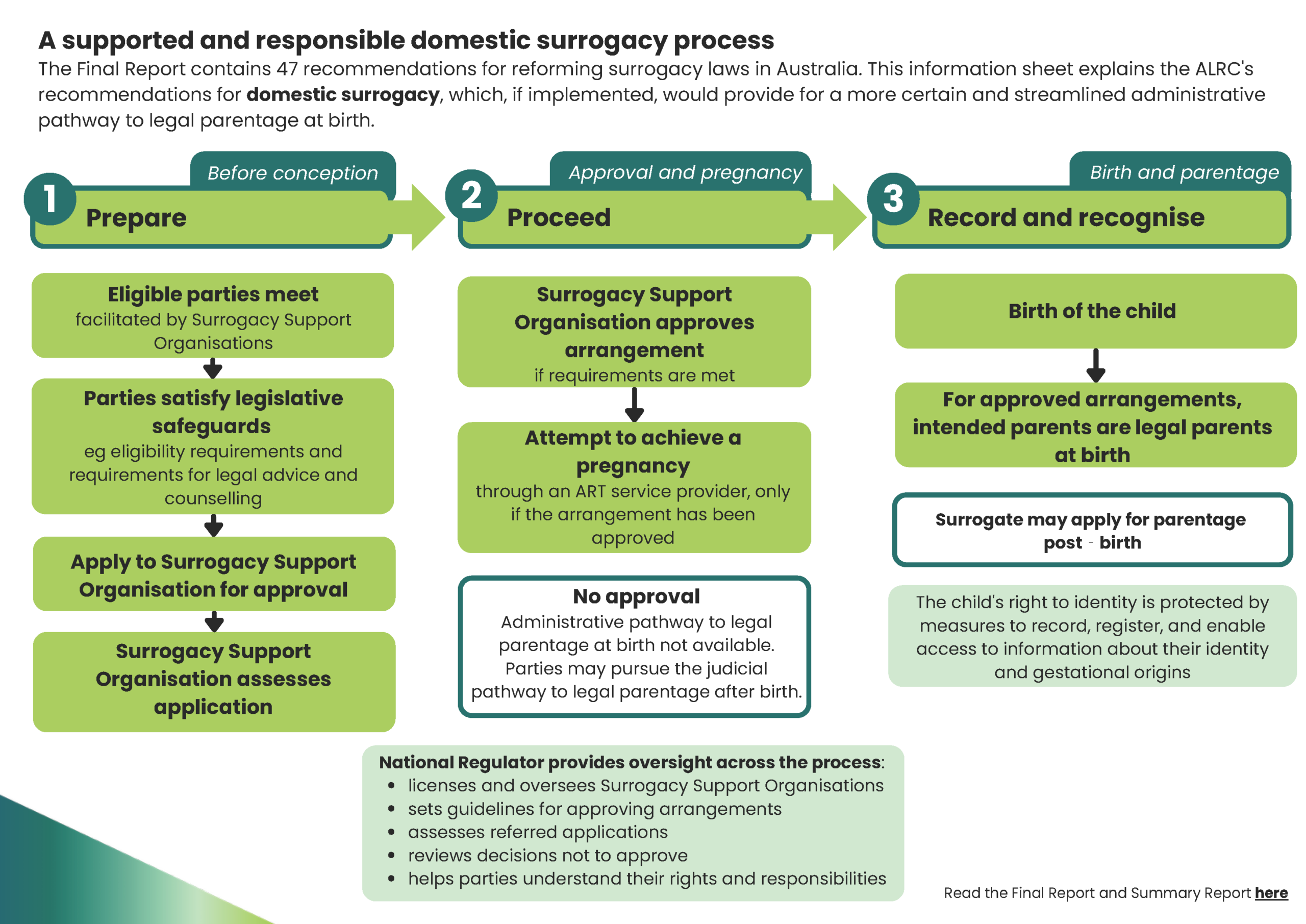
Key findings
A webinar briefing is scheduled for 1pm AEDT on Friday 20 November 2026. Hear from ALRC President Justice Mordy Bromberg, and Assistant Commissioner for the Inquiry, Associate Professor Ronli Sifris in a conversation moderated by ALRC Executive Director Ruth Barson, on the Inquiry, the report, and the ALRC’s recommendations for reform.
Questions can be submitted in advance either via the registration form or by emailing [email protected].
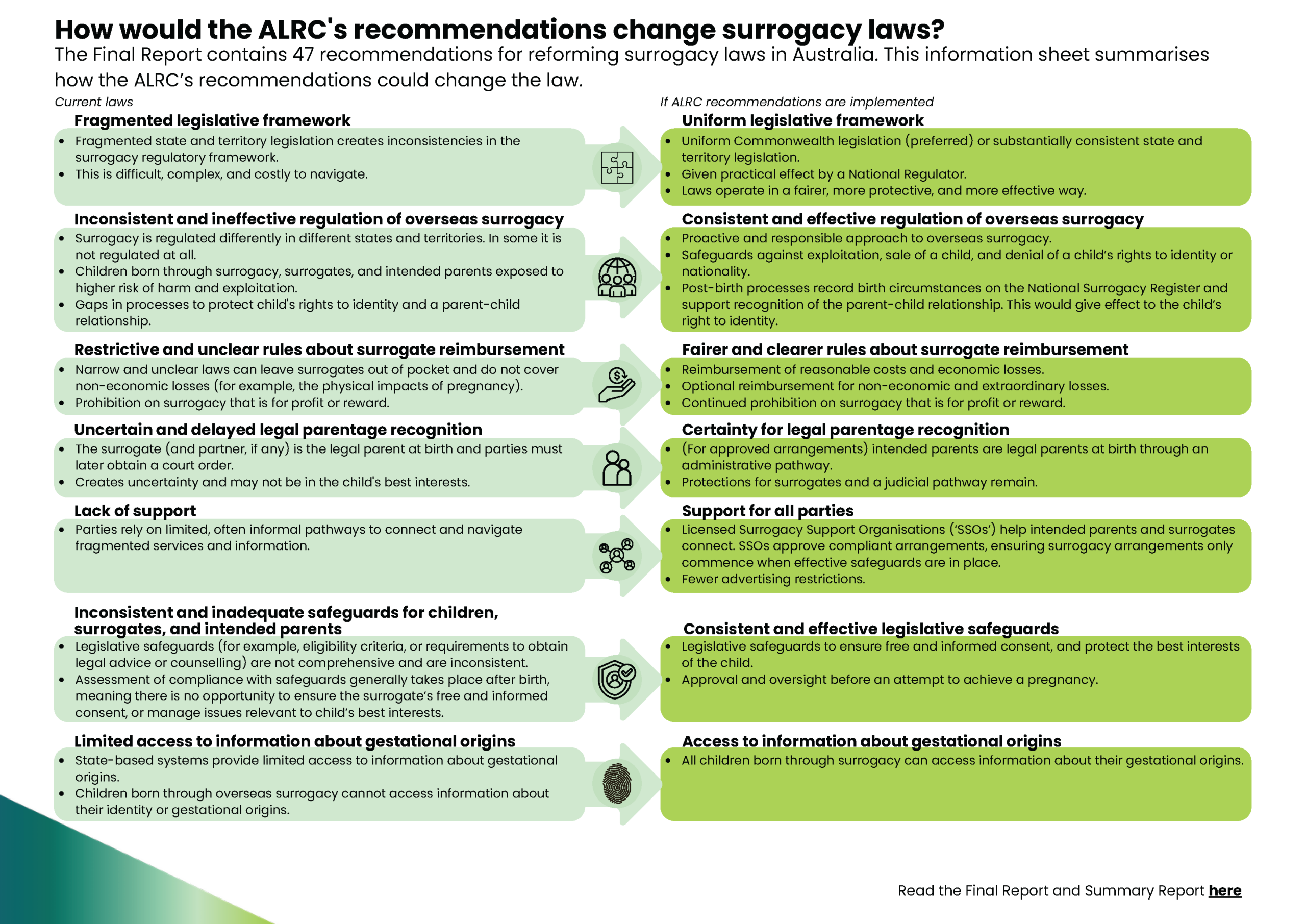
The ALRC found that Australia’s current patchwork of state and territory laws makes domestic surrogacy unnecessarily difficult and uncertain for intended parents, does not adequately protect the rights of children and can leave surrogates financially disadvantaged. The ALRC finds that these barriers are likely contributing to Australians pursuing overseas surrogacy – which now accounts for around 80% of surrogacy arrangements in Australia. Overseas surrogacy is either poorly regulated or unregulated, and the risks of exploitation and other forms of harm can be substantially greater.
The ALRC recommends a nationally consistent framework designed to make well-regulated domestic surrogacy more accessible and fair, strengthen safeguards for all involved, and provide more effective regulation of overseas surrogacy undertaken by Australians.
Listen to an overview of the Review of Surrogacy Laws and its Final Report, in a conversation between ALRC Executive Director Ruth Barson and Principal Legal Officer Jacinth Pathmanathan (approx 14 min).
Chapters and Recommendations
Key reforms recommended in the report include:
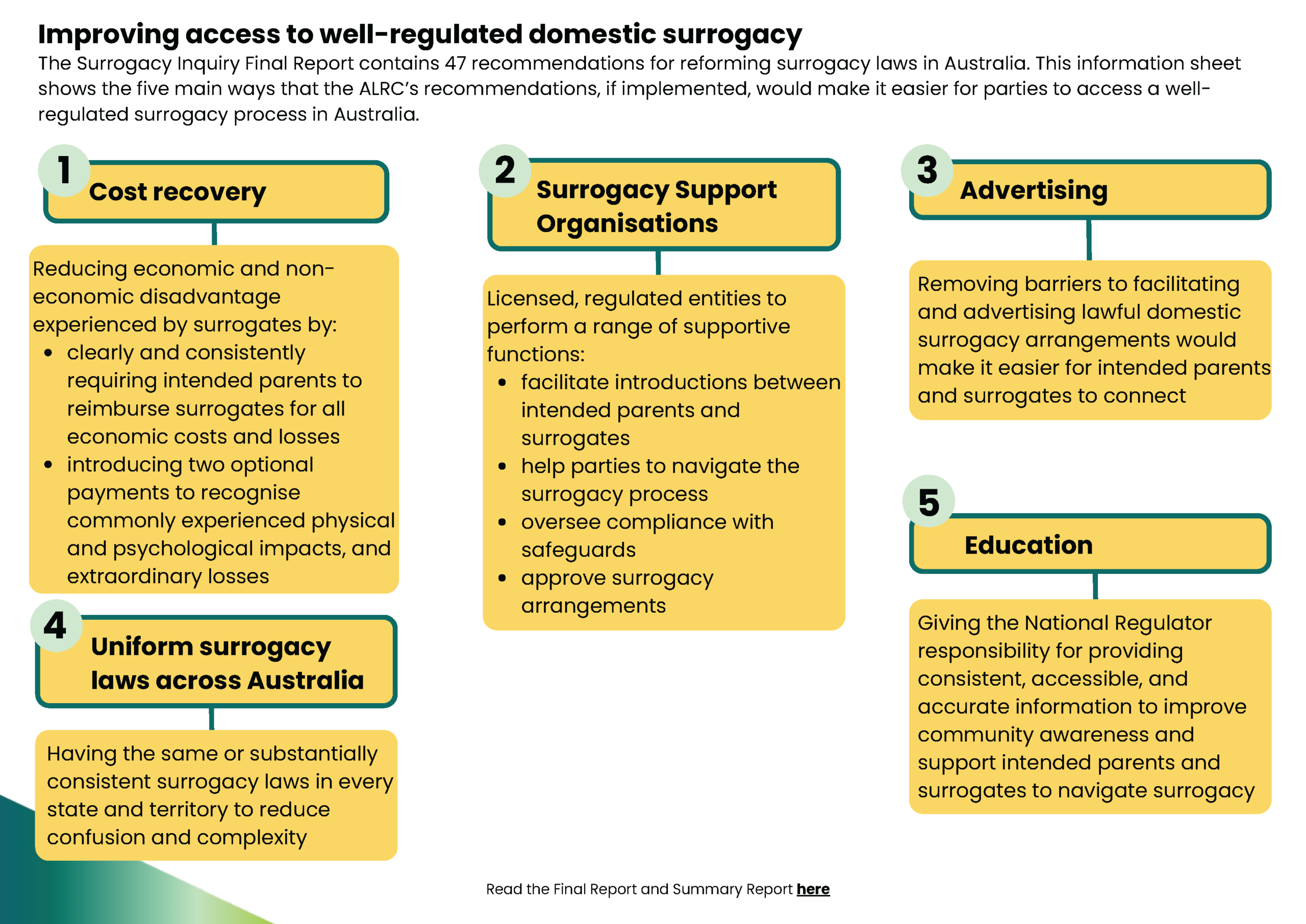
- Creating a nationally consistent surrogacy framework, with a National Regulator to provide oversight, guidance and consistent administration.
- Making domestic surrogacy easier to access, including through licensed, fee-capped ‘Surrogacy Support Organisations’.
- Protecting surrogates from financial disadvantage, while retaining the prohibition on surrogacy for profit or reward.
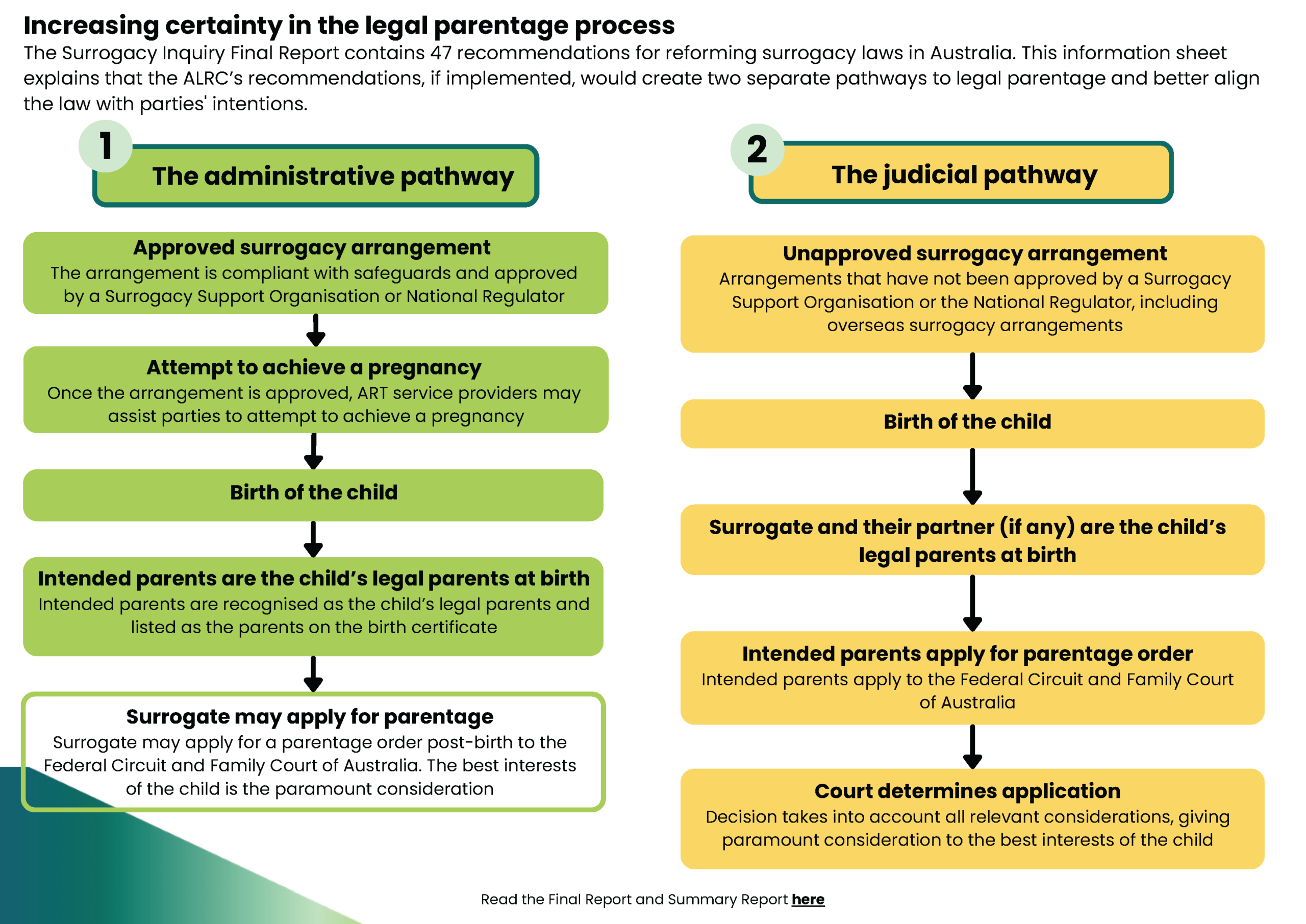
- Providing greater certainty about legal parentage, including an administrative pathway for approved domestic arrangements that comply with the safeguards.
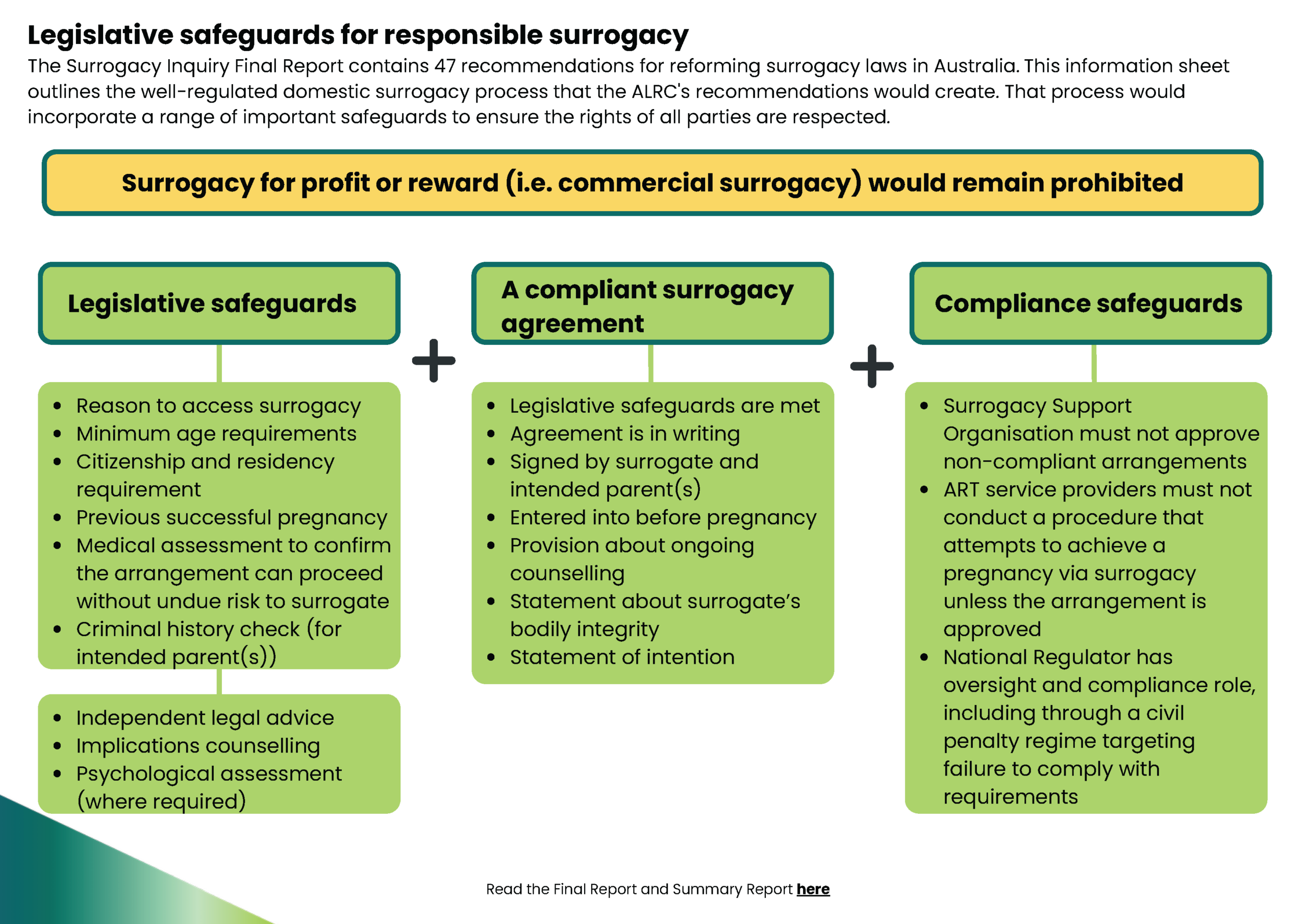
- Strengthening safeguards before surrogacy commences, including requirements relating to independent legal advice, counselling, medical screening, criminal history checks for intended parents, and a compliant written surrogacy agreement.
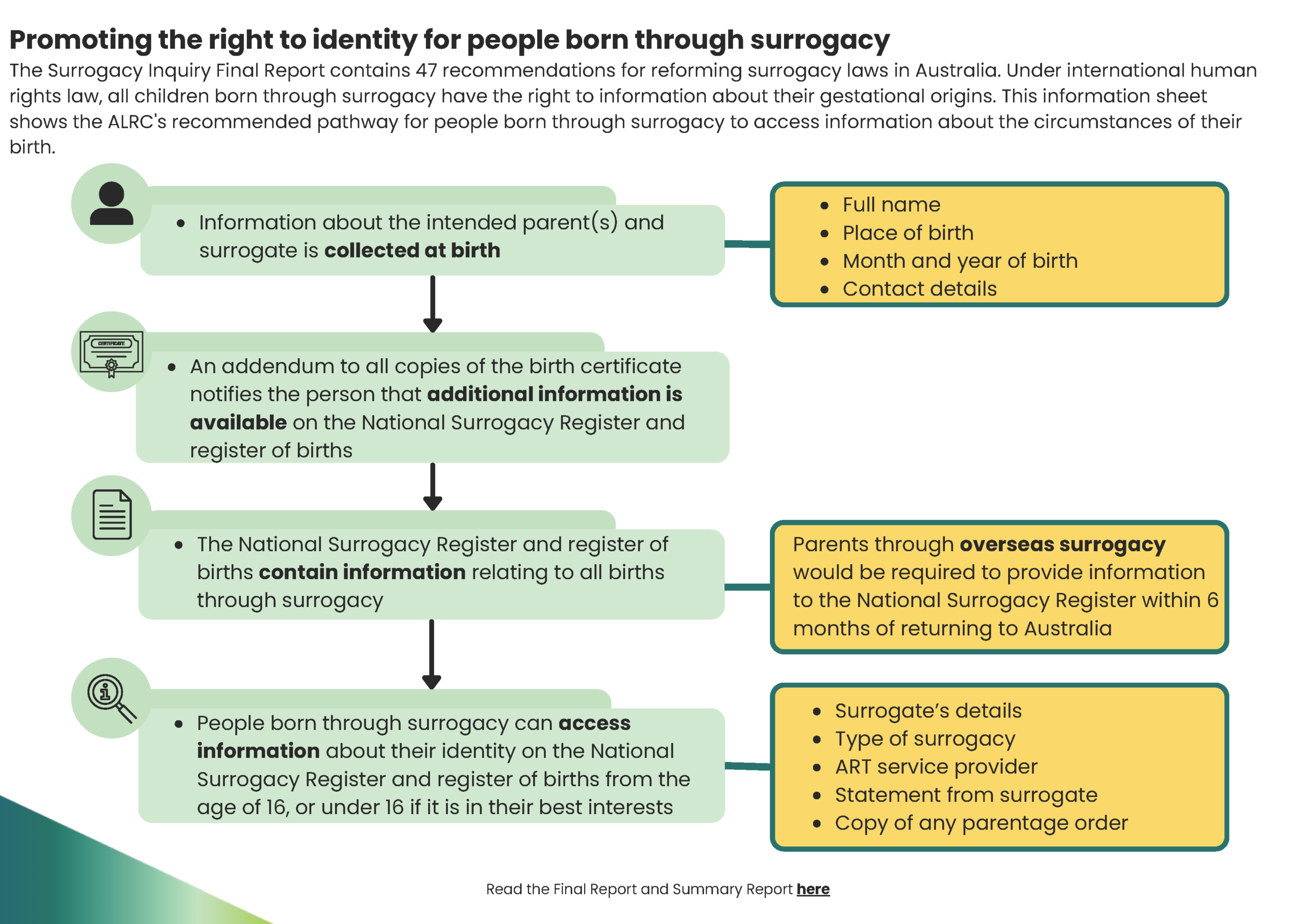
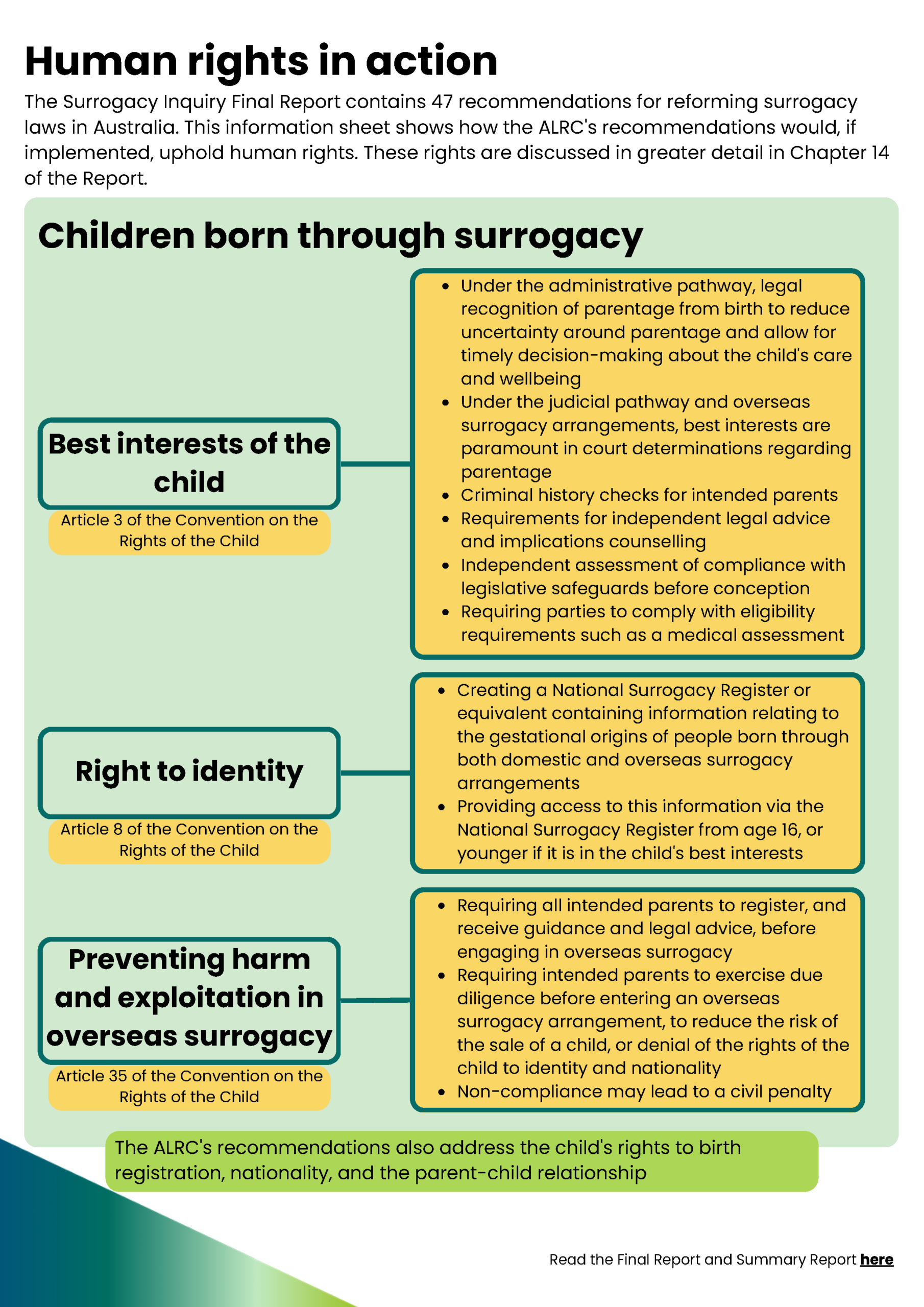
- Establishing a National Surrogacy Register, to better protect the right of children born through surrogacy to information about their identity.
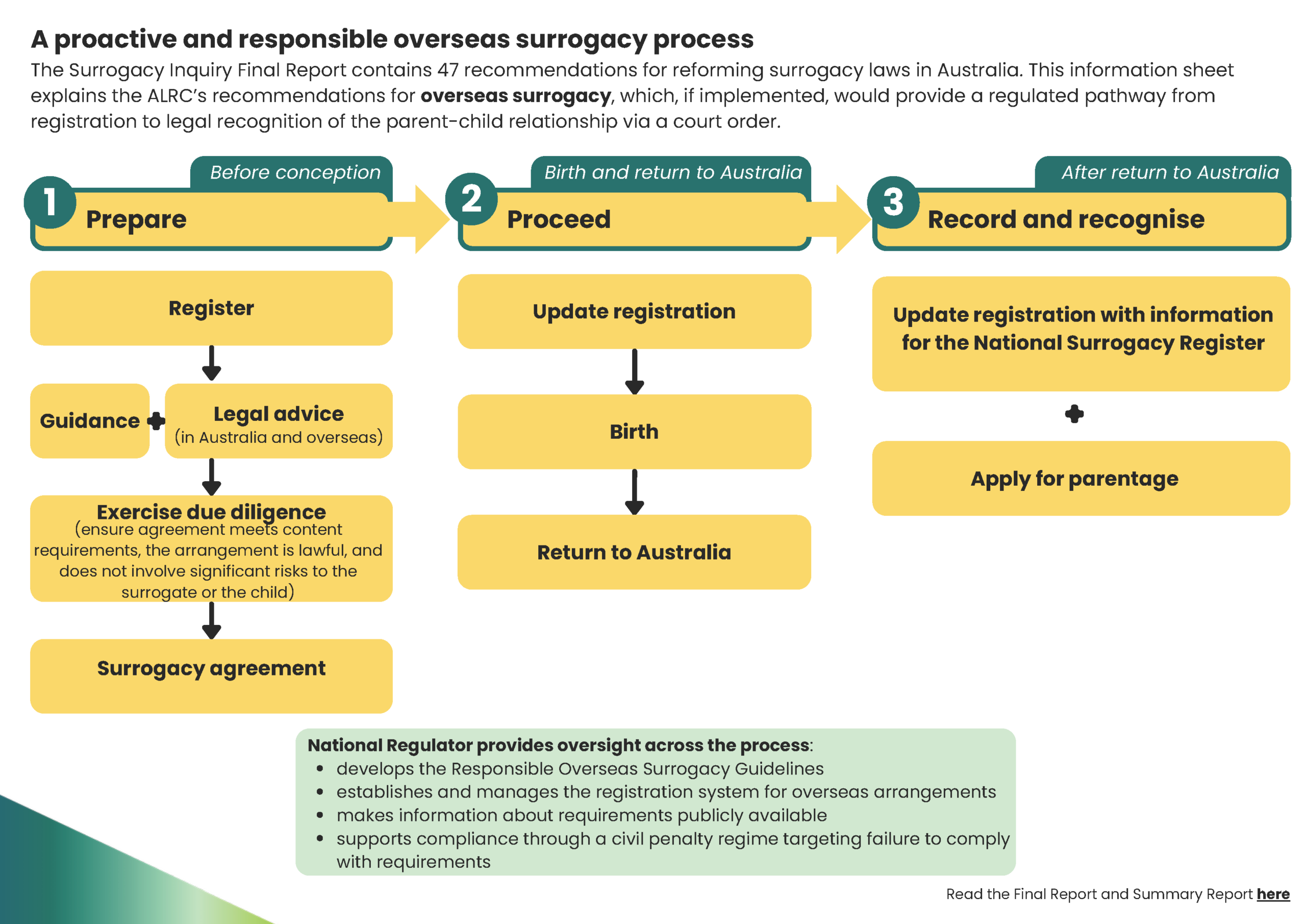
- Introducing a new national framework for overseas surrogacy, requiring intended parents to register before entering an overseas arrangement, obtain official guidance and Australian and overseas legal advice, and take reasonable steps to avoid arrangements involving significant risks.
- Replacing ineffective criminal prohibitions with more enforceable civil penalties and nationally-consistent oversight.
Read the detailed recommendations below, along with an overview of each chapter in the Final Report.
Chapter 1 | Introduction and Executive Summary
Chapter 1 introduces the Review, the Australian surrogacy landscape and the principal problems with the existing legal framework. The chapter explains the Report’s overarching focus on improving access to responsible domestic surrogacy, protecting the rights and interests of children, surrogates, and intended parents, and addressing risks associated with overseas surrogacy.
Chapter 2 | Prohibiting Domestic Surrogacy that is for Profit or Reward (Recommendations 1–2)
Chapter 2 examines the distinction between surrogacy that is not for profit or reward, which is permitted in Australia, and surrogacy for profit or reward, which is prohibited. The chapter considers the rationale for that distinction, what conduct should fall within the prohibition, and how the prohibition should be enforced.
Recommendation 1
1. Legislation should provide that intended parents and surrogates are prohibited from engaging in a domestic surrogacy arrangement for profit or reward (‘prohibited domestic surrogacy arrangement’).
2. Legislation should provide that non-compliance with the prohibition in paragraph 1 will result in liability to a civil penalty.
3. Existing criminal offences that prohibit ‘commercial surrogacy’ (or equivalent) should be repealed.
Recommendation 2
1. Legislation should provide that individuals and organisations, including Surrogacy Support Organisations (Recommendation 8), are prohibited from directly, intentionally or recklessly:
- facilitating, or attempting to facilitate, a prohibited domestic surrogacy arrangement (Recommendation 1); or
- advertising or otherwise promoting engagement in a prohibited domestic surrogacy arrangement (Recommendation 1).
2. Legislation should provide that the prohibitions in paragraph 1 should not apply to:
- a legal professional providing legal advice; or
- any person providing medical or other assistance to a surrogate in order to avoid or address injury or harm to the surrogate’s health.
3. Legislation should provide that non-compliance with the prohibitions in paragraph 1 will result in liability to a civil penalty.
4. Existing criminal offences that prohibit the facilitation (or equivalent)
Chapter 3 | A National Regulatory Framework (Recommendations 3–7)
Chapter 3 examines the problems created by Australia’s inconsistent state and territory surrogacy laws and the case for greater national consistency. The chapter considers how a national framework could be structured and administered, including the role of national regulation and oversight, consistent standards and guidelines, public information, data collection, and regulatory enforcement.
Recommendation 3
1. The Australian, state, and territory governments should enact a legal and regulatory framework for surrogacy that reflects the recommendations in this Report.
2. The legal and regulatory framework should be either uniform under Commonwealth legislation (preferred) or substantially consistent across state and territory laws (Recommendation 4).
3. This legislation should establish and empower a National Regulator to hold the responsibilities and carry out the functions outlined in Recommendation 6.
4. This legislation should establish a civil penalty regime and empower an appropriate court or courts to impose civil penalties and provide associated relief to address non-compliance with the prohibitions or obligations proposed by Recommendations 1–2, 33–35, 38 and 40–45.
5. The legal and regulatory framework should be structured so that:
- the substance of any obligation, right, entitlement, or prohibition conferred or imposed is dealt with in legislation; and
- any necessary corresponding detail is set out in delegated legislation, guidelines, or standards set by the National Regulator (Recommendation 6).
Recommendation 4
1. To implement the preferred approach in Recommendation 3, the Australian, state, and territory governments should enter into an intergovernmental agreement to refer appropriate powers to the Commonwealth Parliament. The Australian Government should then enact Commonwealth surrogacy legislation.
2. In the event that a referral of powers to the Commonwealth is not achievable, the Commonwealth, states, and territories should enter into an intergovernmental agreement to enact nationally consistent surrogacy laws through mirror, hybrid, or applied legislation.
3. Legislation developed under any of the options in paragraphs 1 or 2 should adopt consistent and updated terminology.
Recommendation 5
Legislation should require a statutory review of the operation of the legal and regulatory framework for surrogacy (Recommendation 4) after an appropriate period (between five to seven years).
Recommendation 6
1. Legislation should establish and empower a national regulator for surrogacy, or alternatively, empower an existing national regulator (collectively ‘the National Regulator’) to hold the following responsibilities and carry out the following functions:
Standard setting
- setting licensing conditions for Surrogacy Support Organisations (Recommendation 8);
- setting and maintaining a mandatory scale of maximum fees that Surrogacy Support Organisations may charge for their services;
- developing guidelines on approving surrogacy arrangements to be applied by Surrogacy Support Organisations and the National Regulator (Recommendation 9);
- developing guidelines on applications to be referred by Surrogacy Support Organisations to the National Regulator or assessed by the National Regulator (Recommendation 9);
- developing and maintaining standards, guidelines, and processes on cost and loss recovery for surrogates (Recommendations 23–25);
- developing a standardised draft surrogacy agreement that parties may use as a basis for a compliant surrogacy agreement (Recommendation 20);
- developing the Responsible Overseas Surrogacy Guidelines (Recommendation 37);
Compliance
- licensing Surrogacy Support Organisations, including monitoring compliance with licensing conditions and taking appropriate action, including revoking a licence in response to any breaches of conditions that warrant revocation;
- inspecting Surrogacy Support Organisation records for the purpose of monitoring compliance with licensing conditions;
- accrediting Surrogacy Support Organisation staff members to conduct assessments and make decisions in relation to applications to approve surrogacy arrangements;
- enforcing compliance through the civil penalty regime enacted by legislation (Recommendation 3);
Oversight of surrogacy arrangements
- assessing applications to approve surrogacy arrangements referred by Surrogacy Support Organisations or remitting the application back to the Surrogacy Support Organisation for assessment (Recommendation 9);
- reviewing Surrogacy Support Organisation decisions not to approve a surrogacy arrangement, at the request of a party to the surrogacy arrangement (Recommendation 9);
- keeping records of surrogacy arrangements approved by a Surrogacy Support Organisation or the National Regulator (Recommendation 9);
- establishing and managing a registration system for all overseas surrogacy arrangements (Recommendation 37);
- improving research and data collection on domestic and overseas surrogacy arrangements, in particular to address any gaps in surrogacy data;
Community awareness and information provision
- developing information and educating the public about surrogacy (Recommendation 7);
- developing educational material for professionals who provide services to parties to surrogacy arrangements (Recommendation 7); and
- managing the National Surrogacy Register and providing information held on the Register to people born through surrogacy (Recommendations 31–32).
2. In the event that a national regulator for surrogacy is not established or an existing national regulator is not empowered to perform the responsibilities and functions listed in paragraph 1, the Commonwealth, states, and territories should place these responsibilities and functions with existing regulatory bodies or departments. An intergovernmental agreement should be entered into to facilitate national consistency in the performance of the responsibilities and functions listed in paragraph 1 including, in particular, the standard-setting and compliance functions.
Recommendation 7
1. In carrying out its community awareness and information provision function (Recommendation 6), the National Regulator should publish and promote information to:
- educate the public and increase understanding about surrogacy and address common misunderstandings about surrogacy and Australia’s surrogacy laws;
- inform intended parents and surrogates about surrogacy in Australia and Australia’s surrogacy laws;
- inform the public, and specifically intended parents, about surrogacy laws, policies, and practices overseas, and associated risks; and
- inform the public, and specifically intended parents, about the Responsible Overseas Surrogacy Guidelines and the requirement to register their intention to engage in an overseas surrogacy arrangement (Recommendations 37 and 38).
2. In carrying out its community awareness and information provision function, the National Regulator should also develop educational materials for professionals who provide services in surrogacy arrangements. This should include:
- guidelines for providing appropriate and inclusive care in surrogacy arrangements, to be adopted by healthcare providers such as hospitals and medical professionals; and
- training or training materials on surrogacy and surrogacy laws for professionals, such as Surrogacy Support Organisation management and staff (Recommendation 8), lawyers, healthcare professionals, and counsellors.
Chapter 4 | Support and Approval (Recommendations 8–10)
Chapter 4 explores how surrogates and intended parents find each other, the supports available to them through the surrogacy process, and how compliance with surrogacy laws is assessed. The chapter considers the need for structured support throughout the surrogacy journey and an approval process that ensures appropriate safeguards have been satisfied before an arrangement proceeds.
Recommendation 8
Legislation should empower the National Regulator to license Surrogacy Support Organisations to provide, in accordance with the licensing conditions set by the National Regulator (Recommendation 6), the following supports and implement the following safeguards for intended parents and surrogates:
- facilitating introductions for, or ‘matching’ of, intended parents and surrogates who meet the requirements in Recommendations 11–14;
- coordinating the counselling and other services that need to be engaged with to meet eligibility and process requirements (Recommendations 15–19);
- assessing and approving compliant surrogacy arrangements, or referring ‘complex applications’ to the National Regulator (Recommendation 9);
- providing information, case management, and support for intended parents and surrogates throughout the surrogacy arrangement;
- notifying parties about their right to request a psychological assessment (Recommendation 19); and
- facilitating conflict resolution between intended parents and surrogates.
Recommendation 9
1. Legislation should provide that Surrogacy Support Organisations (Recommendation 8), and where applicable, the National Regulator (Recommendation 6) (collectively, ‘an approval body’), should be empowered to approve compliant surrogacy arrangements.
2. Legislation should provide that to access the administrative pathway (Recommendation 28), parties to a surrogacy arrangement must obtain approval from an approval body before attempting to achieve a pregnancy.
3. Legislation should provide that:
- before granting approval to access the administrative pathway, an approval body must assess all supporting evidence provided by the parties to a surrogacy arrangement in accordance with guidelines developed by the National Regulator (Recommendation 6) and be satisfied that they meet all the preconditions in Recommendations 11–20;
- where a Surrogacy Support Organisation is not satisfied that the parties to a surrogacy arrangement have met all the preconditions in Recommendations 11–20, it must not approve the surrogacy arrangement. The parties may seek to have that arrangement reviewed by the National Regulator; and
- the National Regulator may dispense with a precondition in Recommendations 11–20 if satisfied that a minor procedural irregularity has occurred, or that exceptional circumstances exist justifying approval of the arrangement.
4. The process for approving surrogacy arrangements in paragraph 3 should incorporate the following elements:
- Parties to a surrogacy arrangement may seek approval from a Surrogacy Support Organisation, regardless of whether the arrangement was facilitated by a Surrogacy Support Organisation.
- Surrogacy Support Organisations must refer all ‘complex applications’ (paragraph 7) to the National Regulator, as a condition of their licensing (Recommendation 8), unless the parties do not wish the arrangement to proceed.
- The National Regulator may remit a ‘complex application’ back to a Surrogacy Support Organisation for approval (Recommendation 6).
- Applications to Surrogacy Support Organisations must be assessed and determined by a staff member accredited by the National Regulator (Recommendation 6).
5. Legislation should provide that for a transitional period of two years from commencement, or a further period if prescribed, the National Regulator may assess and approve primary applications submitted by the parties without the involvement of a Surrogacy Support Organisation.
6. Legislation should provide that when an approval body assesses a surrogacy arrangement for approval:
- the completion of a process required by an assisted reproductive technology service provider, which would also satisfy a precondition for a surrogacy arrangement, discharges that precondition;
- there should be a presumption in favour of approval where the parties meet all the preconditions; and
- an approval body should review surrogacy arrangements ‘on the papers’. Meetings with the parties should only occur where an approval body considers them necessary.
7. Legislation should provide that applications should be treated as ‘complex applications’, and be referred by a Surrogacy Support Organisation to the National Regulator, where:
- as part of any psychological assessment, the psychologist recommends that the surrogacy arrangement should not proceed or the psychologist is unable to make a recommendation but identifies risk factors in their report (Recommendation 19); or
- the Surrogacy Support Organisation considers that the application otherwise raises complex issues as identified in guidelines developed by the National Regulator (Recommendation 6).
Recommendation 10
1. Legislation should provide that when a surrogacy arrangement has been approved (‘approved surrogacy arrangement’):
- the approved surrogacy arrangement may proceed on the administrative pathway, and the intended parent(s) will be the child’s legal parent(s) at birth (Recommendation 28);
- the Surrogacy Support Organisation must lodge the approved surrogacy arrangement with the National Regulator (Recommendation 6);
- the approval applies to any embryo transfer or attempt to achieve a pregnancy carried out as part of the approved surrogacy arrangement; and
- the approval body may issue a document certifying that the arrangement is an approved surrogacy arrangement for the purposes of the administrative pathway to legal parentage, and explaining that the legal consequence is that the intended parent(s) will be the child’s legal parent(s) at birth.
2. Legislation should provide that a surrogacy arrangement that is not approved by the Surrogacy Support Organisation or the National Regulator (‘unapproved surrogacy arrangement’) cannot proceed on the administrative pathway to legal parentage, but may proceed via the judicial pathway to legal parentage (Recommendation 29).
Chapter 5 | Accessing Surrogacy — Eligibility (Recommendations 11–16)
Chapter 5 considers who should be eligible to participate in domestic surrogacy arrangements and the circumstances in which surrogacy should be available. The chapter examines the requirements that intended parents and surrogates would need to meet to have their arrangement approved, including age, residency, previous pregnancy experience, medical circumstances, and criminal history.
Recommendation 11
As a precondition for approval (Recommendation 9), intended parents must be unlikely to conceive, gestate, or give birth to a child for a medical, biological, or psychological reason.
Recommendation 12
As a precondition for approval (Recommendation 9):
- a surrogate must be at least 25 years old, unless otherwise approved by an accredited counsellor, and have the legal capacity to make an informed decision; and
- intended parents must be at least 18 years old and have the legal capacity to make an informed decision.
Recommendation 13
1. As a precondition for approval (Recommendation 9) at least one intended parent and the surrogate must be an Australian citizen or permanent resident.
2. State or territory legislation that imposes state or territory-based residency requirements should be repealed.
Recommendation 14
1. As a precondition for approval (Recommendation 9) the surrogate must have previously carried a pregnancy and given birth to a live child.
2. The requirement in paragraph 1 may be dispensed with in circumstances where:
- the obstetrician conducting the medical screening (Recommendation 15) is satisfied that the surrogacy can proceed without undue risk to the surrogate’s health; and
- the counsellor conducting the implications counselling (Recommendation 18) is satisfied that the surrogate and the intended parent(s) understand the potential risks associated with the surrogacy arrangement and are making a free and informed decision to continue with the arrangement.
Recommendation 15
As a precondition for approval (Recommendation 9):
- the surrogate must undergo a medical assessment by an independent obstetrician;
- the obstetrician must certify that the surrogacy can proceed without undue risk to the surrogate’s health; and
- the obstetrician must provide the certification to the surrogate and the surrogate’s nominated Surrogacy Support Organisation (Recommendation 8), so that the certification can be considered as part of the approval process (Recommendation 9).
Recommendation 16
As a precondition for approval (Recommendation 9):
- the intended parent(s) must undergo a Nationally Coordinated Criminal History Check;
- the report from the Nationally Coordinated Criminal History Check must indicate that no offences have been committed by the intended parent(s) against a child, including child exploitation offences; and
- the report from the Nationally Coordinated Criminal History Check must be provided to the intended parents’ nominated Surrogacy Support Organisation (Recommendation 8), so that the report can be considered as part of the approval process (Recommendation 9).
Chapter 6 | Accessing Surrogacy — Process Requirements (Recommendations 17–19)
Chapter 6 examines the steps parties should take before entering a surrogacy arrangement to ensure that their decisions are informed, voluntary, and appropriately considered. The chapter discusses independent legal advice, counselling, and psychological assessment, and how these process requirements would be used to help parties understand the legal, emotional, and practical implications of surrogacy.
Recommendation 17
1. As a precondition for approval (Recommendation 9), all parties must receive independent legal advice. The advice must cover:
- the surrogate’s bodily integrity, autonomy (Recommendation 21), and the legal requirement for free and informed consent in relation to medical treatment or procedures that directly affect them;
- legal parentage under the administrative pathway or the judicial pathway, including the timing and effect of the surrogate’s consent, and the right to apply for a parentage order (Recommendations 28–29);
- the operation and enforceability of the cost and loss recovery provisions in the surrogacy agreement (Recommendations 23–24); and
- the right of the child born through surrogacy to know their genetic and gestational origins, including their right to access registered information (Recommendations 30–32).
2. Legislation should provide that the legal practitioner providing the advice must provide each party with written confirmation that the matters outlined in paragraph 1 were discussed, the requisite advice was provided, and the legal practitioner believes the party appeared to understand the advice, so that it can be considered as part of the approval process (Recommendation 9).
3. Law societies in each jurisdiction should develop and provide accreditation for lawyers who provide legal advice on surrogacy arrangements.
Recommendation 18
1. As a precondition for approval (Recommendation 9), all parties, and the surrogate’s partner (if any), must undergo counselling. The counselling must:
- be provided by a counsellor, who is a full member of the Australian and New Zealand Infertility Counsellors Association;
- include at least:
- two independent counselling sessions with the intended parent(s);
- one independent counselling session with the surrogate;
- one independent counselling session with the surrogate and the surrogate’s partner (if any); and
- a joint counselling session with the intended parent(s), the surrogate, and the surrogate’s partner (if any);
- be provided by the same counsellor for all sessions, unless it is impracticable to do so; and
- include discussion of the following matters:
- the implications of the surrogacy arrangement for the relationships between the parties and their respective families;
- the attitudes of the parties to genetic screening, possible termination of pregnancy, and any other complications that may arise during medical treatment, pregnancy, or birth;
- the possibility of any party changing their mind regarding who should parent the child born through the arrangement;
- the attitudes of the parties towards the conduct of the pregnancy, including the extent to which the intended parent(s) should have input into the surrogate’s lifestyle choices during the pregnancy;
- the implications if the intended parents separate during the surrogacy arrangement;
- the attitudes of the parties relating to how and when the child should be told about their genetic and gestational origins;
- the attitudes of the parties to the surrogate or the surrogate’s family having an ongoing relationship or contact with the child born through the surrogacy arrangement, and the extent of such contact;
- how the parties will resolve any disputes that arise during the surrogacy arrangement;
- where the proposed arrangement is a traditional surrogacy arrangement, the implications of a traditional surrogacy arrangement, including the surrogate’s role as both surrogate and egg donor; and
- any other circumstances relevant to assessing the suitability of the arrangement to proceed.
2. Legislation should provide that if during the counselling process the counsellor identifies risk factors that may affect whether the arrangement should be approved (Recommendation 9), the counsellor must notify the parties’ nominated Surrogacy Support Organisation (Recommendation 8) of those risks.
3. Legislation should provide that the counsellor must advise the parties that ongoing counselling is available to them — individually and collectively — throughout the course of the arrangement and for up to three months following the birth of any child born (or stillborn) through the surrogacy arrangement. Ongoing counselling may be initiated at the reasonable election of any party to the surrogacy arrangement (Recommendations 20 and 23).
4. Legislation should provide that the counsellor must provide each party with written confirmation that the matters outlined in paragraph 1(d) were discussed, and that the counsellor believes the party appeared to understand the counselling and the personal consequences of the surrogacy arrangement, so that it can be considered as part of the approval process (Recommendation 9).
Recommendation 19
1. As a precondition for approval (Recommendation 9), the surrogate and the intended parent(s) must undergo a psychological assessment where:
- any party to a proposed surrogacy arrangement requests such an assessment; or
- the Surrogacy Support Organisation (Recommendation 8) requires such an assessment (paragraph 3).
2. Legislation should provide that where a psychological assessment is required under paragraph 1, each party to the proposed surrogacy arrangement must undergo the assessment.
3. Legislation should provide that the nominated Surrogacy Support Organisation must refer the parties for psychological assessments where it is notified of identified risk factors through the counselling process (Recommendation 18).
4. Legislation should provide that unless unable to, the psychologist conducting the assessment must provide a recommendation to the nominated Surrogacy Support Organisation about whether the surrogacy arrangement is suitable to proceed so that the recommendation can be considered as part of the approval process (Recommendation 9). The recommendation should include any identified risk factors that may affect the suitability of the arrangement. If the psychologist is unable to make a recommendation, they must provide a list of identified risk factors.
5. Legislation should provide that if the psychologist recommends that the surrogacy arrangement should not proceed or is unable to make a recommendation but identifies risk factors in their report, the application is to be treated as a ‘complex application’ and must be referred to the National Regulator (Recommendations 6 and 9), if the parties wish it to proceed.
6. Legislation should provide that the psychologist must provide a copy of the full report to the party who was the subject of the assessment, and to the National Regulator when it is considering the application.
Chapter 7 | Surrogacy Agreements (Recommendations 20–22)
Chapter 7 examines the role of written agreements in establishing shared expectations between surrogates and intended parents before pregnancy. The chapter considers what matters those agreements should address for an arrangement to be approved, their legal status and enforceability, and the importance of ensuring that an agreement respects a surrogate’s bodily integrity and autonomy.
Recommendation 20
As a precondition for approval (Recommendation 9), the parties must have signed a compliant surrogacy agreement. A compliant surrogacy agreement must:
- be in writing and signed by the surrogate and the intended parent(s);
- be entered into before the surrogate becomes pregnant;
- contain provisions relating to permitted payments to the surrogate that are consistent with Recommendations 23 and 24;
- state whether the surrogate elects to receive either or both of the optional payments for non-economic loss and extraordinary loss (Recommendation 24);
- contain a provision that ongoing counselling must be available to the parties — individually and collectively — at the reasonable election of any party, and paid for by the intended parent(s) (Recommendation 18);
- include the statement confirming the requirement to respect the surrogate’s bodily integrity and autonomy (Recommendation 21); and
- include a statement of intention setting out the parties’ expectations of the arrangement, including their expectations for the relationship following the birth of the child.
Recommendation 21
1. Legislation should require a compliant surrogacy agreement (Recommendation 20) to contain a plain English statement provided by the National Regulator (Recommendation 6). The statement should clarify that, subject to compliance with reasonable medical advice in connection with the pregnancy or birth, the surrogate’s bodily integrity and autonomy must be respected, in relation to all decisions and conduct, including:
- decisions and conduct that relate to the management of the pregnancy; and
- decisions and conduct that determine the circumstances in which the surrogate gives birth to the child.
2. Legislation should prohibit the inclusion of any provision in a surrogacy agreement that interferes with the surrogate’s bodily integrity and autonomy, except to the extent that the provision requires compliance with reasonable
medical advice in connection with the pregnancy or birth.
Recommendation 22
1. Legislation should provide that only the cost and loss recovery provisions in both compliant and non-compliant surrogacy agreements are enforceable. The criteria for enforceability should be made nationally consistent, including by:
- removing any requirement that costs and losses are enforceable only if the surrogate relinquishes the child or consents to the transfer of parentage; and
- providing that costs and losses are enforceable only where they are not recoverable under Medicare, health insurance, or any other scheme.
2. Legislation should provide that unlawful surrogacy agreements are void, but that surrogates in such arrangements are entitled to recover costs and losses as statutory entitlements to the extent provided for in Recommendation 23.
Chapter 8 | Cost and Loss Recovery (Recommendations 23–25)
Chapter 8 considers the financial consequences of surrogacy for surrogates and how the law can distinguish appropriate reimbursement from profit or reward. The chapter examines the range of economic and non-economic costs and losses that can arise through pregnancy and childbirth, including physical and psychological impacts, loss of amenity, and circumstances involving serious medical complications.
Recommendation 23
1. Legislation should provide that a surrogacy arrangement that entitles surrogates to the reimbursement of payments provided for in this recommendation is not, for that reason only, for profit or reward (Recommendation 1).
2. Legislation should provide that consistent with this recommendation, intended parents must reimburse the surrogate for all costs and economic losses reasonably incurred by the surrogate or the surrogate’s partner (if any) in relation to the surrogacy arrangement. This must include, but is not limited to:
- costs related to assessments and other preconditions required for a surrogacy arrangement to be compliant with legislative requirements and eligible for approval (Recommendations 11–19);
- medical and wellbeing costs;
- pregnancy-related items, including dietary items and supplements;
- care of dependants;
- additional assistance where the surrogate is unable to perform daily tasks;
- travel and accommodation for the surrogate and any necessary support person;
- loss of earnings (including superannuation contributions);
- health, life, and income protection insurance during the surrogacy arrangement and following the birth of a child, miscarriage, or stillbirth;
- birth support;
- any product or service recommended by the surrogate’s healthcare provider; and
- healthcare costs incurred following:
- the birth of a child, miscarriage, or stillbirth; or
- where no successful pregnancy occurs and the parties agree to cease attempts to achieve a pregnancy.
3. Legislation should provide that in relation to claims for reimbursement made for costs that are incurred beyond the three-month period following the birth of a child, miscarriage, stillbirth, or the termination of a pregnancy, the only costs payable are:
- costs incurred in connection with a serious medical complication experienced during the pregnancy or childbirth (Recommendation 24); and
- costs incurred with prior approval from the nominated Surrogacy Support Organisation (Recommendation 8), unless otherwise ordered by a court.
4. Legislation should provide that the National Regulator (Recommendation 6) should be empowered to develop guidelines, which clarify when costs should be regarded as reasonably incurred in relation to a surrogacy arrangement, and formulate a monthly allowance to cover commonly incurred costs for which the obtaining or keeping of receipts is difficult or inconvenient.
Recommendation 24
1. Legislation should provide that a surrogacy arrangement is not for profit or reward (Recommendation 1) by reason only of the entitlement to the payments provided for in this recommendation.
2. Legislation should provide that where a surrogate has elected to receive a payment to recover non-economic losses and it forms part of a compliant surrogacy agreement (Recommendation 20):
- the intended parent(s) must make a monthly payment to the surrogate to redress the commonly experienced non-economic losses resulting from pregnancy and childbirth, such as the physical and psychological impacts, and loss of amenity. The monthly payment must not exceed any maximum amount set in accordance with paragraph 2(b); and
- the National Regulator should be empowered to set a maximum cap for the non-economic loss payment (Recommendation 6).
3. Legislation should provide that, where a surrogate has elected to receive a payment to recognise an extraordinary loss, and this forms part of a compliant surrogacy agreement (Recommendation 20):
- the intended parent(s) must make an additional payment to the surrogate to redress extraordinary loss arising from any serious medical complications during the pregnancy or childbirth (including, for example, stillbirth or hysterectomy). The payment must not exceed any maximum amount set in accordance with paragraph 3(c);
- the National Regulator should develop guidelines to identify events that would give rise to the extraordinary loss payment (Recommendation 6); and
- the National Regulator should be empowered to set a maximum cap for permitted extraordinary loss payments (Recommendation 6).
Recommendation 25
1. Legislation should provide that:
- before parties to an approved surrogacy arrangement attempt to achieve a pregnancy, the intended parent(s) must deposit the full estimated costs of the surrogacy arrangement, excluding the non-economic loss payment and extraordinary loss payment (Recommendations 23–24) with an accountable entity;
- if the intended parent(s) are unable to deposit the amount required under paragraph 1(a), they may provide a bank guarantee for these costs;
- reimbursements to the surrogate are to be disbursed by an accountable entity within a reasonable time of the claim being made where the claim is not disputed by the intended parent(s); and
- any funds remaining in the account managed by the accountable entity at the end of the surrogacy arrangement must be refunded to the intended parent(s).
2. Any dispute in relation to whether a claimed cost or economic loss has been reasonably incurred by the surrogate or the surrogate’s partner (if any) (Recommendation 23) may be dealt with through conflict resolution by a Surrogacy Support Organisation (Recommendation 8). If the dispute is not resolved by the Surrogacy Support Organisation, an application may be made to a court with appropriate jurisdiction.
Chapter 9 | Other Financial Barriers to Surrogacy (Recommendations 26–27)
Chapter 9 examines financial barriers to domestic surrogacy beyond payments between intended parents and surrogates. In particular, it considers the costs associated with assisted reproductive treatment, counselling, and psychological assessment, and the extent to which these costs can make domestic surrogacy less accessible.
Recommendation 26
The Health Insurance (General Medical Services Table) Regulations 2021 (Cth) should be amended to allow Medicare rebates for assisted reproductive technology services to apply to treatment carried out for the purpose of a surrogacy arrangement.
Recommendation 27
The Health Insurance (General Medical Services Table) Regulations 2021 (Cth) should be amended so that Medicare rebates are available for:
- prearrangement counselling and psychological assessments, which are required for a surrogacy arrangement to be compliant with legislative requirements and eligible for approval (Recommendations 18–19); and
- ongoing counselling undertaken during an approved surrogacy arrangement (Recommendation 20).
Chapter 10 | Legal Parentage (Recommendations 28–29)
Chapter 10 examines one of the central legal issues arising from surrogacy: who should be recognised as the legal parents of a child born through surrogacy and when that recognition should occur. The chapter considers existing parentage processes for both domestic and overseas arrangements, the position of the surrogate and intended parents, the importance of certainty, and the child’s best interests being paramount.
Recommendation 28
1. The Family Law Act 1975 (Cth) should be amended to provide that where there is an approved surrogacy arrangement (Recommendation 9) and a child is born (or stillborn):
- the intended parent(s) who are parties to that arrangement are, upon the birth of the child, the legal parent(s) of the child;
- the surrogate may apply to the Federal Circuit and Family Court of Australia, within three months of the birth of the child, for a parentage order which recognises the surrogate and the surrogate’s partner (if any) as the legal parent(s) of the child;
- the timeframe for the application in paragraph 1(b) may be extended to six months, in exceptional circumstances, at the discretion of the Federal Circuit and Family Court of Australia; and
- the intended parents may still apply to the Federal Circuit and Family Court of Australia for a parentage declaration, where parentage is recognised through paragraph 1(a).
2. The Federal Circuit and Family Court of Australia should be empowered, in an application under paragraphs 1(b) or 1(d), to:
- consider and determine the application, taking into account all relevant considerations, but giving paramount consideration to the best interests of the child, including by reference to s 60CC of the Family Law Act 1975 (Cth); and
- make any other orders necessary to give effect to the best interests of the child.
3. The Federal Circuit and Family Court of Australia should establish a specialist list for dealing with applications involving surrogacy, including applications under paragraphs 1(b) or 1(d).
Recommendation 29
1. The Family Law Act 1975 (Cth) should be amended to provide that where there is an unapproved domestic surrogacy arrangement (Recommendation 9) and a child is born (or stillborn) in Australia, or where there is an overseas surrogacy arrangement which has been entered into by an Australian citizen or permanent resident, and a child is born (or stillborn):
- the surrogate and the surrogate’s partner (if any) are, upon birth, the legal parent(s) of the child;
- the intended parent(s) must apply to the Federal Circuit and Family Court of Australia for a parentage order, within six months of the child being born (for domestic arrangements) or entering Australia (for overseas arrangements); and
- the Federal Circuit and Family Court of Australia should have full discretion to dispense with the timeframe in paragraph 1(b).
2. The Federal Circuit and Family Court of Australia should be empowered, in an application under paragraph 1(b), to:
- consider and determine the application, taking into account all relevant considerations, but giving paramount consideration to the best interests of the child, including by reference to s 60CC of the Family Law Act 1975 (Cth); and
- make any other orders the Court considers to be appropriate.
3. Applications under paragraph 1(b) should be heard and determined within the specialist list (Recommendation 28).
4. The Family Law Act 1975 (Cth) should be amended to provide that the process outlined in paragraphs 1–3 is retrospectively available in respect of children born through surrogacy arrangements that occurred before the proposed amendments come into effect.
Chapter 11 | Identity Rights of Children Born Through Surrogacy (Recommendations 30–32)
Chapter 11 focuses on the rights of people born through surrogacy to know about their origins and the circumstances of their birth. The chapter examines what information should be collected and preserved, how surrogacy should be reflected in birth records, and how and when people born through surrogacy should be able to access information about their gestational origins.
Recommendation 30
1. Legislation should require that birth registration statements and any other documents used to register the birth of a child born in any Australian state or territory include a dedicated section to collect information relating to surrogacy related births. The information to be collected should include the surrogate’s identifying details such as their full name, place of birth, month and year of birth, and contact details.
2. Legislation should provide that where the information in paragraph 1 has been provided to a registry of births, deaths, and marriages, an addendum must be attached to each copy of the birth certificate issued to a person born through surrogacy.
3. Legislation should provide that the addendum in paragraph 2 must:
- state that additional information is available and may be obtained through the National Surrogacy Register (Recommendation 31) and the births, deaths and marriages register; and
- provide that counselling services are available to people born through surrogacy.
Recommendation 31
1. Legislation should establish a National Surrogacy Register. The Register should contain an entry for every person born through surrogacy after the relevant provision commences. Each entry should contain the information required in Recommendation 32.
2. To facilitate ease of access for people born through surrogacy and people born using donated gametes, consideration should be given to either:
- combining the National Surrogacy Register with a National Donor Register, to replace existing state and territory donor registers; or
- b. linking entries in the National Surrogacy Register with entries relating to the same person held in state and territory donor registers.
3. Legislation should provide that:
- a person born through surrogacy has a right to access the information contained in the National Surrogacy Register from the age of 16, by application to the National Regulator (Recommendation 6);
- a person born through surrogacy who is under the age of 16 may access the information contained in the Register if the National Regulator is satisfied that such access would be in the child’s best interests; and
- to inform its assessment in paragraph 3(b), the National Regulator may require the person born through surrogacy to provide a counselling certificate or similar documentation from an accredited counsellor.
4. Legislation should provide that the contact details of the surrogate or the person born through surrogacy should only be disclosed to either party where the other party has consented to the disclosure.
Recommendation 32
1. Legislation should require the following information to be provided to the National Regulator (Recommendation 6) for inclusion on the National Surrogacy Register (Recommendation 31) within six months of the birth of a child through surrogacy:
- Identifying information about the surrogate, including:
- full name;
- month, year, and place of birth; and
- contact details.
- Whether the surrogacy was a traditional surrogacy or gestational surrogacy.
- Details of the relevant assisted reproductive technology service provider and doctor (if any).
- A personal statement from the surrogate, if the surrogate elects to provide one.
- A copy of the parentage order, if one is obtained (Recommendations 28–29).
2. Legislation should provide that:
- following registration of the birth of a child born through surrogacy, state and territory births, deaths, and marriages registries must provide any information they hold that is listed under paragraph 1 to the National Regulator;
- if a child born through surrogacy was conceived using the services of an assisted reproductive technology service provider, that provider must provide the National Regulator with the information listed under paragraphs 1(b) and 1(c);
- if a parentage order is made in relation to a child born through surrogacy (Recommendations 28–29), the Federal Circuit and Family Court of Australia must provide a sealed copy of that order to the National Regulator for inclusion on the National Surrogacy Register; and
- parties to surrogacy arrangements, which includes surrogates and intended parents, may provide any additional information to the National Regulator, such as the surrogate’s optional personal statement in paragraph 1(d).
3. Legislation should provide that:
- the provision of the information listed in paragraph 1 is mandatory for surrogacy arrangements occurring after the relevant provision commences; and
- parties to surrogacy arrangements that occurred before commencement of the provision may provide the information listed in paragraph 1 to the National Regulator for inclusion on the National Surrogacy Register.
Chapter 12 | Domestic Compliance (Recommendation 33–35)
Chapter 12 examines how the domestic surrogacy framework should be monitored and enforced. The chapter considers conduct that may undermine the safeguards applying to domestic surrogacy, the respective responsibilities of participants and service providers, and the appropriate use of regulatory and civil penalties to encourage compliance and address harmful conduct.
Recommendation 33
1. Legislation should provide that Surrogacy Support Organisations (Recommendation 8) are prohibited from intentionally or recklessly:
- approving a surrogacy arrangement that does not comply with the legislative requirements (Recommendations 11–20); or
- receiving referral fees from services that are engaged with to assist parties to meet the legislative requirements.
2. Legislation should provide that non-compliance with the prohibitions in paragraph 1 will result in liability to a civil penalty.
Recommendation 34
1. Legislation should provide that an assisted reproductive technology service provider is prohibited from transferring an embryo, or otherwise facilitating an attempt to achieve a pregnancy for the purposes of a surrogacy arrangement (whether traditional or gestational), unless satisfied it is an ‘approved surrogacy arrangement’ (Recommendation 10).
2. Legislation should provide that non-compliance with the prohibition in paragraph 1 will result in liability to a civil penalty.
Recommendation 35
1. Legislation should provide that individuals and organisations, including Surrogacy Support Organisations (Recommendation 8), are prohibited from coercing, or attempting to coerce (by pressure, force, or deception), the involvement of a person in a domestic surrogacy arrangement.
2. Legislation should provide that non-compliance with the prohibition in paragraph 1 will result in liability to a civil penalty or a criminal sanction.
Chapter 13 | Responsible Overseas Surrogacy (Recommendation 36–47)
Chapter 13 examines the reality that many Australians pursue surrogacy overseas and the difficulties of regulating conduct that occurs across different countries and legal systems. The chapter focuses on reducing risks including the sale of children, exploitation, and other forms of harm, protecting children's identity and nationality rights, improving the information available to intended parents, and addressing legal issues concerning parentage, citizenship, passports, and visas.
Recommendation 36
The Australian Capital Territory, New South Wales, Queensland, and Western Australia should repeal criminal offences which prohibit ‘commercial surrogacy’ or ‘surrogacy for reward’ overseas.
Recommendation 37
1. Legislation should require the National Regulator (Recommendation 6) to:
- establish and manage a registration system for all overseas surrogacy arrangements;
- compile and maintain the Responsible Overseas Surrogacy Guidelines; and
- make reasonable efforts to ensure that information about the requirement to register (Recommendation 38) and the Responsible Overseas Surrogacy Guidelines are publicly and readily available to intended parents.
2. The Responsible Overseas Surrogacy Guidelines in paragraph 1(b) should:
- specify the minimum content requirements for an overseas surrogacy agreement in order to reduce the risk that a surrogacy arrangement will involve significant risk of:
- exploitation of the surrogate;
- the sale of a child; or
- the denial of the rights of the child to identity or nationality;
- provide guidance (either generally or in relation to specific jurisdictions) about the nature and extent of the risks specified in paragraph 2(a), including the warning signs that indicate risks and the reasonable measures that should be taken to avoid those risks;
- include information about the processes and evidentiary requirements for applications which are necessary for children born through overseas surrogacy to return to Australia, including applications for Australian citizenship, an Australian passport, or an Australian visa; and
- include information about the limitations on the Australian Government’s ability to provide assistance when difficulties arise overseas, including that the Australian Government cannot intervene in the legal processes of other countries.
Recommendation 38
1. Legislation should provide that:
- intended parents are prohibited from engaging in overseas surrogacy without first registering their intention with the National Regulator (Recommendation 6);
- registration must occur prior to (and within 12 months of) entry into an overseas surrogacy arrangement; and
- registration lapses after 12 months if no overseas surrogacy arrangement has been entered into and will need to be renewed if intended parents seek to engage in overseas surrogacy after this period.
2. Legislation should provide that non-compliance with the prohibition in paragraph 1 will result in liability to a civil penalty.
Recommendation 39
Legislation should require the National Regulator (Recommendation 6) to:
- advise intended parents, upon registering their intention (Recommendation 38), that they must comply with the legal requirements set out in Recommendations 41–45, and that failure to comply with any of those requirements will result in liability to a civil penalty; and
- provide intended parents, upon registering their intention, with the Responsible Overseas Surrogacy Guidelines (Recommendation 37).
Recommendation 40
1. Legislation should prohibit any person involved in promoting or facilitating an overseas surrogacy arrangement from intentionally or recklessly providing misleading or deceptive information or advice in relation to the arrangement.
2. Legislation should provide that non-compliance with the prohibition in paragraph 1 will result in liability to a civil penalty.
Recommendation 41
1. Legislation should provide that prior to (and within 12 months of) entry into an overseas surrogacy arrangement, intended parents must obtain legal advice from an Australian lawyer about:
- their obligations under Australian law in relation to engaging in overseas surrogacy; and
- the legal requirements for applications that are necessary for children born through overseas surrogacy to return to Australia, including applications for Australian citizenship, an Australian passport, or an Australian visa.
2. Legislation should provide that non-compliance with the requirements in paragraph 1 will result in liability to a civil penalty.
Recommendation 42
1. Legislation should provide that prior to (and within 12 months of) entry into an overseas surrogacy arrangement, intended parents must obtain legal advice from a lawyer in the overseas jurisdiction where the arrangement is proposed to occur about:
- the legality of the proposed arrangement in the overseas jurisdiction;
- the legal status of the intended parent(s), in relation to parentage of or parental responsibility for the child, in the overseas jurisdiction, including whether they will be recognised as the child’s legal parent(s) by operation of law upon the child’s birth, and if not, what steps would be required to be recognised as the child’s parents;
- the legal status of the surrogate and the surrogate’s partner (if any) in relation to parentage of, or parental responsibility for, the child; and
- the child’s legal status, in relation to nationality (including as to any risk that the child will be stateless), and the processes and mechanisms available to support the child’s right to identity.
2. Legislation should provide that to satisfy the obligation in paragraph 1, intended parents must make reasonable enquiries and be reasonably satisfied that the lawyer providing the advice is independent of any other party or person interested (such as an intermediary or agency) in the proposed surrogacy arrangement.
3. Legislation should provide that non-compliance with the requirements in paragraph 1 will result in liability to a civil penalty.
Recommendation 43
1. Legislation should provide that intended parents are prohibited from engaging in an overseas surrogacy arrangement unless a reasonable person, having taken into account the nature and extent of the risks specified and the guidance for avoiding those risks provided by the Responsible Overseas Surrogacy Guidelines (Recommendation 37), and having otherwise made reasonable enquiries, would be satisfied that:
- the surrogacy arrangement will not contravene the laws of any jurisdiction in which any aspect of the surrogacy arrangement will take place;
- the surrogacy agreement complies with the minimum content requirements set out in the Responsible Overseas Surrogacy Guidelines; and
- the surrogacy arrangement will not involve a significant risk of:
- exploitation of the surrogate;
- the sale of a child; or
- the denial of the rights of the child to identity or nationality.
2. Legislation should provide that non-compliance with the prohibition in paragraph 1 will result in liability to a civil penalty.
3. Legislation should provide that in respect of any court proceeding in which a contravention of the prohibition in paragraph 1 is alleged and, for the purpose of determining whether a reasonable person having made reasonable enquiries would not have been satisfied of the matters specified in paragraph 1, relevant information in the Responsible Overseas Surrogacy Guidelines as at the time that the surrogacy arrangement was entered into is admissible as evidence of any fact asserted in the Responsible Overseas Surrogacy Guidelines, unless rebutted.
Recommendation 44
1. Legislation should provide that intended parents must update their registration (Recommendation 38), within three months of entering into an overseas surrogacy arrangement, by providing:
- confirmation that they have received the legal advice required under Recommendations 41 and 42, with such confirmation specifying the name and contact details of the lawyers; and
- a copy of the written surrogacy agreement (Recommendation 37).
2. Legislation should provide that non-compliance with the requirements in paragraph 1 will result in liability to a civil penalty.
Recommendation 45
1. Legislation should provide that, within six months of a child born through overseas surrogacy entering Australia, parents through overseas surrogacy must provide to the National Regulator (Recommendation 6), for inclusion on the National Surrogacy Register (Recommendation 31), the following information (where known):
- Country where the child was born.
- Identifying information about the surrogate, including:
- full name;
- month, year, and place of birth; and
- contact details.
- Identifying information about genetic origins.
- Whether the surrogacy was a traditional or gestational surrogacy.
- Details of the relevant surrogacy agency, assisted reproductive technology service provider, and doctor (if any).
- A personal statement from the surrogate, if the surrogate wishes to provide one.
2. Legislation should provide that, within six months of a child born through overseas surrogacy entering Australia, the intended parent(s) must apply to the Federal Circuit and Family Court of Australia for legal parentage through the judicial pathway (Recommendation 29).
3. Legislation should provide that intentional or reckless failure to comply with the requirements in paragraphs 1 or 2 will result in liability to a civil penalty.
4. Legislation should empower the Federal Circuit and Family Court of Australia to order intended parents to comply with the requirements in paragraphs 1 and 2. Non-compliance will result in liability to proceedings for contempt of court.
5. Legislation should provide that if a parentage order is made in relation to a child born through overseas surrogacy, the Federal Circuit and Family Court of Australia must provide a sealed copy of the order to the National Regulator for inclusion on the National Surrogacy Register.
6. Legislation should provide that:
- the provision of the information listed in paragraph 1 is mandatory for overseas surrogacy arrangements occurring after the relevant provision commences; and
- parties to overseas surrogacy arrangements that occurred before commencement of the provision may provide the information listed in paragraph 1 to the National Regulator for inclusion on the National Surrogacy Register.
Recommendation 46
Commonwealth legislation and administrative processes that govern applications for Australian citizenship, an Australian passport, or an Australian visa for children born through surrogacy should be reviewed and reformed in order to:
- improve data-sharing mechanisms between the Department of Home Affairs and the Department of Foreign Affairs and Trade;
- align documentary requirements, to the extent practicable, across citizenship, passport, and visa application processes;
- allow documents to be provided to the Australian Government once, rather than requiring separate provision for each type of application specified in paragraph b; and
- provide clear instructions and guidelines, including by way of examples, of the documentation required for each application.
Recommendation 47
Commonwealth legislation and administrative processes should be amended, where necessary, to provide that where an intended parent is recognised as a legal parent of a child born through surrogacy, either through the administrative pathway (Recommendation 28) or through the judicial pathway (Recommendation 29), the surrogate and the surrogate’s partner (if any) are not considered to be parents of, or to have parental responsibility for, the child for the purposes of a passport application or passport renewal application, unless the Federal Circuit and Family Court of Australia expressly orders otherwise.
Chapter 14 | Compliance with International Human Rights Obligations
Chapter 14 considers the surrogacy framework through the lens of Australia’s international human rights obligations. The chapter examines the rights and interests of children, surrogates, and intended parents, including the best interests of the child, their right to identity, and issues relating to the sale of a child, and surrogates’ autonomy and reproductive freedom, and their right to be free from discrimination.
What we heard


Background
More Australians are using surrogacy to grow their families each year, through both domestic and overseas arrangements. Estimates are that there were 84 domestic surrogacy births in 2023, up from 27 in 2014. However, more than 300 children are born each year through overseas surrogacy arrangements, representing around 4 in 5 of the Australian children born through surrogacy.
About the Review
On 6 December 2024, the Commonwealth Attorney-General referred a review of surrogacy laws to the ALRC. The Inquiry’s Terms of Reference asked the ALRC to review Australia’s surrogacy laws, policies and practices, and to propose reforms, particularly regarding uniform or complementary laws across Australian jurisdictions, and reforms that are consistent with Australia’s obligations under international laws and conventions. The Terms of Reference also asked the ALRC to consider: reducing barriers to domestic ‘altruistic’ surrogacy, including appropriate reimbursements for surrogates; how Australian law handles overseas surrogacy arrangements, including legal parentage; and the information available to children born through surrogacy, including information on birth certificates.
The ALRC received 1,697 submissions and consulted with more than 120 individuals and organisations during the Inquiry. The Final Report makes 47 recommendations.
The ALRC’s Review of the Future Acts Regime was led by ALRC President, the Honourable Justice Mordy Bromberg, supported by Associate Professor Ronli Sifris and the ALRC’s Inquiry Team.
Further information and resources
You can find further information and resources related to the Review of Surrogacy Laws below.
Information sheets
|
|
|
|
|
|
|
|
|
|