
Problem identification
The key problems that are sought to be addressed by this inquiry include the following:
- Regulation is overly complex and unwieldy, making it difficult for regulators, regulated entities, government agencies, courts, and legal practitioners to keep track of the body of regulatory materials.
- There are a large number of definitions scattered throughout legislation, and many key terms are defined differently within and between related statutes. In addition, many similar concepts and norms are described in different terms in different statutes.
- Definitions are frequently used as a means of ‘switching on and off’ sets of substantive obligations, rather than being used to elucidate meaning. As a result, multiple layers of detailed exceptions and qualifications to definitions are scattered across legislative sources, such that it becomes a drawn-out process to identify when particular obligations apply.
- There is no identifiable principled basis on which applicable rules are contained in and allocated between: primary legislation, delegated legislation, and soft law (such as regulatory guidance).
- Delegated legislation, including legislative instruments issued by regulators, are frequently used to substantively amend primary legislation, with implications for transparency, navigability, and broader rule of law objectives.
- The structure and framing of Chapter 7 of the Corporations Act do not provide clear links between the individual provisions and the fundamental norms of behaviour that they seek to pursue, as recommended by the Financial Services Royal Commission.
- An overly prescriptive approach to regulation creates risks of regulatory arbitrage (eg the design or provision of products and services to circumvent the requirements), adds to compliance costs, and reduces productivity.
Outcomes
The inquiry aims to achieve the following high-level outcomes:
- A legal framework that supports a productive and agile financial services sector while protecting consumers;
- Navigable regulation (greater ease in finding, understanding and complying with the relevant rules);
- Simplification (primarily reducing unnecessary complexity, including overlapping, inconsistent, and overly prescriptive rules);
- Clarity of obligations, and the fundamental norms of behaviour to which obligations are directed;
- Identification and clarification of the underlying policy objectives of Chapter 7 of the Corporations Act, and an assessment of the extent to which key provisions give effect to those objectives consistently and coherently;
- Regulation that is technology-neutral and supportive of innovation;
- Transparent and appropriate use of the legislative and regulatory hierarchy;
- A manageable regulatory framework for regulators and government agencies to administer, and for industry to implement and comply with, efficiently and effectively.
The focus of this inquiry is financial services regulation. The Terms of Reference (ToR) set out three sub-topics, each of which is to be the subject of a separate Interim Report:
- the use of definitions;
- regulatory design and hierarchy of laws; and
- the framing or structuring of Chapter 7 of the Corporations Act 2001 (Cth).
Each Interim Report, along with the Final Report, must be tabled by the Attorney-General in Parliament (within 15 sitting days), in accordance with the ALRC’s governing statute. Each Interim Report will contain specific options for reform, on which stakeholders and the public will be invited to make submissions.
In preparing the Final Report, the ALRC will take into account stakeholder feedback received on the options set out in the Interim Reports in developing a final set of specific recommendations for reform.
The ToR emphasise the importance of ‘simplifying’ the law ‘within the context of existing policy settings’. The ALRC understands that the government’s intention is that the inquiry be primarily a technical exercise focused on legislative design, rather than an interrogation of the fundamental policy settings underpinning the existing regulatory framework. Nevertheless, it is likely that any amendments to legislation, including technical amendments relating to structure, design and framing, will have policy implications.
This sets out the ALRC’s approach to this multi-year inquiry. It briefly outlines the structure of the inquiry, a preliminary analysis of existing problems and intended inquiry outcomes, and a description of some of the key topics to be addressed in the course of the inquiry.
Public engagement taking place in 2020 following the release of the Final Report, Pathways to Justice–Inquiry into the Incarceration Rate of Aboriginal and Torres Strait Islander Peoples (ALRC Report 133).
The ALRC forms an advisory committee, or panel of experts, for each Inquiry:
- Professor Gabrielle Appleby, Faculty of Law, University of New South Wales
- The Hon. Robert French AC, Chancellor of the University of Western Australia and retired Chief Justice of the High Court of Australia
- Professor Matthew Groves, Alfred Deakin Professor, Deakin University
- Ms Sia Lagos, Chief Executive Officer and Principal Registrar, Federal Court of Australia
- Emerita Professor Kathy Mack, College of Business, Government and Law, Flinders University
- Mr Tony McAvoy SC, Frederick Jordan Chambers
- Mr John McKenzie, Legal Services Commissioner for NSW, Office of the Legal Services Commissioner
- Ms Rowena Orr KC, List G Barristers
- Dr Marian Sullivan, Psychiatrist and former part-time member of the Administrative Appeals Tribunal
- Mr Chin Tan, Race Discrimination Commissioner, Australian Human Rights Commission
The ALRC forms an advisory committee, or panel of experts, for each Inquiry:
- Professor Elise Bant, University of Western Australia Law School
- Mr Alan Cameron AO, Chairperson, New South Wales Law Reform Commission
- Ms Shannon Finch, General Counsel, Westpac Group; and Executive member, Law Council of Australia
- Dr Andrew Godwin, Principal Fellow, University of Melbourne Law School
- The Hon Kenneth Hayne AC KC, former Royal Commissioner; and former Justice of the High Court of Australia
- Ms Bronwyn Livermore, Second Parliamentary Counsel, Office of Parliamentary Counsel
- Mr Joseph Longo, Chair, Australian Securities and Investments Commission
- Mr Anthony Seebach, Division Head, Law Division, Department of Treasury
- Mr Mark Steward, Director of Enforcement and Market Oversight, Financial Conduct Authority (United Kingdom)
- Hon Justice Julie Ward, President of the Court of Appeal, Supreme Court of New South Wales
- Ms Mohita Zaheed, Acting Division Head, Financial System Division, Department of Treasury
This Inquiry’s final report will be provided to the Attorney-General by 30 November 2023.
|
September 2020 |
Terms of Reference received |
|
30 November 2021 |
Interim Report A tabled in Parliament and publicly released |
|
25 February 2022 |
Submissions to Interim Report A closed |
|
30 September 2022 |
Interim Report B tabled in Parliament and publicly released |
|
30 November 2022 |
Submissions to Interim Report B closed |
|
22 June 2023 |
Interim Report C tabled in Parliament and publicly released |
|
26 July 2023 |
Submissions to Interim Report C closed |
I, the Hon Christian Porter MP, Attorney-General of Australia, having regard to:
- the Government’s commitment in response to the Royal Commission into Misconduct in the Banking, Superannuation and Financial Services Industry to simplify financial services laws;
- the importance, within the context of existing policy settings, of having an adaptive, efficient and navigable legislative framework for corporations and financial services;
- the need to ensure there is meaningful compliance with the substance and intent of the law; and
- the continuing emergence of new business models, technologies and practices;
REFER to the Australian Law Reform Commission (ALRC) for inquiry and report, pursuant to subsection 20(1) of the Australian Law Reform Commission Act 1996 (Cth), a consideration of whether, and if so what, changes to the Corporations Act 2001 (Cth) and the Corporations Regulations 2001 (Cth) could be made to simplify and rationalise the law, in particular in relation to the matters listed below.
A. The use of definitions in corporations and financial services legislation, including:
- the circumstances in which it is appropriate for concepts to be defined, consistent with promoting robust regulatory boundaries, understanding and general compliance with the law;
- the appropriate design of legislative definitions; and
- the consistent use of terminology to reflect the same or similar concepts.
B. The coherence of the regulatory design and hierarchy of laws, covering primary law provisions, regulations, class orders, and standards, to examine:
- how legislative complexity can be appropriately managed over time;
- how best to maintain regulatory flexibility to clarify technical detail and address atypical or unforeseen circumstances and unintended consequences of regulatory arrangements; and
- how delegated powers should be expressed in legislation, consistent with maintaining an appropriate delegation of legislative authority.
C. How the provisions contained in Chapter 7 of the Corporations Act 2001 (Cth) and the Corporations Regulations 2001 (Cth) could be reframed or restructured so that the legislative framework for financial services licensing and regulation:
- is clearer, coherent and effective;
- ensures that the intent of the law is met;
- gives effect to the fundamental norms of behaviour being pursued; and
- provides an effective framework for conveying how the law applies to consumers and regulated entities and sectors.
Scope of the reference
The ALRC should identify and have regard to existing reports and inquiries, and any associated Government responses, including:
- the 2019 Final Report of the Royal Commission into Misconduct in the Banking, Superannuation and Financial Services Industry;
- the 2017 Report of the Treasury’s ASIC Enforcement Review Taskforce;
- the 2015 Final Report of the Australian Government Competition Policy Review;
- the 2014 Final Report of the Financial System Inquiry;
- the 2014 Final Report of the Productivity Commission, Access to Justice Arrangements; and
- any other inquiries or reviews that it considers relevant.
Consultation
The ALRC should consult widely including with regulatory bodies, the financial services sector, business and other representative bodies, consumer groups, other civil society organisations, and academics. The ALRC should produce consultation documents to ensure experts, stakeholders and the community have the opportunity to contribute to the review.
Timeframe for reporting
The ALRC should provide a consolidated final report to the Attorney-General by 30 November 2023, and interim reports on each discrete matter according to the following timeframes:
- 30 November 2021 for Topic A;
- 30 September 2022 for Topic B;
- 25 August 2023 for Topic C.
|
The Final Report was tabled in Parliament on 18 January 2024 |
The ALRC was asked to inquire into the potential simplification of laws that regulate financial services in Australia.
The Inquiry was part of the Government’s response to the Royal Commission into Misconduct in the Banking, Superannuation and Financial Services Industry released in February 2019. The ALRC was not tasked with recommending policy changes regarding the content of obligations on financial service providers. Rather, the inquiry was more technical in nature, and sought to facilitate a more adaptive, efficient, and navigable framework of legislation “within the context of existing policy settings”. The ultimate goal of reform is to promote meaningful compliance with the substance and intent of the law.
The Terms of Reference focused on the provisions of the Corporations Act 2001 (Cth) and the Corporations Regulations 2001 (Cth) while also referring to other financial services legislation, and legislative instruments. Three sub-topics are specifically outlined, each of which was the subject of an interim report by the ALRC, prior to release of the consolidated Final Report:
- A first interim report focusing on the appropriate use of definitions in corporations and financial services legislation was published on 30 November 2021;
- A second interim report focusing on regulatory design and the hierarchy of primary law provisions, regulations, class orders, and standards, was published on September 2022;
- A third interim report focusing on potential reframing or restructuring of Chapter 7 of the Corporations Act was published on 22 June 2023.
The ALRC’s work complements the ongoing work of the Department of Treasury (Cth) in seeking to simplify relevant legislation.
Contact Us
For enquiries, please email [email protected].
| Subscribe to eNews |
| View all Inquiry Publications |
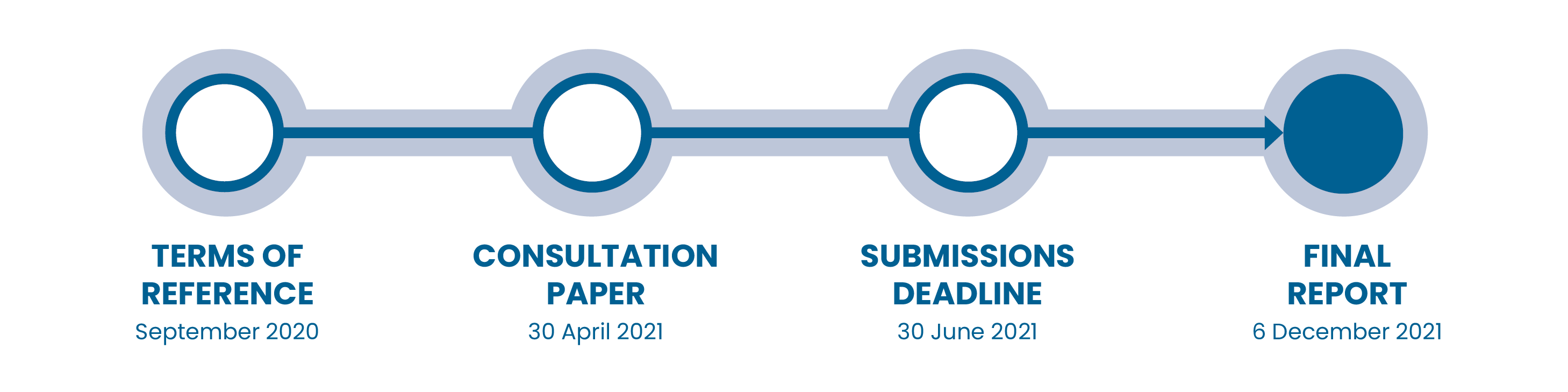
| September 2020 | Terms of Reference received |
| 30 April 2021 | Consultation Paper released |
| 30 April 2021 | Submissions opened |
| 21 June 2021 | Amended Terms of Reference received* (changing reporting deadline to 30 September or two months after delivery of the High Court’s judgment in Charisteas v Charisteas, whichever is later) |
| 30 June 2021 | Submissions closed |
| 30 September 2021 |
Amended Terms of Reference received* |
| 6 December 2021 |
Final Report delivered to the Attorney-General |
| 2 August 2022 | Final Report tabled in Parliament and publicly released |